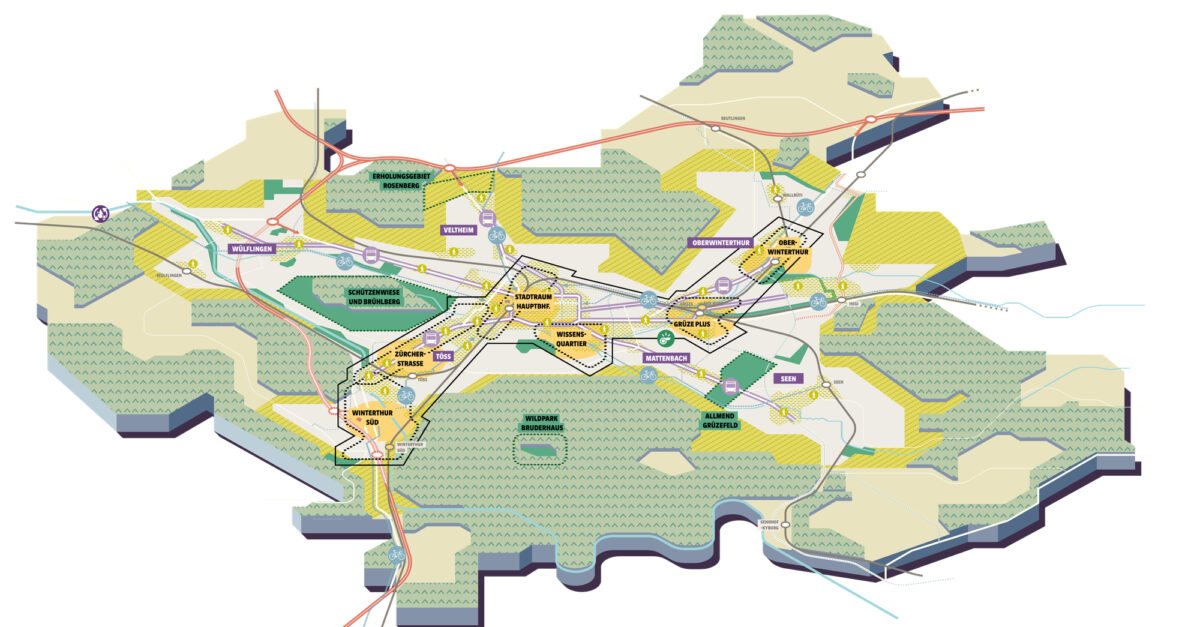
The master plan has already undergone an intensive public participation process. Between 2023 and 2024, approximately 90 objections were received, containing 800 individual requests, of which the city took nearly half into account. The fact that the referendum committee nevertheless failed to fundamentally water down the plan shows just how deep the conflict is between conservative forces and the left-wing and Green parliamentary majority.
A Tool That Goes Beyond Its Scope
A municipal master plan is intended to coordinate spatial development—no more and no less. The current draft goes significantly further. The SVP of the Canton of Zurich describes the document as having ballooned to five times the size of the previous version. Christian Hartmann of the referendum committee warns that the plan would strip the parliament and the public of their power, regardless of their political composition.
Detailed Rules Instead of Guidelines
One example illustrates the problem perfectly. In the future, ground floors must mandatorily house non-commercial meeting places—a highly granular requirement far beyond the scope of traditional structural plan tasks. Added to this are mandatory procedures such as test planning and expert assessments before any construction begins. Dani Romay from the committee sums it up: A master plan should set guidelines, not cement detailed political programs for 15 years.
The dissenting vote from the City Council
Not everyone sees the political nature of the master plan as a problem. City Councilwoman Christa Meier defends precisely this approach. The master plan is highly political and should remain so; after all, it is the parliament’s responsibility to adopt it. This position illustrates how differently the roles of the master plan and politics are interpreted in Winterthur.
A One-Sided Approach to Mobility
The master plan aims to cut the share of motorized road traffic in half, from 42 to 20 percent. Necessary traffic relief projects, such as the Heiligberg Tunnel, are completely absent from the plan. Regarding the outskirts parking plan, land-use decisions are also being set in stone for the long term, even though valuable crop rotation areas remain important for agriculture and regional food security.
Doubts About Economic Viability
The Winterthur Homeowners’ Association also criticizes the fact that the master plan lacks a financial impact assessment. In particular, the association considers the goal of creating 30,000 new jobs by 2040 to be hardly realistic. This brings the plan’s economic viability into focus alongside the political debate.
Not Against Development, but in Favor of Flexibility
The referendum committee makes it clear that it does not oppose growth. Winterthur needs more housing, strong businesses, and attractive neighborhoods—no one disputes that. That is precisely why a master plan is needed that leaves room for flexibility rather than preempting future political decisions today. In the coming months, the committee will seek dialogue with the public and recommends a clear “No” vote on November 29, 2026.