When Ecology Becomes a Return on Investment
Sustainable construction is often seen as an expensive luxury rather than a smart investment. A new study using the Empa and Eawag campus parking garage as an example shows the opposite. Investing in flexibility today saves millions tomorrow. The proof lies in an unassuming wooden building in Dübendorf.
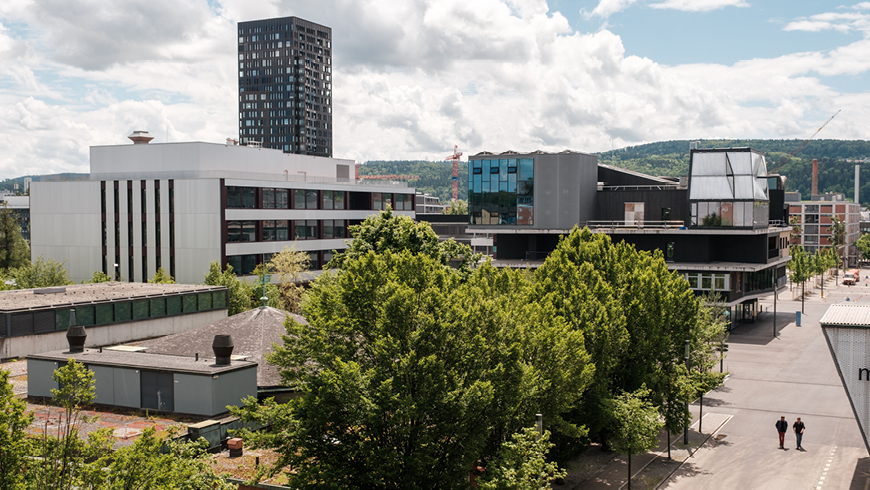
The “co-operate” research campus, a joint project of Empa and Eawag in Dübendorf, opened in June 2024. The buildings were designed, among other things, for flexible and sustainable use. Photo: Empa
The award-winning hybrid-construction parking garage on the “co-operate” research campus combines ecological measures—such as a solar power system, an innovative geothermal storage system, and cement savings achieved through a wood-concrete hybrid construction method—with an almost car-free environment. However, one crucial detail—one that isn’t immediately apparent when looking at the building—is that it was designed from the outset to be repurposed at a later date. The modular construction using demountable prefabricated components, the light-filled wood facade, and the ceiling height suitable for office use make it possible to convert the building into office or retail space without demolishing it.
Two Scenarios for an Uncertain Future
Empa and Eawag explicitly factored in a declining demand for motorized private transportation during the planning phase. In the first scenario, the parking garage is partially converted into office or retail space; in the second, it becomes completely redundant because passenger transport will rely on public transit or combined mobility in the future. This dual strategy distinguishes the project from a traditional parking garage, which is built for a single purpose.
The Method Behind the Calculation
Study author Bernhard Kümmerli from the ETH Institute for History and Theory of Architecture, in collaboration with Wüest Partner, used net present value analysis to offset initial investments against future transformation costs. This method allows for a direct comparison between the flexible construction method and a conventionally built parking garage over the entire life cycle. According to Kümmerli, such economic sustainability criteria have largely been overlooked in architecture to date.
The figures are convincing despite higher construction costs
The result is clear. Despite construction costs that are 22 percent higher, future cost savings amount to approximately 6 million Swiss francs for a partial conversion and approximately 12 million Swiss francs for a complete repurposing. The higher initial investment thus pays for itself many times over during the building’s lifespan.
A Model for the Entire Construction Industry
Kevin Olas, Head of Real Estate at Empa, sees such financial analyses as an important lever for the industry, as well-founded statements on economic sustainability have been lacking until now. According to Olas, if the net present value method were consistently applied in the future, it could significantly accelerate the transition to climate-friendly construction practices. The campus parking garage thus not only provides a functional building but also a computational model that other building owners and investors could adopt directly.