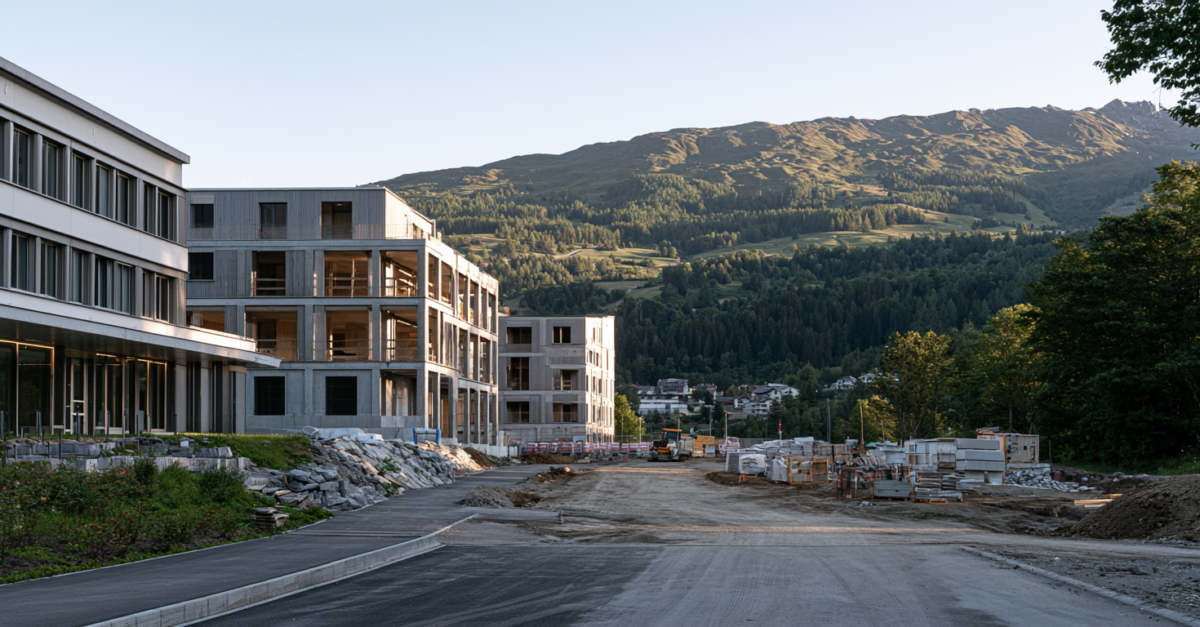

At the Du Lac site in St. Moritz, a municipal housing project can now go ahead following months of delays. Following the withdrawal of an appeal in June 2026, construction of 31 flats for local residents is set to begin at the end of August 2026. According to the current schedule, residents are due to move in in spring 2028.
This means that, in one of Switzerland’s tightest housing markets, a project is once again on track – a project that represents more than just an ordinary new-build for the local labour market and local politics. St. Moritz intends to create flats on the site next to the Du Lac retirement home, aimed at a variety of households and specifically designed to meet local housing needs.
Delay despite a prepared construction site
The project had already been partially anticipated in terms of construction. With the extension of the car park at the neighbouring retirement home, the foundations and basement for the future residential building were laid at the end of 2024. At the same time, the planning application for the building construction was underway. However, the objection lodged against the proposal submitted in December 2024 blocked the next step. The fact that the local authority nevertheless continued with tenders, provisional contracts and the detailed planning for the timber construction demonstrates the time pressure behind the project.
Housing for staff and families
The plans include 31 flats with 2.5 to 5.5 rooms and covered balconies. The mix is designed to cater for various household types. For St. Moritz, this is not only a question of housing provision but also of the site’s function. Housing in the immediate vicinity of the care home can make it easier to recruit staff and indirectly support the running of the care services. Available data on the local housing market has for years shown high demand for affordable first homes and for housing for people who work in the town on a permanent basis.
Foundation to regulate letting
It remains to be seen what criteria will be used to allocate the flats in future. The local authority is working on guidelines designed to link flat size, occupancy and income more closely. These principles are to be enshrined in a public-law foundation for social housing, the establishment of which will continue in 2026. For the property sector, this very point is crucial: it is not only the construction, but also the subsequent management that determines whether municipal housing actually reaches the target groups.
The Du Lac case thus highlights two points. Firstly, even housing projects with broad local support in high-price areas remain vulnerable to procedural issues. Secondly, it is not enough simply to provide building land and construction loans. Only once letting rules, the organisation responsible and occupancy have been clarified does a new development become an effective instrument of housing policy.