
The pressure is not driven by new zoning designations, but rather by densification within the existing development. Since its adoption on June 3, 2024, the municipal master plan has explicitly committed to moderate growth while also pointing to the large development areas “Günterstall” and “Im Dorf,” where a significant amount of new housing is already slated for construction.
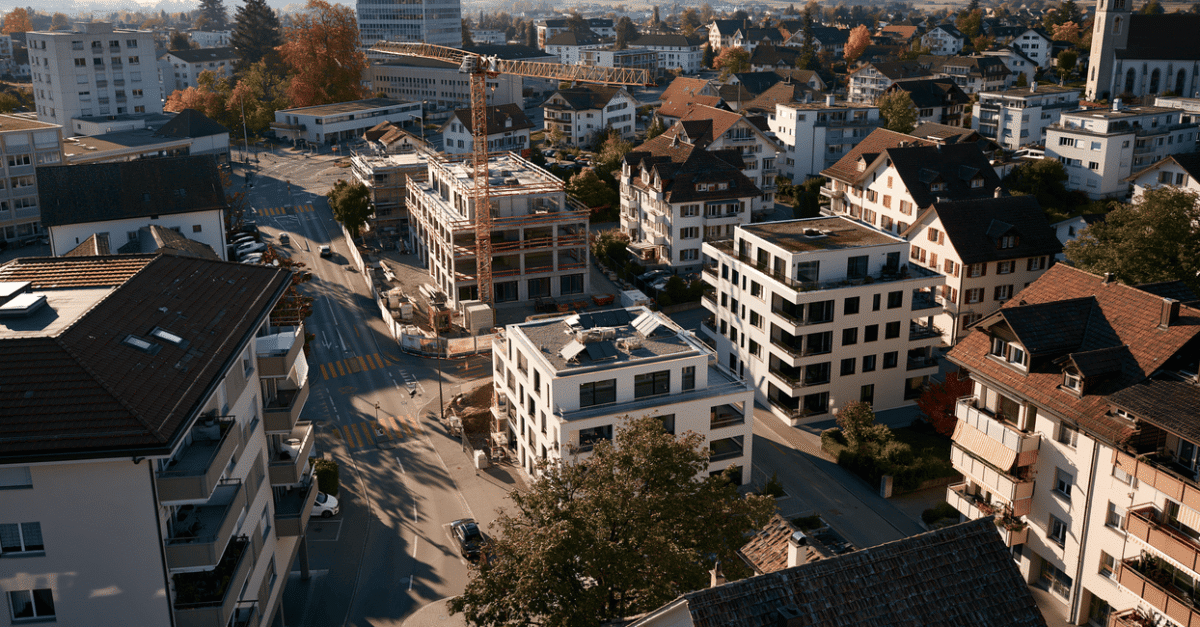
This creates a direct conflict between two objectives in Kaltbrunn. On the one hand, the municipality wants to promote inward urban development; on the other hand, it must support the infrastructure—including roads, utilities, and waste management—for a significantly larger housing stock. A smaller portion of the development at Uznacherstrasse 59, comprising 14 apartments, has already been completed. Other projects, such as the one at Uznacherstrasse 18 with 19 planned apartments, are still in the planning stages.
Inward Development Instead of New Building Zones
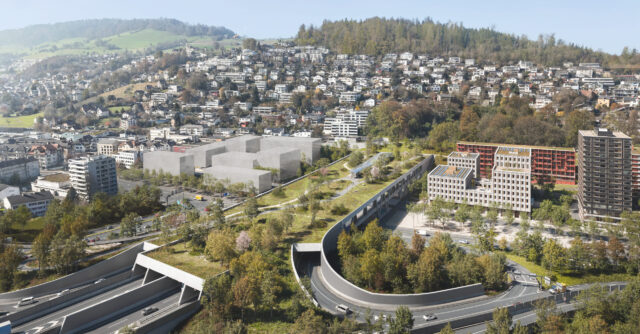
Planning for the major “Im Dorf” project is well advanced. The special-use plan covers a 13,872-square-meter site owned by W. Rüegg AG on Uznacherstrasse. The business is to be relocated from the village center to Fischhausenstrasse so that the former factory site can be repurposed and developed more densely in the medium term. The documents for the special-use plan explicitly describe the site as an area for infill development and as a restructuring zone in the municipal master plan.
This approach aligns with current local planning. According to the structural plan, Kaltbrunn is foregoing new structural plan areas within the planning horizon because significant capacity already exists through internal reserves and large development areas. The housing boom is thus occurring primarily on zoned or already developed land.
Housing Market Remains Tight
The scale is considerable for a municipality of this size. According to cantonal statistics, Kaltbrunn already had 2,346 housing units in 2024, and the vacancy rate stood at 1 percent in 2025. External municipal statistics based on official data show a housing stock of 2,383 units and a population of 5,128 residents for 2025. An additional 300 or so units would thus significantly expand the housing stock, even if some of them are built in phases.
It is precisely this mechanism that is of interest to the real estate industry. Kaltbrunn is not growing through spectacular new zoning designations, but rather through the repurposing of industrial sites, infill development, and several medium-sized multifamily housing projects. This increases the housing supply but shifts the burden to development, transportation, and municipal infrastructure. How quickly the pipeline will actually be built now depends on approval procedures, phasing, and the feasibility of the individual projects.