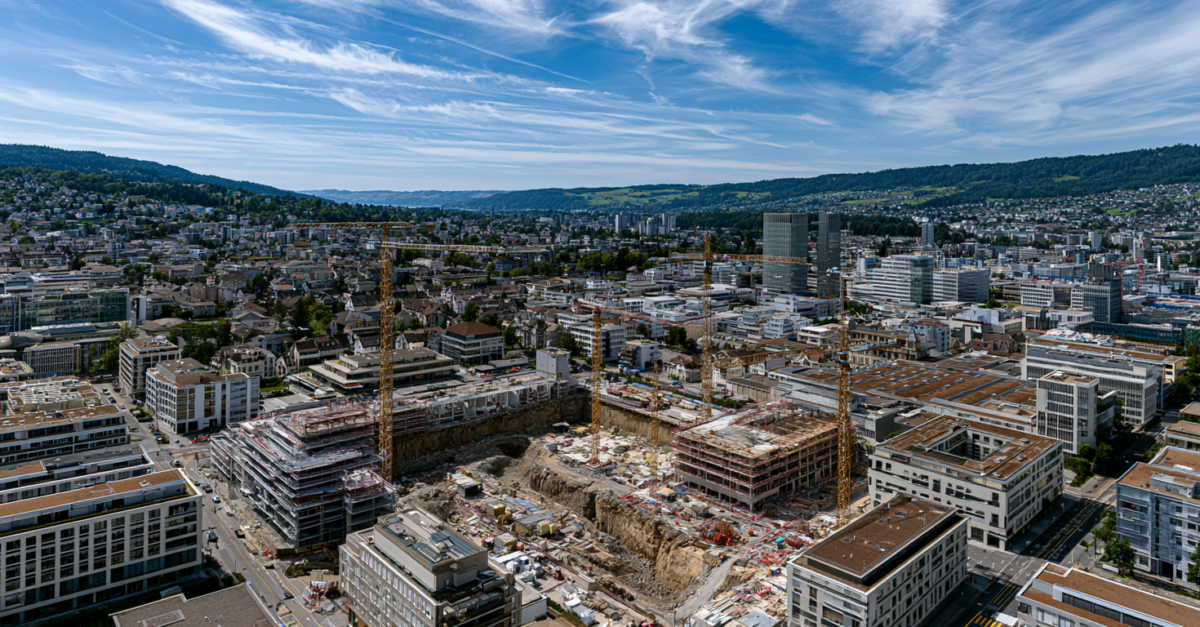

At the An der Aa site in Zug, work is beginning on the redevelopment of a site whose significance extends far beyond public transport. With the new main depot for Zugerland Verkehrsbetriebe, a building for the emergency services and space for the cantonal administration, a site currently dominated by commercial operations will be redeveloped by the early 2030s to allow for the creation of additional housing in the north.
The core of the project lies in the densification of the infrastructure. In future, buses are to be garaged underground. This will free up 8,400 square metres of development space on the site, the building rights for which will be transferred to the Zug Pension Fund. Plans envisage around 160 flats there, 40 per cent of which will be affordable, complemented by commercial facilities and a neighbourhood square.
From operational site to urban building block
The transformation has political backing. On 3 March 2024, Zug’s electorate voted overwhelmingly in favour of the ‘An der Aa II’ development plan. The plan combines transport infrastructure, emergency services, administrative facilities and residential development within the same area. It is precisely this integration that is relevant to the property sector: only by reorganising the transport services into a more compact layout can the site be made available for the subsequent residential development.
According to available information, the new ZVB main base, together with the emergency services and the cantonal administration, is due to become operational by 2031. Around 250 office workstations are planned for the administrative area. The residential buildings for the Zug Pension Fund will follow. This marks a shift from what was previously a functionally self-contained depot towards a mixed-use neighbourhood offering additional housing in a central location.
Residential development to follow in the second phase
The timetable is crucial for the residential section. Construction of the two residential buildings cannot begin until the operational facilities have been relocated. The plans include two buildings with up to eight storeys, each around 30 metres high. The provision of affordable housing is particularly important in Zug, as new, larger residential projects are rare in the city and affordable housing is usually only created as part of complex site developments.
A protracted planning process with clear consequences
The fact that the ground-breaking ceremony is taking place only after around 16 years of planning highlights the scale of effort involved in such mixed-use projects on inner-city infrastructure sites. For developers, investors and public building authorities, the project serves as an example of how mobility, administration and housing can be reorganised within a confined space. The key outcome lies not in the individual new building, but in the release of land: without the underground bus service, the residential section would not exist at this location.