Growth without stagnation. The new Limmat Valley takes shape
An economic area has grown up between Zurich and Baden that was long considered a transit zone. Today, the Limmat Valley has around 110,000 inhabitants and around 70,000 jobs. It is densifying, rebuilding and reorganizing its traffic. Anyone who still describes the Limmat Valley today as a peripheral location has simply missed reality.
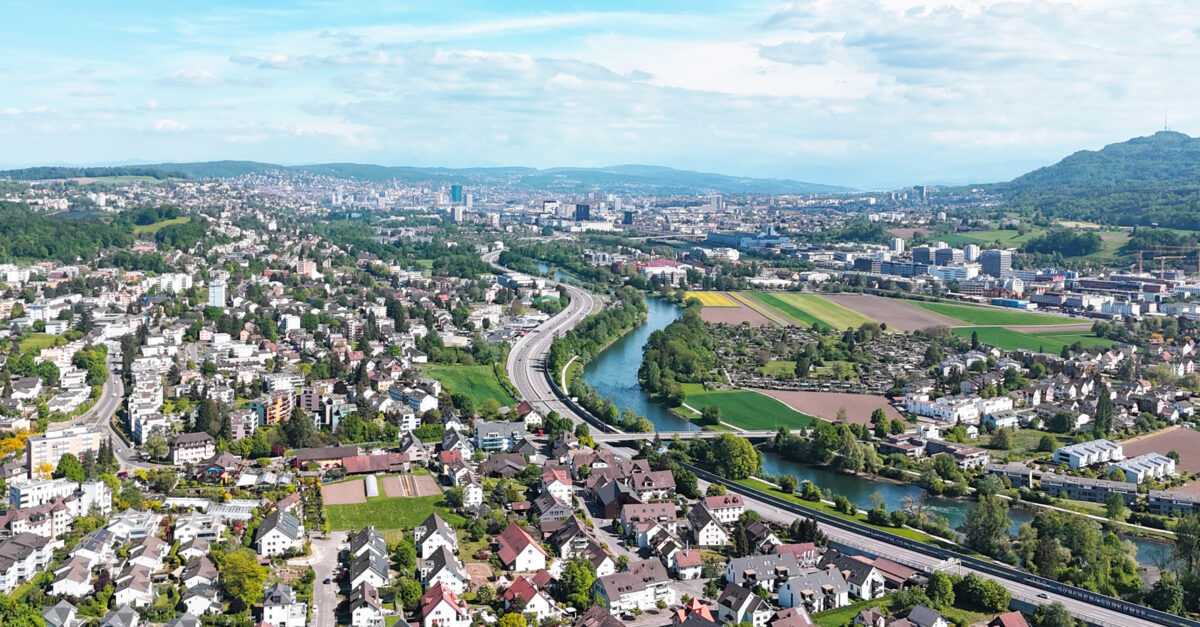
The figures speak for themselves. The population in the core area from Schlieren to Wettingen rose from around 98,800 in 2015 to around 110,000 in 2024. That is over 11,000 additional inhabitants within nine years. At the same time, the number of employees grew by 9,500 to 68,500. The Limmat Valley is therefore not only growing as a residential region, but is also continuing to develop into a serious business location.
By 2040, the federal government, the cantons of Zurich and Aargau expect a further increase of 20 to 30 percent in population and employees. What sounds like a forecast at first glance has long been factored into the planning fundamentals.
Densifying instead of fraying
Growth is no longer based on expansion, but on transformation. In the core area between Schlieren, Dietikon and Spreitenbach, dense settlements, established town centers, commercial areas and green spaces meet directly. The region must develop its qualities in existing areas, not on greenfield sites.
This is precisely the guiding principle of the Limmattal agglomeration program, which the cantons of Zurich and Aargau have been jointly promoting for years. What counts is precision, not breadth. Densification in well-developed locations, upgrading of open spaces, strengthening of public spaces.
The infrastructure bet is paying off
For decades, considerable federal funds flowed into the region. Over several generations of programs, the Limmat Valley has been awarded more than 330 million francs in federal funding. For the period 2024 to 2028 alone, 22 measures are planned, with the federal government contributing around CHF 20 million.
The Limmattalbahn is an example of this strategy. 13 kilometers of track, 27 new stops, a new backbone for the region. The effect is measurable. in 2024, around 29,000 more passengers used public transport every day than in 2016, an increase of 21 percent.
Fewer cars, more movement
Despite strong population and employment growth, motorized private transport fell. Around 28,000 fewer vehicles per day were counted at 20 measuring points on cantonal roads in 2024 than in 2015, a decrease of ten percent.
Identity as a location signal
The Limmat Valley is not a random administrative association. Associations, economic bodies, location promoters and political bodies from both cantons make targeted investments in regional identity, quality of life and joint projects. This commitment is having an effect, as 94% of the population feel at home in the region and a clear majority are in favor of closer cooperation between municipalities and cantons.
The region has understood that urban quality and economic clout are not mutually exclusive. The Limmat Valley is shaping up to be the next strong agglomeration axis in Switzerland, visible, measurable and with a tailwind.