Seebach Gains Space for Affordable Housing
On the Gauss-Stierli site in Zurich-Seebach, one of the neighborhood’s last industrial brownfields could be transformed into a mixed-use cooperative project featuring 175 to 225 affordable apartments. However, it is unlikely that residents will be able to move in until 2036 at the earliest.
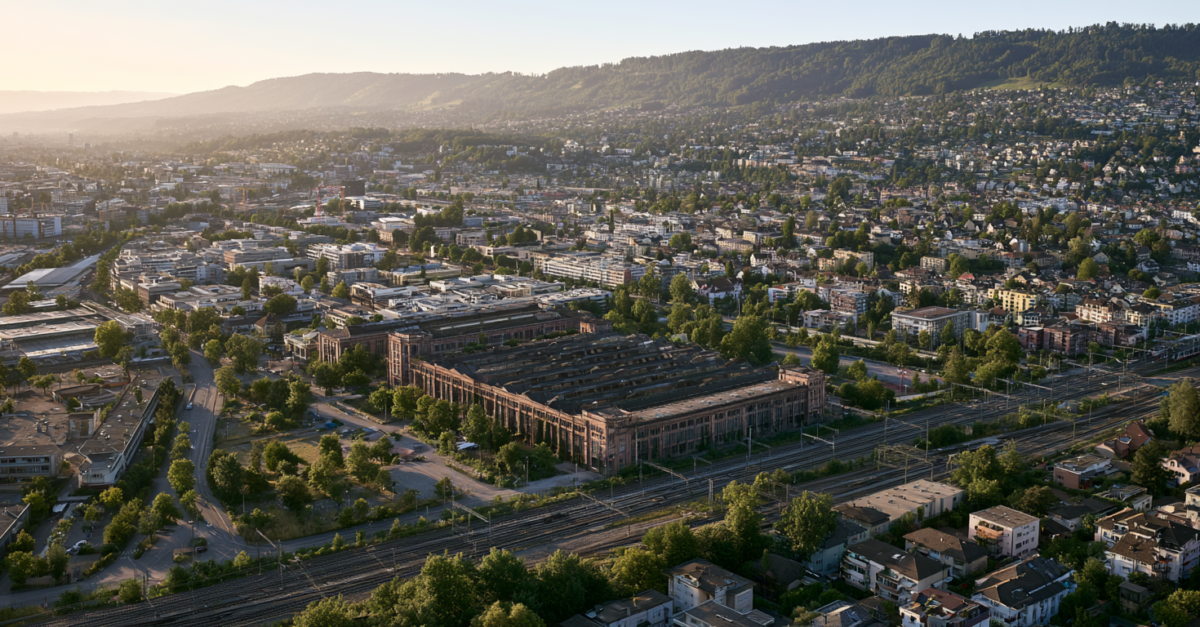

In Zurich-Seebach, a rare piece of undeveloped land is being repurposed for nonprofit housing. According to available information, the Kalkbreite cooperative has secured an exclusive building rights option on the Gauss-Stierli site. According to initial feasibility studies, the site—which was formerly used for industrial purposes—could accommodate 175 to 225 affordable apartments, as well as space for commercial, cultural, and neighborhood uses.
The project has not yet been finalized. A rezoning remains a prerequisite, followed by a design plan, project planning, and the permitting process. Kalkbreite itself expects occupancy to begin no earlier than 2036. The project is nonetheless significant for Zurich’s tight housing market because it would convert one of the last major brownfield sites in Seebach into a long-term public-interest use.
Building Rights Instead of Traditional Site Development
The owner, Werner Hofmann, had acquired the approximately 12,500-square-meter site as recently as September 2025 and, rather than pursuing the development on his own, subsequently partnered with a cooperative. This is precisely where the real news value lies: A private owner is opening up an inner-city development site to a model that combines affordable housing with commercial and community uses. The commercial portion is expected to be roughly 40 percent, thereby ensuring mixed-use development rather than fully densifying the site for residential purposes.
For Kalkbreite, Seebach would represent a significant step forward. The project would be considerably larger than many cooperative infill developments and would markedly expand the organization’s presence in northern Zurich. At the same time, the case illustrates how challenging the timeline remains, even with a clear housing policy direction: in an urban context, ten years or more can easily pass between securing the property and the first residents moving in.
Seebach is densifying along multiple axes
The Stierli site is not an isolated project. On the nearby Thurgauerstrasse site, the City of Zurich is developing another large nonprofit neighborhood with approximately 800 apartments, space for commerce and services, senior housing, and a neighborhood park. Architectural competitions for parts of the site began in 2025, while the school complex opened in 2024. As a result, Seebach is being densified not just in isolated areas, but across several interconnected development zones.
Accessibility to the neighborhood is also being improved in parallel. At the Zurich Seebach train station, SBB is extending the platforms so that 300-meter-long S-Bahn trains can stop there in the future. In addition, a new pedestrian and bicycle underpass is being built. For the area surrounding the Stierli site, this is more than just a side note: larger residential and mixed-use projects become more viable when neighborhood connections and public transit capacity grow alongside them.
Interim Use Bridges the Long Wait
Until the actual transformation begins, the site will remain in flux. Kalkbreite anticipates commercial interim use before renovation and new construction begin. This aligns with the site’s history and prevents the vacant lot from remaining unused until a planning decision is made. The open question now is less whether Seebach will continue to grow, and more whether it will be possible—in terms of both policy and planning—to translate this growth on the Stierli site into affordable housing in a timely manner.