

Kohler Law is a new boutique law firm specialising in construction and real estate law, constitutional and administrative law, and contract law. With over 15 years of experience in law firms in Zurich and Aargau, I advise and represent private individuals, companies and public institutions. As a sole practitioner, I guarantee a direct point of contact, high availability and advice tailored to your needs. My priority is to find efficient, practical and sustainable solutions.
Sales contract law
For movable items that are intended to be integrated into an immovable structure (e.g. building materials), there is now a complaint period of at least 60 days for obvious and hidden defects. The limitation period for defect rights remains five years, although a reduction in the period is still permissible.
When purchasing land with new buildings that are yet to be constructed or are no more than two years old, buyers are now entitled to a mandatory right of rectification free of charge for the first time. In addition, obvious and hidden defects can now also be reported within at least 60 days of discovery. The rights relating to defects for all types of land purchases expire five years after transfer of ownership, and this period may not be shortened.
Contract law
In the future, a 60-day complaint period will apply to obvious and hidden defects in immovable works. This also includes defects in movable works that have been integrated into an immovable work, or defects in works by architects/engineers that form the basis for the creation of an immovable work. Another new feature is a mandatory right to free rectification; contractual exclusions or limitations, such as maximum amounts, are invalid. The five-year limitation period cannot be shortened at the expense of the customer; it begins with the acceptance of the work.
Building contractor’s lien
The lien secures payment of outstanding claims for remuneration for work performed by contractors. For owners, this can limit creditworthiness or mean a risk of double payment. The new rule is that security covering the principal claim and default interest for ten years prevents the registration of the lien. This introduces a clear, practical regulation that solves previous problems with unlimited interest guarantees.
Entry into force and transitional law
The changes will apply from 1 January 2026. Purchase and works contracts concluded before this date will continue to be subject to the old law; claims for rectification for new buildings completed before 2026 will only exist if contractually agreed. However, mandatory limitation periods and the new security rule in the building contractor’s lien apply regardless of the contract date.
Recommendations
It is definitely advisable to adapt all contract templates to the new law. When selling properties that are yet to be built, the purchase and works contracts should be aligned with each other in order to avoid contradictions between the liability under the purchase contract and the works contract. This applies in particular to works contracts concluded in 2025 if the property is not sold until 2026. Particular attention should be paid to SIA Standard 118, as this – unlike the statutory provisions – contains a prior right of rectification for the contractor.
Defect rights and builders’ liens – important changes


More Articles
Zurich’s housing shortage is easing slightly
In the canton of Zurich, the first reliable signs of a slight easing are emerging. The vacancy rate rose to 0.52 per cent in 2026, and the ZKB expects 8,500…

Bern is opening the Dählhölzli for the next phase of refurbishment
The Bern City Council has approved a project planning grant of 2.5 million Swiss francs for the redevelopment of the Aare site at Dählhölzli Zoo. This brings a multi-stage project…

Home ownership defies higher mortgage rates
House prices in Switzerland are rising sharply once again. In the third quarter of 2026, prices for detached houses rose by 2.0 per cent and those for flats by 1.7…

The choice of estate agent can have a dramatic impact on the selling price
A difference of up to 180,000 Swiss francs for the same property, with a gap of 120,461 Swiss francs depending on the commission incentive. A ZHAW study shows that when…
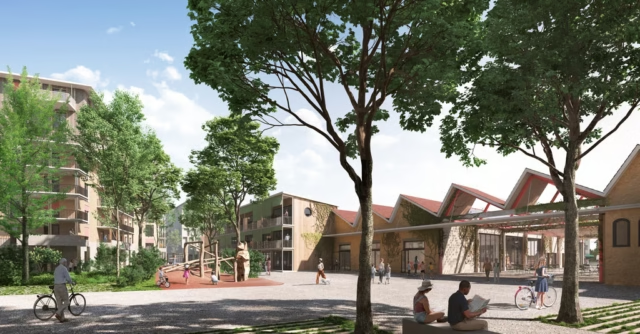
Reussbühl West caught between residential and commercial use
In Lucerne, Reussbühl West is set to become the next major neighbourhood development site, with up to 800 flats. However, the development plan is sparking political and planning disputes, as…