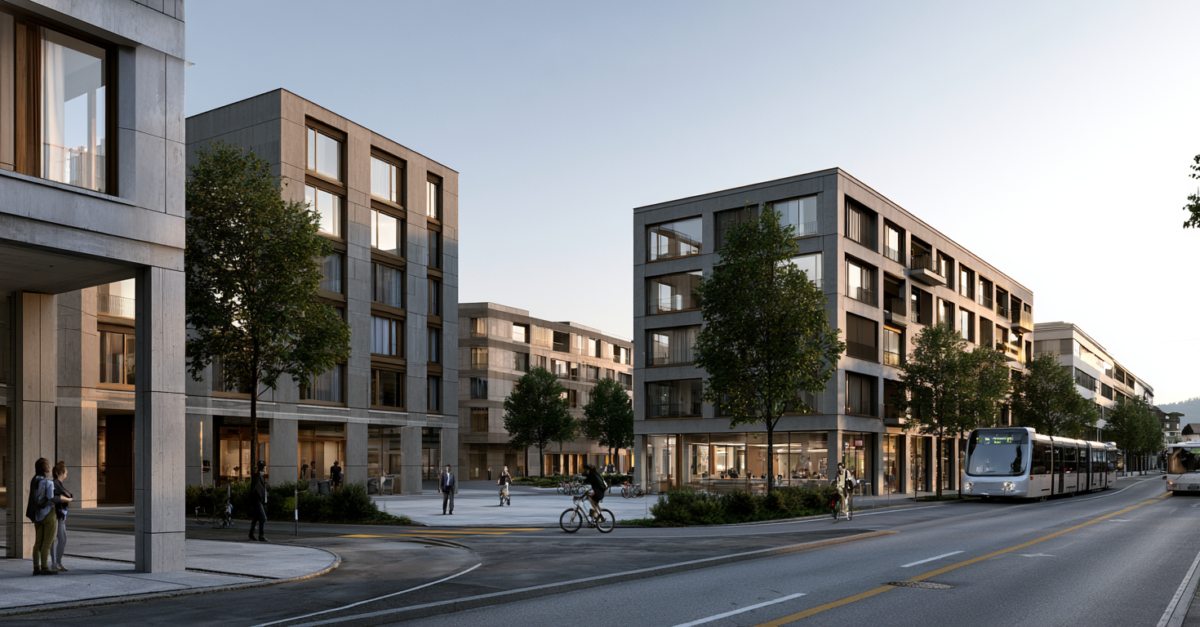

On Untere Bahnhofstrasse in Rapperswil-Jona, a new replacement development is set to achieve more than simply revitalising a largely vacant retail site. The Cityhof project combines 77 rental flats, new retail and commercial spaces, and a café with a reorganisation of the street layout designed to alleviate one of the most challenging traffic situations in the town centre.
Planning documents available to the public show that the Merkurstrasse special-use plan provides the basis for the new development at Untere Bahnhofstrasse 19 and 21. The public consultation period runs from 16 June to 15 July 2026. Construction is scheduled to begin in 2029 at the earliest, with occupancy possible from 2031 at the earliest. This means the project remains a medium-term development scheme, but the decision on its direction is already relevant for the city centre.
Urban regeneration at a key location
The core of the project lies in the integration of building construction and transport. Plans for the new development include an upgraded Linthplatz, new pedestrian routes and a reorganisation of delivery traffic via Merkurstrasse. This is particularly significant here: the site lies between the railway station and the old town, making it one of the most visible junctions in the city centre.
Particularly striking is the planned straightening of the sharp bend on Untere Bahnhofstrasse. According to available information, the carriageway is to be widened there so that large vehicles can negotiate the bend more safely. For the property development, this is more than just a technical detail. The new building thus serves as a catalyst for reorganising a problematic urban space in terms of both function and design.
Living with minimal caruse
Equally clear is the transport policy focus in the usage concept. No extensive new car parking is planned for the site. Instead, the project relies on a high number of cycle parking spaces and a letting model designed to favour households that do without a car. This is in keeping with the dense, central location and demonstrates how residential projects in well-connected locations are increasingly organising their mobility through usage concepts rather than through additional underground car parks.
It is precisely this aspect that is of interest to investors, developers and cities: Cityhof is neither a purely new-build residential development nor a traditional replacement for a retail property. The project demonstrates how an outdated retail site is being transformed into a denser mixed-use development with a higher proportion of residential units, less car-centric design and higher standards for public space. Whether the timetable can be met, however, depends on the ongoing planning process and any potential objections.