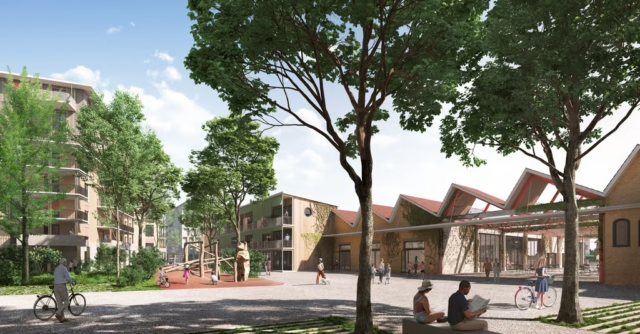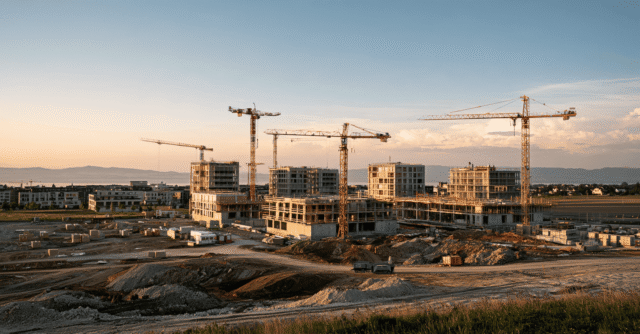

Basel-Stadt is tightening housing policy requirements for large development sites. With the amended Housing Promotion Ordinance, the government has set out how the counter-proposal to the withdrawn ‘Basel baut Zukunft’ initiative is to be implemented: On regeneration sites covering more than 15,000 square metres, at least one third of the gross floor area designated for residential use must in future be permanently let on a non-profit basis and in accordance with the principle of rent based on costs.
For developers, landowners and building lease partners, the procedural aspect is particularly crucial. The binding agreement with the canton must now be concluded prior to the planning permission process. This shifts the quota for affordable housing from a political objective to an early stage of project planning. Anyone planning major conversions of industrial, commercial or railway sites must therefore incorporate the social housing component much earlier into their calculations, choice of partners and site programme.
Early intervention in project development
The political framework for this has been in place since 15 May 2024. On that date, the Grand Council enshrined the counter-proposal in the Housing Promotion Act; following the withdrawal of the initiative, the amendment was officially published again in June 2024. The canton is now making implementation subject to specific conditions. These include a prior agreement with the canton, the setting of maximum net rents before the first tenancy agreement is signed, and monitoring via spot checks and statistical analyses. In the event of breaches, further measures may be imposed, including requiring the property to be re-let.
In return, the capital gains tax on the affected residential portion is reduced from 40 to 20 per cent. This partially offsets the new obligation, but does not alter the fact that, on large sites, not only density and mixed-use development but also the ownership and letting structure must be factored into future planning. This will be particularly relevant for long-term regeneration areas, which are the key driver for additional housing in Basel.
Housing development remains dependent on sites
The tightening of regulations affects a market that is dependent on new neighbourhoods. In 2024, a net total of 511 flats were built in Basel-Stadt, whilst the vacancy rate fell once again to 0.8 per cent. Publicly available data also shows that large-scale site developments are set to make a decisive contribution to the creation of housing in the coming years as well. This is precisely why the new regulation carries such weight: it directly links future housing construction on large-scale redevelopment sites to permanently affordable housing segments.
This sends a clear signal to the market. Basel-Stadt does not intend to secure affordable housing solely through subsidy programmes or individual negotiations, but rather to make it a mandatory component of major urban development projects. Whilst this raises planning requirements, it also provides greater clarity regarding which social requirements will actually apply to regeneration sites in future.