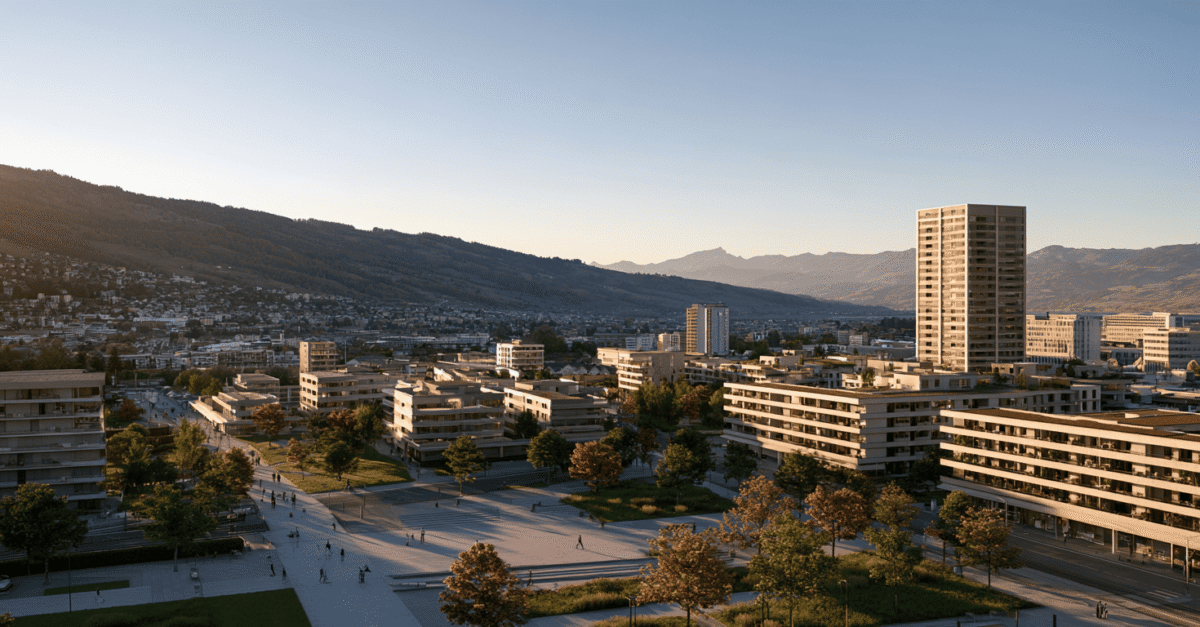

The project is not yet ready for construction. Following the preliminary planning stages in 2023 and 2024, the client is working on a draft project, which is intended to serve as the basis for assessing the cantonal planning requirements and for the subsequent design plan. The project website states that construction of the first sub-projects is due to start from 2028, whilst the most recent project information regarding the redevelopment of the site assumes a start date from 2029.
Densification right next to the station
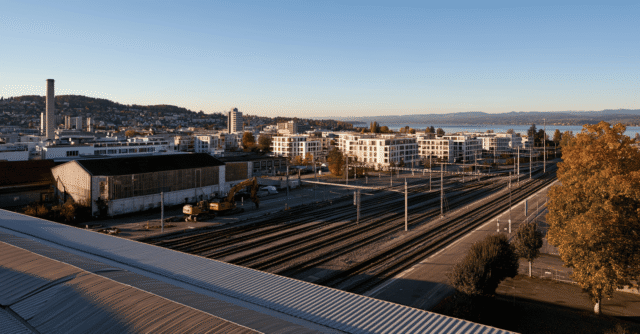
The plan is to develop a mixed-use neighbourhood on the site next to the current headquarters of the St. Jakobs Kellerei, comprising housing, retail, offices and a nursery. The master plan anticipates around 22,000 square metres of residential floor space. Around 20 per cent of this is to be developed as affordable housing. The developers estimate this will result in at least 40 affordable flats, spread across several buildings.
A landmark with a social mission
A striking feature of the development is the planned Casa Grande high-rise at the southern end of the site, near the junction with the Zeughaus site. According to the available project details, the tower may be no more than 58 metres high. Affordable flats are also planned for this building. At the same time, the concept focuses on communal facilities within the building, such as laundrettes distributed across the floors.
Access remains the key test
Further planning is underway in parallel for the area surrounding the station. In its structural plan report, the Canton of Schwyz points out that development in Seewen-Schwyz depends on several access projects around the station and on the Muotabrücke West. The municipality also states in its infrastructure planning documents that pedestrian and cycle routes, as well as access roads, must be secured in the cantonal land-use plan and in the design plans. Around 200 car parking spaces are planned for the Schuler site, along with approximately 500 long-term and just under 300 short-term bicycle parking spaces.
For the property market in Schwyz, the project is therefore more than just a single residential development. If the planning hurdles are overcome, a new neighbourhood will emerge at the railway station with a significant density, mixed-use development and a binding commitment to provide a proportion of affordable housing.