What Will Become of Chur’s Most Famous Residential Tower?
At Aspermontstrasse 19, a new chapter is beginning for one of Chur’s most famous buildings. The Lacuna high-rise is undergoing extensive renovation after approximately 70 tenants were forced to vacate their apartments. The owner, Asga Pensionskasse, aims to strengthen the residential tower technically, energetically, and spatially for the coming decades.
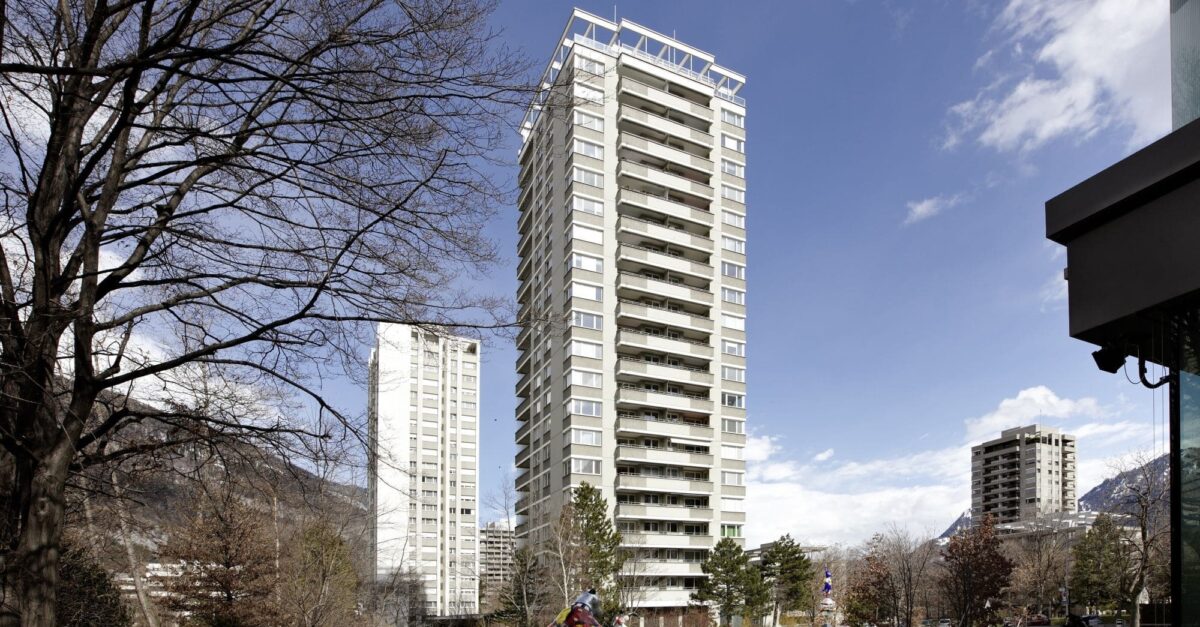
The Lacuna housing development in Chur. Photo: Domenig Architekten
The Lacuna skyscraper has dominated the Chur skyline since the 1970s. With 24 stories and a height of 85 meters, it is considered the tallest high-rise in Graubünden. It was built as part of the large Lacuna housing development, which was constructed between 1964 and 1981 according to modernist urban planning principles.
Today, the building is showing its age. The facade, building systems, and interior finishes no longer meet current standards for energy efficiency, comfort, and safety. The renovation therefore affects not just individual apartments but the entire building structure.
70 households had to leave
The extensive work could not be carried out while the building was occupied. In the summer of 2025, approximately 70 tenants received notice to vacate. They had to leave their apartments by the end of April 2026. More than 100 people were directly affected. The eviction triggered a difficult situation. In a tight housing market, any temporary loss of housing places an additional burden on residents. At the same time, the project illustrates how profoundly the renovation of large postwar buildings impacts people’s lives.
Renovation Instead of New Construction
The pension fund is planning a comprehensive renovation. The project aims to ensure the building remains usable for the coming decades and includes the modernization of the building envelope, the technical systems, and the apartments. The call for bids also mentions renewed living space set within a spacious green area with views of the Grisons mountains.
The renovation is also a commitment to preserving the existing structure. Instead of demolishing the high-rise and rebuilding it, the existing structure will be reused. This can save “gray energy” and preserve the building, which is a defining feature of the urban landscape. Whether the modernization realizes this potential depends on the quality of its energy-efficiency, architectural, and social implementation.
Not everything has been clarified yet
Recent reports show that the project has now reached another phase. For former residents, this transparency is crucial. The key question will be whether a return is possible—and under what conditions. Equally important are the rent levels after the renovation and how social diversity within the building is managed.
More ThanJusta Facade Renovation
The Lacuna high-rise represents a challenge familiar to many Swiss cities. Postwar buildings provide housing in well-connected locations. After five or six decades, however, they often require fundamental upgrades in energy efficiency, safety, and building systems.
Aspermontstrasse therefore represents more than just a single construction project. It highlights the conflict between climate-friendly renovation of existing buildings and the protection of existing tenancies. Chur is gaining a modernized landmark. Whether it will once again become a home for a diverse community of residents will be determined in the coming phases of the project.