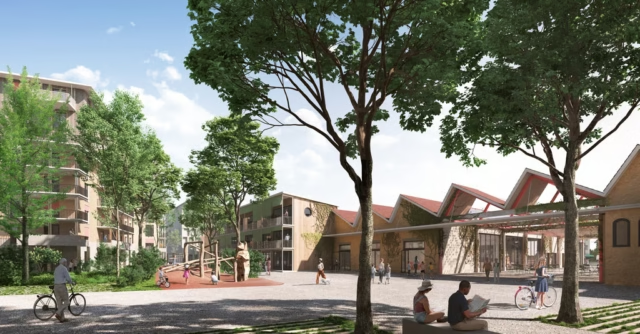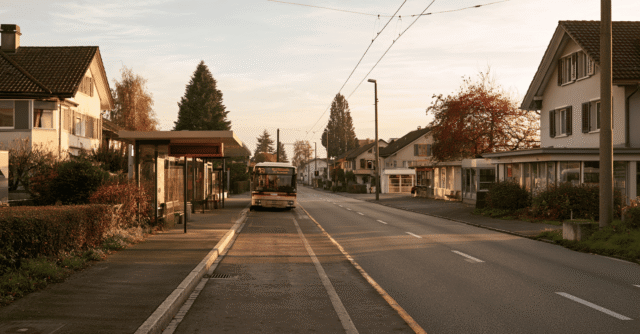
Modern cities must simultaneously manage transportation, energy supply, housing, infrastructure, administration and climate adaptation. This is despite a growing population and increasingly scarce resources. Smart city approaches see the city as an ecosystem in which mobility, energy, buildings, climate and governance are interlinked. Sensors, data rooms and digital platforms create transparency, provide real-time information and improve the basis for long-term decisions. The decisive factor is not the digitalization of individual silos, but the interaction of systems.
Switzerland in the top international group
Zurich has held a top position in the IMD Smart City Index for years and once again leads the global rankings in 2025. Geneva and Lausanne are also in the top 10, underlining the strength of the Swiss approach with high data quality, well-developed infrastructure and a strong research landscape. At the same time, medium-sized cities such as St. Gallen, Winterthur and Lugano are developing their own smart city strategies, data platforms and pilot projects. Often with a focus on mobility, administration and energy.
International role models and different approaches
Singapore is regarded as a reference for integrated national digital strategies in which mobility, energy, administration and health are linked via data and platforms. Copenhagen combines smart city technologies with a consistent sustainability policy and low-emission mobility, while Helsinki scores with extensive open data approaches and digital administration. Cities such as Dubai, London and Amsterdam have different priorities. From large infrastructure programs to data-driven mobility and data-ethical governance. What they have in common, however, is a clear political will and long-term strategies.
Governance, data and federal reality
Smart city is only partly a question of technology. Without resilient data spaces, clarified responsibilities, data protection rules and transparent decision-making processes, projects remain piecemeal. In federal Switzerland, municipalities, cities, cantons and the federal government also have to coordinate their roles. For many municipalities, Smart City therefore primarily means process modernization, cross-departmental cooperation and a new understanding of urban development. UrbanTech and PropTech combine administration, real estate management, energy and mobility systems. The closer these systems are linked, the greater the leverage for sustainable urban development.
Technology as a means, not an end
The most successful smart cities in the world are not characterized by the number of sensors they have, but by the way they deal with complexity. They use technology in a targeted way to improve quality of life, resilience and efficiency. They embed digital solutions in social and ecological goals. Smart City is therefore less an IT project than an urban development project in which technology remains a tool. The decisive factor is how cities use data and digital systems to make smarter, more inclusive and more sustainable decisions.
What exactly is a smart city?
Smart city – precisely defined:
A smart city is a city that uses digital technologies, data and networked systems to improve quality of life, sustainability, efficiency and participation. It integrates energy, mobility, buildings, administration and the environment into a common data and organizational model and uses this information to intelligently manage services, infrastructure and urban planning.
The decisive factor is not the technology itself, but the ability to use it responsibly, safely and purposefully in the interests of the entire population.
Smart cities promise efficiency, sustainability and better urban services. At the same time, they harbor risks that need to be carefully addressed. The following areas are particularly critical:
Data protection and surveillance
Sensors, cameras, mobility data and networked infrastructures generate huge amounts of data about the population’s behavior, movements and usage. Without clear rules, this can lead to a risk of surveillance, whether by the state or the private sector.
The power of algorithms
When data-based systems control decisions, for example in transport, administration or energy use, there is a risk of non-transparent or difficult-to-understand processes. A lack of explainability or unverifiable models can weaken public trust.
Democratic control
Smart city decisions are often made at the interface between the administration, technology providers and infrastructure operators. Critics warn that important urban development decisions could increasingly be influenced by technical systems or private companies.
Social inequality
Digitalization is expensive. Cities with fewer resources run the risk of falling behind. A “digital divide” can also emerge within a city. Between those who can use all services and those who remain excluded. Be it for financial, technical or social reasons.
Complexity and dependency
The smarter a city, the more dependent it is on digital systems, platforms and external technology partners. Outages, cyberattacks or technical disruptions can have significant consequences for infrastructure, security or supply.
Lack of standards and governance
Without clear governance models, isolated solutions, incompatible systems and unclear responsibilities arise. This can negate efficiency gains and make long-term investments more difficult.
International smart city gadgets that have made headlines
Smart lamp posts, networked street lamps (Barcelona, Los Angeles, London)
Smart lanterns with sensors for traffic, noise, weather, air quality and parking lot detection.
They caused a stir because they are disguised as harmless infrastructure but collect large amounts of data.
– Symbol for “visible invisible” smart city technology.
“Quayside Project” Sidewalk Labs sensor masts (Toronto)
Alphabet/Google planned a district with a fully sensorized environment.
Temperature, movement, mobility, waste, energy – everything was to be measured in real time.
– Stopped after criticism of data protection. Discussed worldwide.
“Lampposts-as-a-Platform” (Singapore)
Singapore equipped lampposts with cameras, microphones and IoT modules as infrastructure for autonomous driving and safety systems.
– Internationally renowned for AI-based monitoring and efficiency.
Smart waste bins, solar-powered waste containers (Bigbelly, New York, Berlin, Vienna)
Compact waste, report fill levels and sometimes serve as Wi-Fi hotspots.
– Was in the headlines because some models were able to secretly collect data (“WLAN tracking”).
Intelligent parking spaces, sensor parking spaces (San Francisco, Amsterdam)
Ground sensors report free parking spaces in real time.
– Known for the SFpark project, which measurably reduced traffic.
Autonomous delivery robots (London, Tallinn, San Francisco)
Robots that transport food and parcels.
– Media excitement because they are considered “new road users” on the sidewalks.
AI-based traffic lights (Hangzhou, Tel Aviv, Los Angeles)
Cameras and AI control traffic lights dynamically, reducing congestion times by up to 30 %.
– The “City Brain” system from Alibaba in Hangzhou has become particularly well known.
Drone programs for rescue and logistics (Rwanda, Dubai, Zurich)
Drones deliver medicines, defibrillators and medical supplies.
– Known for Zipline (Rwanda) and medical drone logistics in Switzerland.
Smart benches with charging function and sensors (Prague, New York, Dubai)
Solar modules charge smartphones, integrated sensors measure environmental values.
– Viral because they combine design, energy and technology.
Holographic citizen information and AR maps (Seoul, Tokyo, Shanghai)
Interactive AR displays for navigation, participation or administration.
– The first prototypes were celebrated at trade fairs and shared globally.
Sound Traffic Light, noise radar systems (Paris)
Cameras and microphones measure vehicles that are too loud and automatically trigger fines.
– Great media coverage due to privacy vs. noise abatement.
Robot police and autonomous security vehicles (Dubai)
Dubai was one of the first cities to present “Robocop”-like surveillance robots.
– Global media topic, futuristic and controversial at the same time.
Top 20 Smart Cities 2025 – International ranking
1.Zurich (Switzerland)
Outstanding combination of quality of life, digital administration, mobility and energy efficiency.
2.Oslo (Norway)
Leading in climate protection, autonomous mobility solutions and digital governance.
3.Singapore (Singapore)
Smart nation as a guiding principle of the state, fully integrated mobility & administration.
4.Geneva (Switzerland)
International governance, smart mobility management, high urban service quality.
5.Copenhagen (Denmark)
World leader in sustainable urban development and networked mobility planning.
6.Lausanne (Switzerland)
Strong research (EPFL), innovative urban planning, mobility and energy data spaces.
7.Helsinki (Finland)
Open data, digital administration and one of the highest transparency standards in the world.
8.London (United Kingdom)
Mobility data, AI pilot zones, sharing economy and world-leading GovTech scene.
9.Abu Dhabi (UAE)
Massive digitization of administration, smart mobility & automated infrastructure.
10.Amsterdam (Netherlands)
Pioneer in data ethics, circular economy and citizen-oriented smart city projects.
11.Stockholm (Sweden)
Strong IoT infrastructure, energy efficiency, digital access to public services.
12.Seoul (South Korea)
Smart governance, AI traffic light systems, highly connected city infrastructure.
13.Dubai (UAE)
One of the most technology-driven cities in the world: autonomous transportation, 3D printing, GovTech.
14.Vienna (Austria)
Excellent administration, smart living, social innovation and urban resilience.
15.Barcelona (Spain)
Urban sensor technology, mobility platforms, open data movement and civic tech.
16.Prague (Czech Republic)
Rise in Europe: smart mobility, digital administration, open data initiatives.
17.Tokyo (Japan)
Autonomous mobility, robotics, smart infrastructure on a megacity scale.
18.Tallinn (Estonia)
E-government world champion, blockchain-based administration, digital identity.
19.Canberra (Australia)
Digital administration and mobility systems at a very high level.
20.Vancouver (Canada)
Sustainable urban planning, smart mobility, strong tech and innovation scene.