Traffic 45 is reigniting the battle over the tunnels
The federal government has once again placed 45 billion projects in the transport sector on its list of priorities, despite the Federal Audit Office’s sharp criticism of the selection and funding process. The battle over the allocation of funds is intensifying, particularly in relation to the Grimsel Tunnel, controversial motorway expansion projects and in Lucerne.
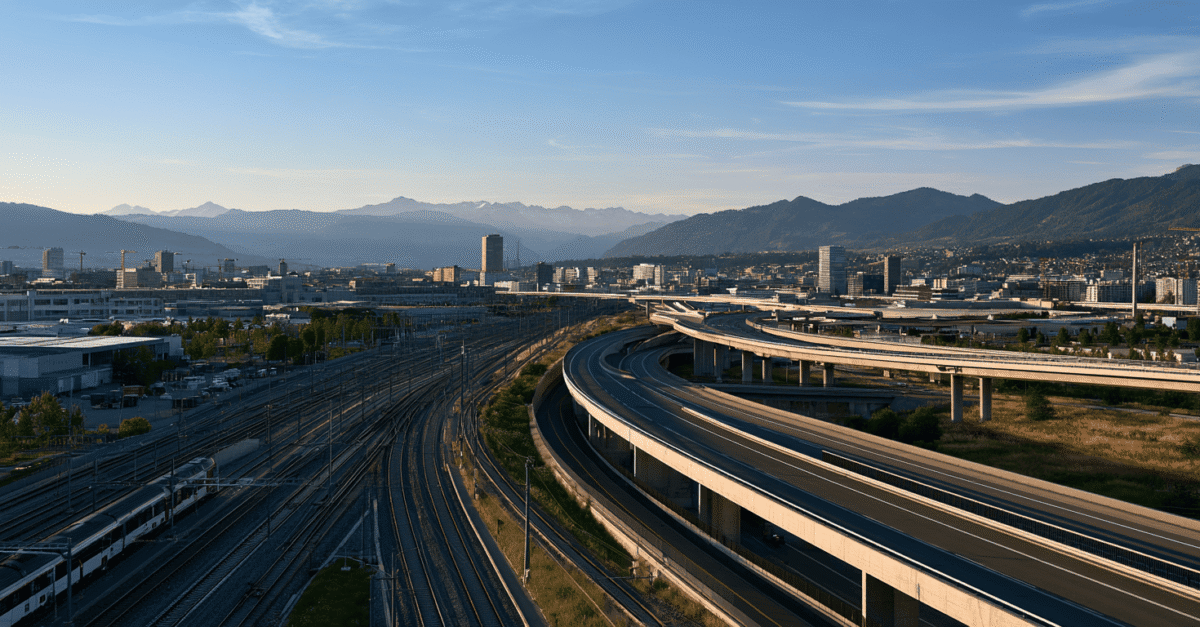

The conflict centres on the order of priority. On 14 September 2026, the Swiss Federal Audit Office criticised the fact that 45 key criteria for prioritising transport projects were missing, that cost-effectiveness assumptions were in some cases too optimistic, and that there was no secure funding for the expenditure of around 50 billion Swiss francs planned up to 2045. Nevertheless, individual projects totalling 11 billion francs are due to be submitted to Parliament in early 2027.
This turns an infrastructure proposal into a fierce battle over the allocation of construction volumes, rail hubs and road capacity. The Federal Council had opened the consultation on ‘Transport 45’ on 19 June 2026, bringing rail, road and urban transport together in a single package for the first time.
Grimsel remains the main point of contention
The Grimsel Tunnel between Innertkirchen and Oberwald is particularly controversial. The scheme is one of the prioritised rail projects up to 2045, although its benefits are hotly contested both politically and from a technical perspective. The Swiss Federal Audit Office described the project as a clearly inefficient use of funds. According to project estimates, the Federal Office of Transport anticipates costs of 800 million Swiss francs. For the regions involved, the tunnel would improve accessibility; for critics, it is an expensive priority project at the expense of more heavily used corridors.
Roads return to the list of contentious issues
The ‘Traffic 45’ plan is also reopening old disputes regarding national roads. As part of the 2027 expansion phase, the federal government intends, amongst other things, to press ahead with the six-lane expansion between Aarau Ost and Birrfeld, as well as between Perly and Bernex. The Financial Control Office notes, particularly with regard to such projects, that alternatives such as the conversion of hard shoulders or other operational measures have not been sufficiently examined. The political backdrop is all the more contentious because voters rejected the 2023 expansion phase for national roads on 24 November 2024. At that time, the Rhine Tunnel, the Fäsenstaub Tunnel and the third tube of the Rosenberg Tunnel, amongst others, were rejected at the ballot box.
Lucerne grapples with the scaleof the project
In the rail sector, the Lucerne through station faces the same conflict of objectives, albeit under different circumstances. The project’s importance for transport is widely recognised, but the cost intensifies competition for scarce funds. According to SBB, the first phase – comprising the underground station and the Dreilinden Tunnel – will cost around 3 billion Swiss francs. In January 2026, the Federal Council set a budget of 5.1 billion Swiss francs for both phases. This means Lucerne is in direct competition with other major rail expansion projects that are vying for funding within the same planning horizon.
It is precisely this prioritisation that is crucial for property and location development. Transport 45 does not merely define routes; it reorders the priorities of accessibility, urban densification and investment across Switzerland’s entire infrastructure landscape. Which projects actually reach Parliament in early 2027 will therefore have an impact far beyond the transport sector.