Uri Powers Up the Energy Transition
Switzerland’s largest battery storage facility is currently in operation in Gurtnellen. Axpo and energieUri have installed two large, adjacent batteries in the Plattischachen industrial park with a combined capacity of 58.4 megawatts. The facility can store excess electricity and feed it back into the grid during critical moments. This sets a new pace for the energy transition in the Reuss Valley.
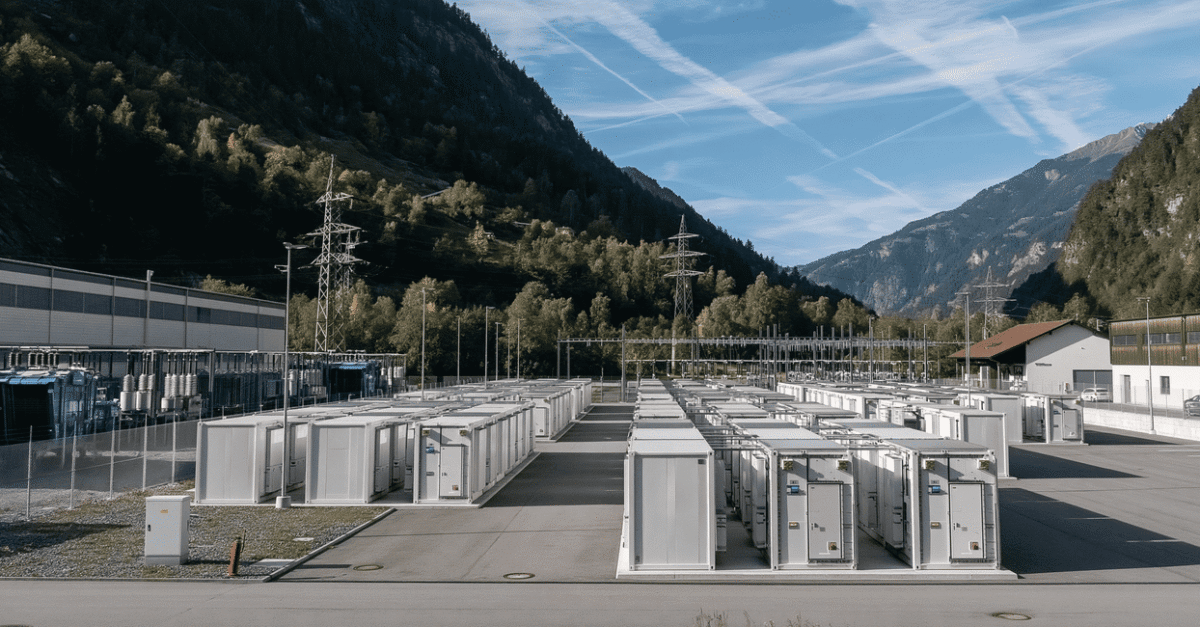

The facility consists of two independent projects. Axpo operates a storage facility with 50 megawatts of power and 100 megawatt-hours of capacity. energieUri contributes a battery with 8.4 megawatts of power. Together, they form the country’s most powerful operational battery storage facility to date.
The responsibilities are clearly divided. Axpo manages its storage facility with a national focus. energieUri tailors its facility to the needs of the canton of Uri. Although both systems are located at the same site, they are operated independently by their respective companies.
Storing Electricity When It’s Available
The sun and wind don’t always provide electricity when households, businesses, and industry need it. Battery storage systems provide short-term balancing here. They absorb excess electricity and feed it back into the grid when demand is high. This stabilizes frequency and the grid and reduces the strain on other flexible power plants.
Such systems are particularly valuable for an electricity system with more solar and wind power. They do not replace grid expansion, seasonal storage, or hydropower. But they respond quickly. It is precisely this short-term flexibility that is becoming more important as the share of decentralized generation grows.
A Hub in the Reuss Valley
The location is no coincidence. Key elements of the energy infrastructure converge in Plattischachen. A substation operated by the national grid company and energieUri’s Arniberg power plant are located in the immediate vicinity. The canton of Uri views this as an energy hub with national significance.
The new storage facility also complements Uri’s broadly diversified energy portfolio. energieUri points to the recently commissioned Uri wind farm, the Isenthal pumped-storage power plant, the Sidenplangg alpine photovoltaic plant, the Meiental hydroelectric power plant, and a hydrogen project in Bürglen planned jointly with Axpo.
Axpo is expanding across Europe
For Axpo, Gurtnellen is part of a broader storage strategy. The facility is currently the largest operational battery storage system in the company’s portfolio. According to the company, additional projects with a total capacity of over 300 megawatts are under construction in France, Germany, Italy, Poland, and Romania.
There is also a trend toward hybrid systems. Photovoltaic or wind farms are being combined directly with batteries. This allows electricity to be temporarily stored locally, marketed more effectively, and supplied in a way that better serves the grid.
A Record with a Short Shelf Life
The record set in Gurtnellen is unlikely to stand alone for long. Switzerland is planning additional large-scale storage facilities because the timing of electricity production and consumption is increasingly out of sync. This confirms that batteries are evolving from pilot projects into infrastructure.
The facility in the Reuss Valley does not solve all energy issues. Its strength lies in providing power over a span of seconds and hours, not in supplying electricity throughout a long winter. That is precisely why it is important. It demonstrates how Switzerland is making its power grid faster, more stable, and more flexible for a future with more renewable energy.