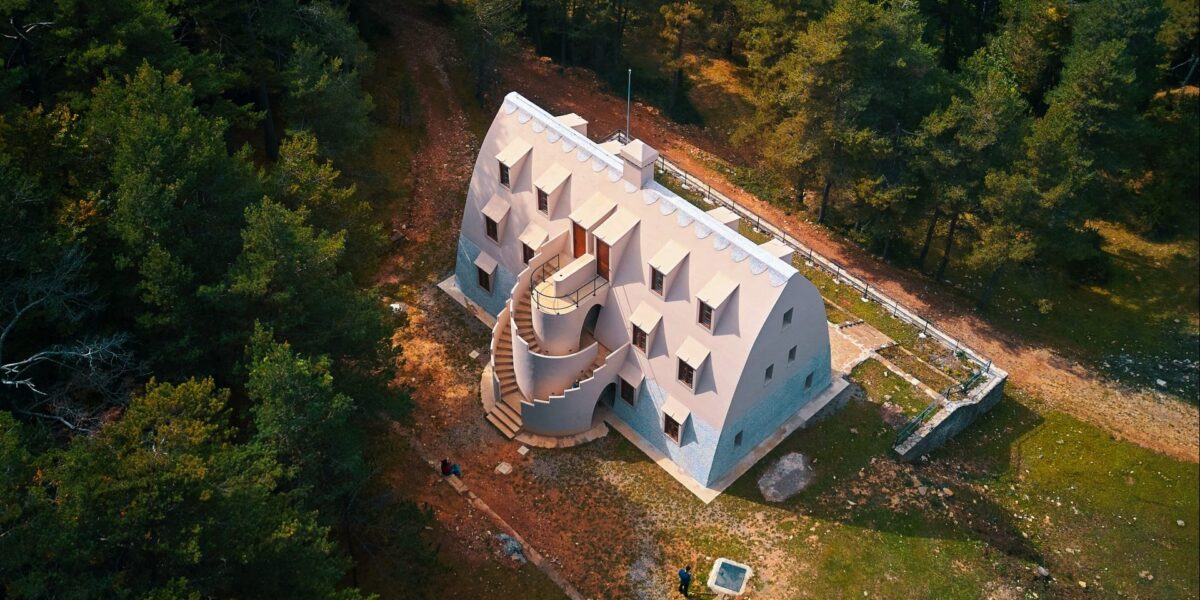
Neither original plans nor an official signature by Gaudí exist for the Catllaràs chalet. For decades, the attribution was based primarily on formal similarities to known works. The investigation commissioned in 2023 by the Gaudí Chair of the Polytechnic University of Catalonia therefore opted for a different strategy: geometric and constructive analyses instead of archival finds at the last moment.
Under the direction of Galdric Santana, the building was measured in three dimensions, its supporting structure analysed in detail and compared with confirmed Gaudí buildings. The team also analysed historical photographs and the building history surrounding the projects for Eusebi Güell. The study concludes that the design was by Gaudí, but that the execution was the responsibility of third parties and deviated from the original concept.
The logic of the vaults
The core of the argument is the supporting structure. The chalet has a rectangular floor plan and a pointed vaulted roof that reaches almost to the ground. The roof and façade are structurally one unit; windows are located exclusively in the long walls and look like mansards cut into the vault. The end walls remain closed, statically consistent, formally radical.
The decisive factor is the central longitudinal axis, which acts as a load-bearing backbone to support the storeys. Santana emphasises that this constructive logic is typical of Gaudí. The vault not only serves as a ceiling, it also supports the levels above it. This is based on working with a chain or cable model. The sagging line of a loaded chain provides the ideal pressure line of an arch. If this model is turned round, the result is a vault shape that is almost completely under pressure, a principle that Gaudí systematically utilised.
Interventions during construction
However, the study also shows that the load-bearing structure was altered during construction. Instead of consistently transferring the loads via the vault and the central axis, the builders inserted additional transverse walls. Longitudinal beams took over parts of the load transfer, which weakened the original radical clarity of the system.
Santana sees this as a possible reason why Gaudí never openly claimed authorship. The “cable car”, working with the ideal chain line, was not consistently implemented in the chalet for the support of the floor slabs. The idea can be seen in the supporting structure, but its consistent application was only partially realised.
Gaudí and Güell
The chalet was commissioned by Eusebi Güell, Gaudí’s main patron. He ran a coal mine and the Asland cement factory in the region. The building served as accommodation for engineers and technical specialists and their families. As such, the house does not stand in the context of prestigious city palaces, but rather in the field of tension between industry, infrastructure and the harsh mountain landscape.
The project coincided with a phase in which Gaudí was working on Park Güell and the Colònia Güell church at the same time. Against this background, it seems plausible that he did not take on the construction management of a remote chalet in the Pyrenees himself. After the mine and factory were shut down, the house was used as a country school for a time and many locals remember it from their childhood. Today it has been restored and is open to the public, and is an identity-forming building block for the municipality of La Pobla.
Typical of the region and highly rational
The chalet occupies a special place in Gaudí’s oeuvre. It is significantly smaller than icons such as the Sagrada Família, but it shows central motifs of his thinking. Santana speaks of a large-scale reinterpretation of the Gothic mountain huts of the Pyrenees. Gaudí takes up regional building traditions, but transforms them structurally and geometrically.
The compact, self-contained form responds to the harsh climate and reduces construction costs. Materials are largely sourced from the surrounding area and the building blends topographically into the slope. The 45-degree distributors in the floor plan, which Gaudí also used in the Torre Bellesguard, are also characteristic. They create flowing spatial transitions and break up rigid orthogonal systems – another element of identification.
How architectural science examines authorship
The study of the Catllaràs chalet is not only a contribution to Gaudí research, but also a lesson in methods of architectural attribution. In contrast to painting, buildings rarely have a clear “signature”. Works are remodelled, extended or converted by employees, plans are lost or only exist in fragments. The researchers therefore combined geometric analyses, material investigations and digital 3D models with historical source work. Proportions, curvatures and structural logic were compared with verified Gaudí buildings, while photographs from the time of construction completed the picture. At the presentation, the Minister of Culture emphasised how indispensable such scientific certifications are in order to reliably determine authorship. Catllaràs’ chalet is thus transformed from a local special case into a clearly localised building block in the oeuvre of one of the most important architects of modernism.