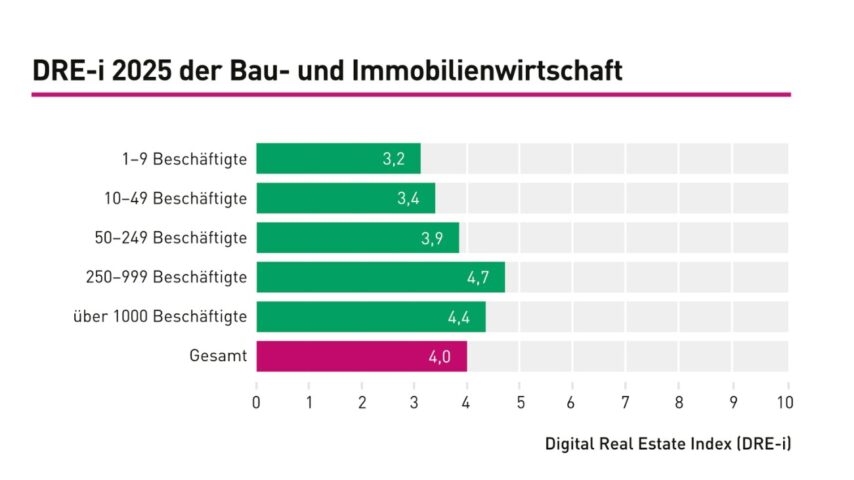
The industry’s digital maturity level has fallen slightly in 2025. This is shown by the Digital Real Estate Index 2025: on a scale of 1 to 10, the level of digitalization in the real estate industry currently stands at 4.0 points, a decline compared to the previous year (2024: 4.6 points). There are many reasons for this. Increasing complexity, insufficient data quality, cost pressure. This development affects almost all company sizes and roles, but to varying degrees.
The digital divide is deepening
The digital divide is particularly evident when it comes to company size. Although the decline affects all categories, small companies in particular are struggling the most with the cost and financing of digitalization. Medium-sized and large companies are able to maintain their lead to some extent.
Changing roles
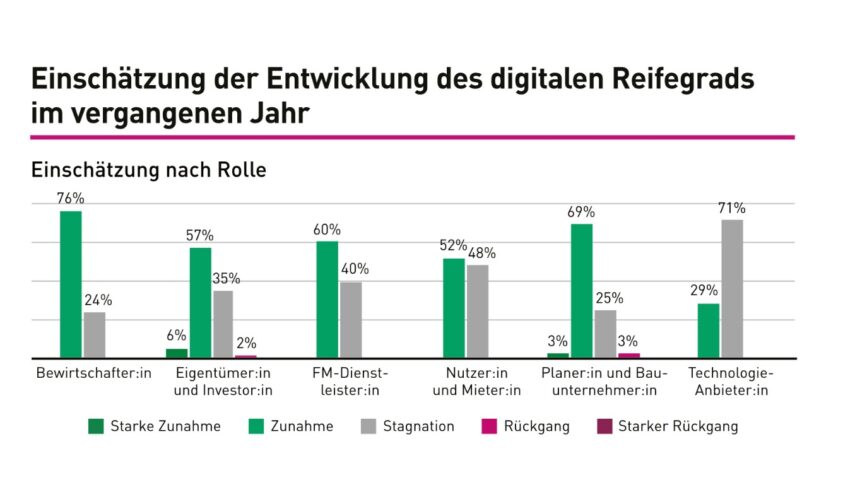
There are major differences between the various roles. Facility management service providers and property managers were even able to slightly increase their digital maturity. The situation is different for planners, construction companies, owners and investors: Here, disillusionment is spreading with regard to digital maturity. In particular, the consistent use of Building Information Modeling (BIM) across the entire life cycle remains a major challenge. In turn, users and tenants are more critical of their digital maturity than in the previous year.
Perceived stagnation instead of a spirit of optimism
The industry’s perception is increasingly in line with the measured values. An increase in critical assessments could already be observed in the previous year. This trend is even more pronounced this year. The majority of respondents speak of stagnation rather than major progress.
Technologies: Benefits recognized, limited use
Artificial intelligence has found its place in the industry’s consciousness. In the ranking of the most useful digital technologies, Artificial Intelligence & Machine Learning occupies third place. Given the rapid development and increasing presence of AI in the form of Large Language Models (LLM), this is hardly surprising. However, actual use is lagging behind: not even a fifth of respondents are already using the technology. The situation is similar for data analytics. The industry also sees great benefits in this area and is making efforts to increase its use, but the potential has still not been exhausted. Platforms and portals remain the frontrunners among the technologies.
Conclusion: Maturity also means reflection
The current decline in digital maturity does not mark a step backwards, but rather a phase of classification. This is because the real estate industry has recognized that digital maturity does not come from buying tools, but from their measurable benefits. An initial digitalization push is followed by disillusionment, triggered by high integration costs, a lack of standards and inadequate data strategies. At the same time, companies’ understanding of their own level of maturity has grown.
As a result, the view has become more critical, but also clearer. There is a growing realization that many digital initiatives fail because they are implemented as pure IT projects and too little attention is paid to organizational and human factors. Without clear governance, appropriate competencies and the consistent involvement of employees, the added value remains limited.
A more realistic attitude opens up the opportunity to make future steps more targeted, more effective and more successful in the long term. Real progress is made when digital transformation is no longer seen as a project with an end date, but is recognized as a permanent management task.