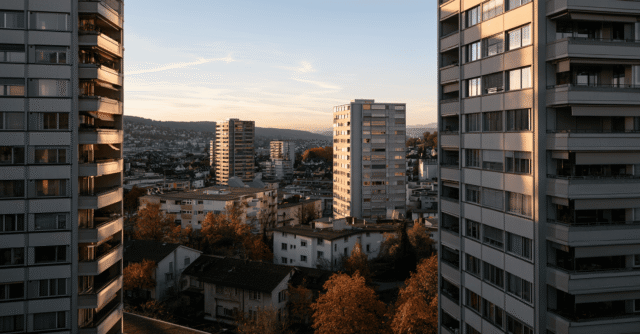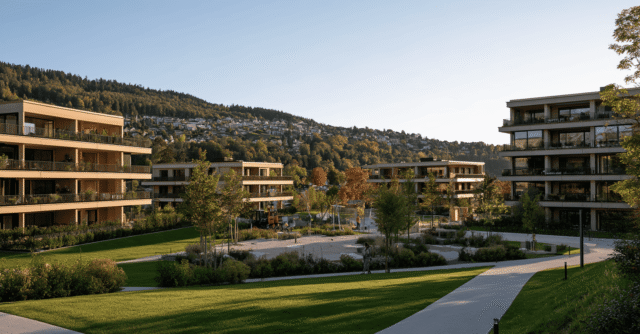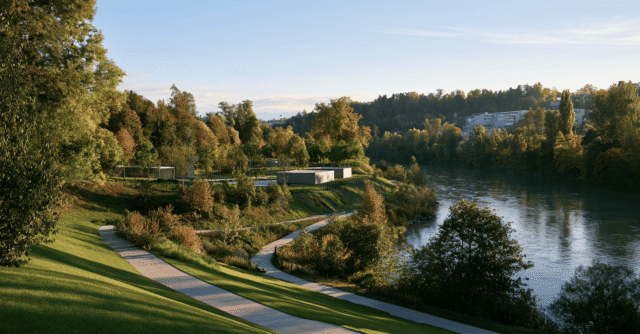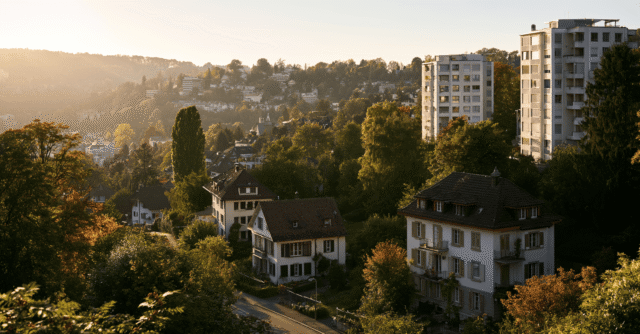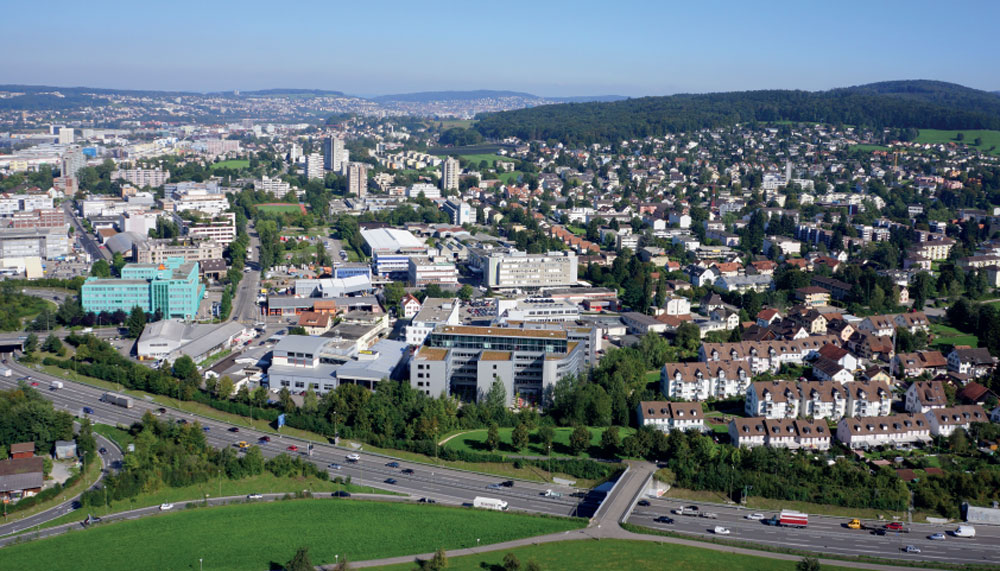
Just a few years ago, an abandoned commercial lot dominated the landscape of Urdorf-Nord. The transformation began not just with a master plan on paper, but in concrete terms with a shipping container. On the Luberzen site—the heart of the development area—the municipality opened a privately operated, 24-hour self-service convenience store. This was followed by food trucks, which quickly became popular with employees in the neighborhood. During the summer months from June through September, a summer lounge and concert evenings rounded out the program. This dynamically evolving interim use is not just a stopgap measure, but a catalyst that shows what Urdorf-Nord can become.
Location as a Trump Card
What sets Urdorf-Nord apart strategically is its exceptional connectivity. The Limmattalbahn serves the area with two stops, and the highway, S-Bahn, and Zurich Airport are all within easy reach. Directly adjacent are the Limmattal Cantonal School and Limmattal Hospital, two of the region’s most important educational and healthcare institutions. This combination of accessibility and proximity to key institutions makes the site equally attractive to businesses, educational institutions, and residential uses.
Revision of the Building and Zoning Regulations Opens New Possibilities
The planning course was set as early as 2017, when the municipality adopted an area-specific development strategy for Urdorf-Nord. Since then, the regional and, subsequently, the municipal structure plan have permitted so-called mixed-use developments—that is, the combination of work and residential spaces on the same site—in the vicinity of the LTB “Kantiallee” stop. The amendment to the municipal building and zoning regulations required to implement this mixed-use development is scheduled for the municipal assembly on June 17, 2026. If this is approved, the legal path will be clear for a densely developed, vibrant, and affordable urban project in one of the best-connected locations in the Limmat Valley.
Investments in the Entire Municipality
Urdorf-Nord should not be viewed in isolation. In the fall of 2024, the municipal council approved the “Urdorf 2030” real estate strategy, which calls for investments of up to 110 million Swiss francs at ten locations throughout the municipality. This includes schools, kindergartens, the town center complex, and the fire station, as well as soccer infrastructure and a community gathering place. Implementation is divided into two phases: 2025–2029 and 2030–2033. The strategy underscores that Urdorf is not merely making piecemeal repairs but is investing structurally in its future.
Cooperative Housing as a Statement
Alongside public development, the private sector in Urdorf is also making a statement. The Zurich Trade Union Housing and Building Cooperative and the Zurich Housing and Settlement Cooperative are constructing replacement buildings in southern Urdorf, the design plan for which was approved by the municipal assembly in November 2024. The winning project by Duplex Architects relies on geothermal heat pumps with free cooling technology. The groundbreaking is scheduled for 2027, and the fourth and final construction phase is set to be completed by the end of 2036. Cooperative housing construction with a commitment to sustainability is thus taking root in an area on the rise. Further private neighborhood renewal projects aimed at enhancing Urdorf’s quality of life are currently in the works.
A Model for the Region
Back to Urdorf-Nord: What is taking shape in Urdorf-Nord is more than just a local construction project. It is a laboratory for exploring how municipalities in the Limmat Valley can redefine their identities. Building a “city within a village” means densification without losing character, urbanity without gentrification, and growth without compromising quality. Urdorf demonstrates that this balancing act is possible when strategy, planning, and temporary use work in harmony.