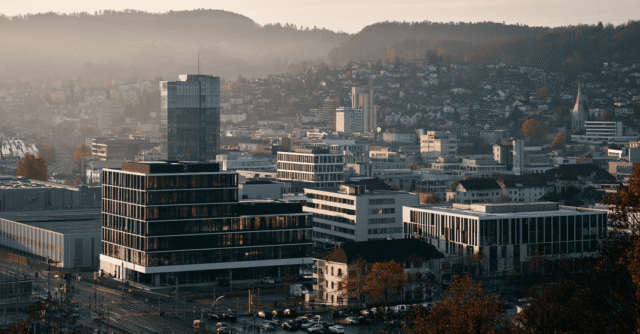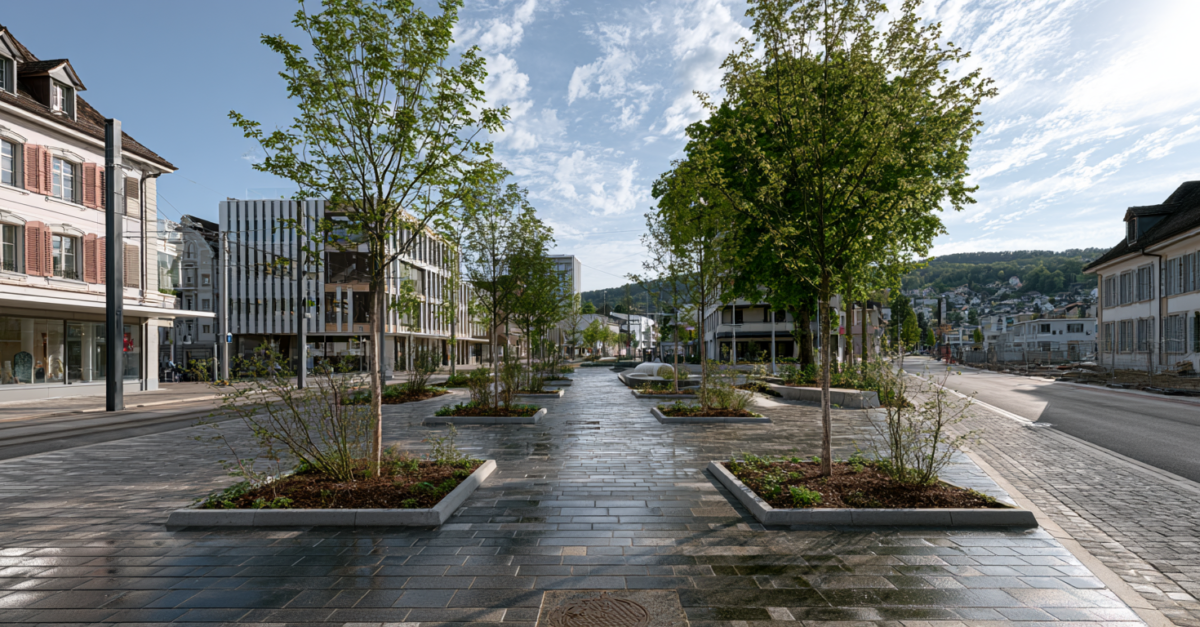

The “sponge city” principle sounds simple. Instead of getting rid of rainwater as quickly as possible, the idea is to retain it on-site, allow it to infiltrate, and use it for cooling. What seems obvious in the lab is a complex task in the built-up city. Sealed surfaces must be broken up, soils made more permeable, and new green spaces created.
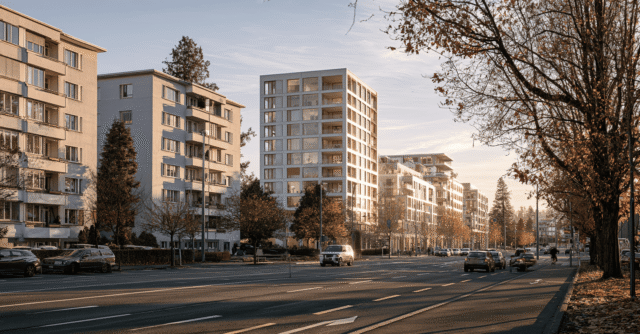
In Baden, the focus is specifically on the redevelopment projects on Badstrasse and Kirchplatz. Majo Kupresak, head of civil engineering, gets to the heart of the matter: simply removing asphalt isn’t enough. What matters most, he says, is what happens to the water afterward. If targeted storage is successful, the entire city will benefit.
Trees as Air Conditioning
Plants and trees provide dual cooling through shade and evaporation. In the shade of large trees, it can be up to 10 degrees Celsius cooler than on sealed surfaces. A single tree evaporates several hundred liters of water per day, acting like a natural air conditioner. Zurich has recognized this and decided to remove 145,000 square meters of asphalt and plant 2,000 additional street trees within ten years.
A Nationwide Movement:
Baden is not alone. Bern has been specifically testing the “sponge city” principle in pilot projects since 2024. Geneva and Lausanne have set ambitious tree-planting goals. Geneva aims to cover 25 percent of its urban area with shade-providing trees by 2030, while Lausanne aims for 30 percent by 2040. Lucerne is focusing on light-colored pavements and permeable surfaces. In 2025, the Canton of Zurich launched a comprehensive framework program to support municipalities in implementing these measures.
Private and Public Working Together
The principle only works when public projects and private properties work together. In Baden, the so-called “asphalt crackers” complement the city’s measures. They advise homeowners directly on removing impervious surfaces on private property. Baden also receives financial support from Mobiliar, which is committed to natural hazard prevention and climate adaptation throughout Switzerland.
In Poland, too, the “Sponge City” project in Bydgoszcz demonstrates how large- and small-scale measures can be combined: parks, wetlands, and permeable surfaces work together as a resilient system to combat heat and flooding. The message is the same everywhere: rain is not a burden. It is a resource.