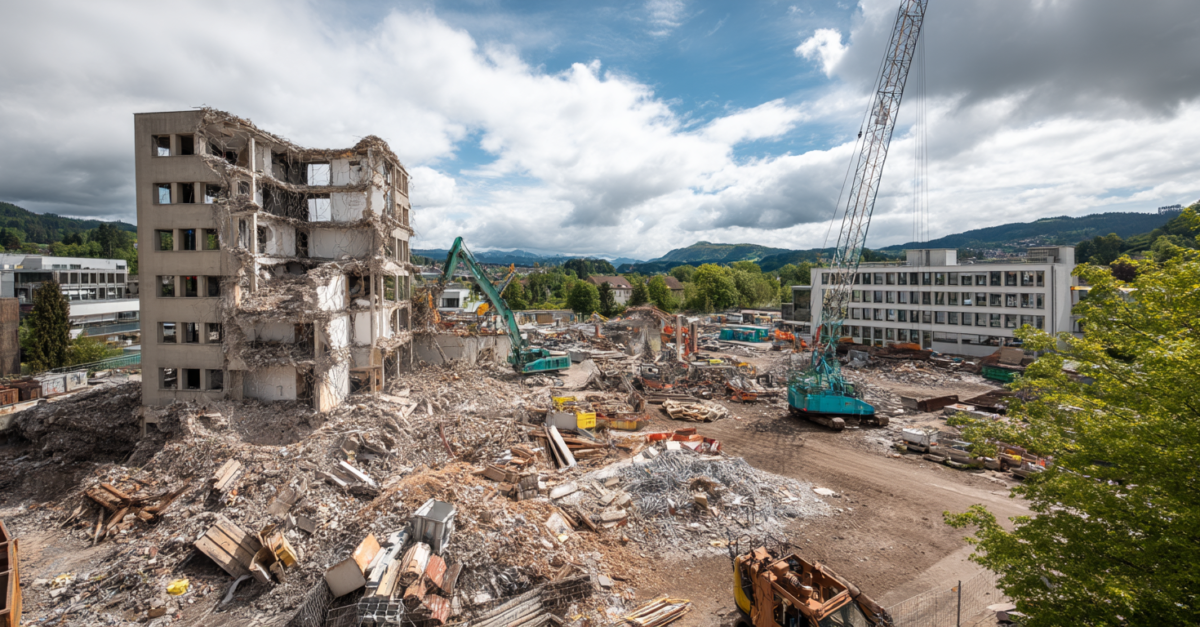

Millions of tons of construction waste and excavated material are produced in Switzerland every year, more than in any other waste segment. At the same time, over 40 million tons of sand, gravel and other building materials are used in new buildings, roads and infrastructure. Around 80 percent of this construction waste is already being recycled, but the potential for high-quality reuse is significantly greater.
Urban mining as a strategy rather than a niche
Initiatives such as urbanmining.ch explicitly promote the city as a raw material mine and provide tools to make material potential visible. Engineering and consulting companies systematically analyze sites and building portfolios to determine which materials are available, when and in what quality. This turns urban mining from a recycling issue into strategic resource planning for existing buildings.
Projects show the leverage
Studies on Swiss sites show that hundreds of tons of CO₂ can be saved by reusing building components and using secondary building materials. In demolition projects, load-bearing elements, façade components or finishing components are specifically removed and integrated into new buildings or interim uses. Such approaches are increasingly being incorporated into competitions, planning competitions and investor criteria.
Waste management as a raw material partner
Energy and waste disposal companies throughout Switzerland are investing in plants that recover metals from municipal solid waste slag and extract phosphorus from sewage sludge. Studies show that Swiss waste contains relevant quantities of strategic metals, the recovery of which is of ecological and economic interest. This shifts the focus from landfill space to raw material recovery on an industrial scale.
Politics and regulation are moving towards
The federal government is increasingly anchoring the circular economy and urban mining in strategies and enforcement aids. The waste and construction products regulations require that construction waste is reused wherever possible and that secondary construction materials are increasingly used. Cantons and cities are developing urban mining guidelines and potential studies that serve as the basis for construction specifications, submission criteria and funding programs.
What this means for project developers
Those who are familiar with material flows in existing buildings can reduce risks in the procurement market and position projects with clear CO₂ and resource advantages. At the same time, regulatory pressure is increasing to use secondary building materials and to think circularly about deconstruction projects. Early urban mining analyses are therefore becoming a competitive factor.