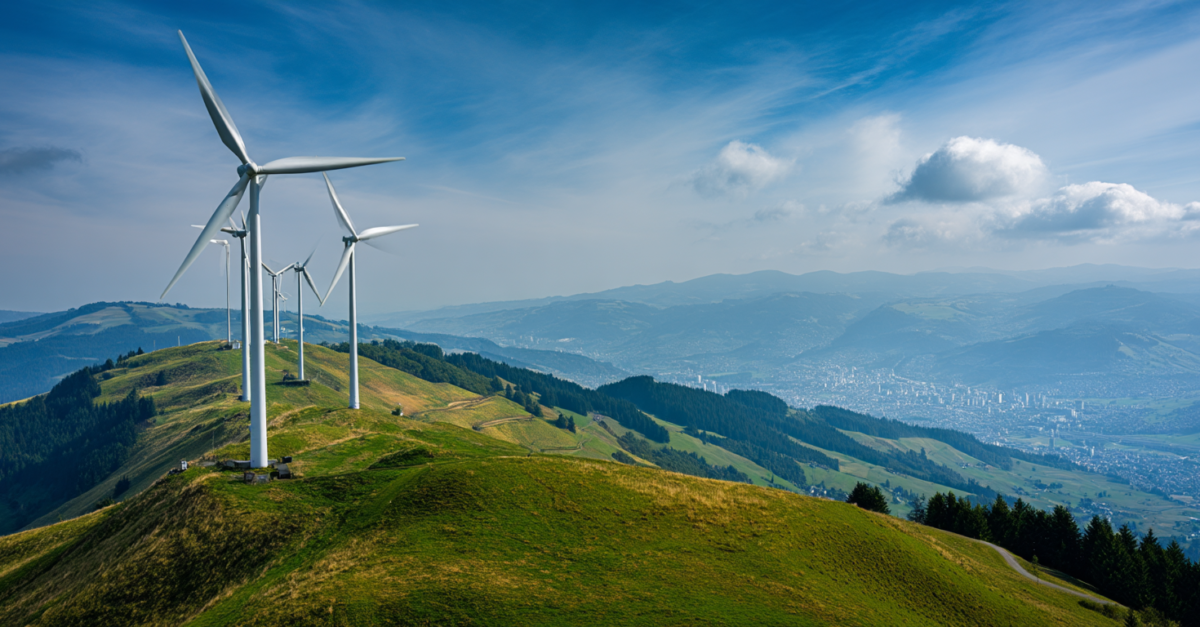

A clear majority of people in and around St. Gallen would support a wind farm on the Peter and Paul hill. According to a press release, this is the finding of a study by the University of St. Gallen on the hypothetical ‘Petra and Paula’ wind farm.
According to the study, 45.3 per cent would vote ‘yes’ and 30.1 per cent ‘somewhat yes’. In the city of St. Gallen itself, as many as 52 per cent of respondents answered with a clear ‘yes’. Only 11 per cent of all respondents clearly rejected the wind farm.
However, the study also examined the intensity of the feelings with which respondents reacted. Opponents rejected the wind farm much more strongly than supporters approved of it. “We are observing an asymmetrical emotional response – only 11% of respondents would reject the ‘Petra and Paula’ wind farm. However, this group expresses strong feelings, which often brings them a disproportionate amount of attention,” study leader Martina Rothenberger is quoted as saying in the press release.
The origin of the wind turbines influences the decision. Wind turbines from Denmark increase acceptance, whilst technology from the USA or China reduces it. The material used also has an impact: steel and wood increase acceptance, whilst concrete reduces it. The involvement of the local community, on the other hand, has a lesser influence on attitudes towards the wind farm.
The study is part of the research project “The influence of financial participation on the dynamics of social acceptance of wind energy” (PARTI-DYNACCEPT), which is funded by the Swiss Federal Office of Energy (SFOE) and supported by the Canton of St. Gallen. For the study, 322 people were surveyed in the city of St. Gallen or one of the 28 surrounding municipalities. They were selected to be representative of the population in terms of age and gender.