Offices are catching up, whilst housing seems expensive
Swiss residential properties continue to dominate the investment portfolios of many institutional investors. However, a window of opportunity is reopening in the office and other commercial property sectors. Higher cash flow yields, lower valuations and tighter supply are suddenly making this segment considerably more attractive to selective buyers.
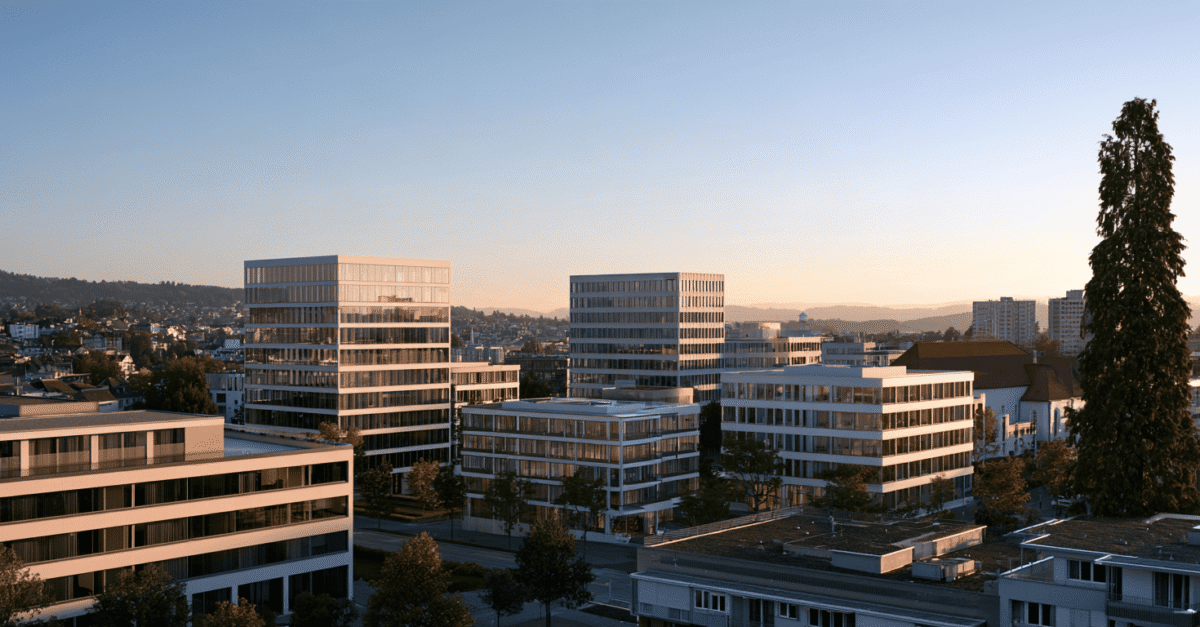

The turnaround is primarily down to valuations. Whilst residential property in Switzerland is buoyed by excess demand, low vacancy rates and high premiums on listed funds, commercial properties are priced at significantly less euphoric levels following the years of high interest rates. It is precisely this that is once again creating scope for higher current returns for institutional investors.
Current market reports do not indicate a broad-based recovery across the entire sector, but rather a selective rebound. High-quality office space, logistics and healthcare properties in strong economic locations are in demand. Weaker locations and older portfolios, on the other hand, remain under pressure because occupiers have become less tolerant when it comes to quality, flexibility and sustainability.
Residential funds well ahead
This divergence is particularly evident in the listed market. The SXI Real Estate Funds Broad index showed a premium of around 36.3 per cent at the end of February 2026. At the same time, market observers point out that residential funds are achieving significantly higher premiums than commercially-oriented vehicles. UBS noted at the end of 2025 that the highest cash flow yields for residential funds were, in some cases, as low as 1.6 per cent, whilst individual commercial funds were yielding over 5 per cent. For investors, this means that defensive stability in the residential segment now comes at a high price.
This preference is also reflected in the direct market. The Switzerland Annual Property Index compiled by MSCI and Wüest Partner shows a total return of 4.9 per cent for residential properties and 3.8 per cent for retail properties in 2024. In 2025, the total return on Swiss income-generating properties improved to 5.4 per cent, according to Julius Bär, citing the index. The market environment has therefore recovered, but the segments continue to react differently.
Quality is becoming an even more decisive factor
For offices, location remains the key factor. UBS expects overall demand for office space to decline in 2026 due to weak employment growth, with the supply-to-demand ratio rising from 5.5 to 6.0 per cent. At the same time, PwC describes the Swiss office market as moving sideways, with marked regional differences. Whilst market values of office properties across Switzerland were 4.2 per cent higher in August 2026 than in the previous year, the recovery is unevenly distributed. Central, flexible and ESG-compliant spaces remain in demand. Peripheral or outdated buildings continue to carry higher letting and repositioning risks.
Diversification is making a comeback as a key consideration
This is particularly relevant for portfolios with a heavy focus on residential property. UBS emphasises the growing importance for institutional investors in 2026 of segment selection, location quality, suitability for alternative uses and active asset management. Logistics space is explicitly regarded there as an attractive addition to portfolios, offering comparatively high returns. The crux of this resurgence therefore lies less in a general easing of market conditions than in a new pricing logic. Anyone entering the commercial property market today is often buying more current income and greater diversification than in the oversaturated residential segment. The price to pay is a significantly greater effort in selecting properties and locations.