

Real-world laboratories do not provide theory. They test solutions in the very places where they are later intended to be implemented. The Blue Nexus Lab, or BlueX for short, is a ten-year project and operates directly within local communities. Eawag brings experience from Fehraltorf to the project, where a similar laboratory has been operating since 2016. There, a dense monitoring network has demonstrated that reliable data prevents costly misguided investments.
The ‘sponge city’ as the answer
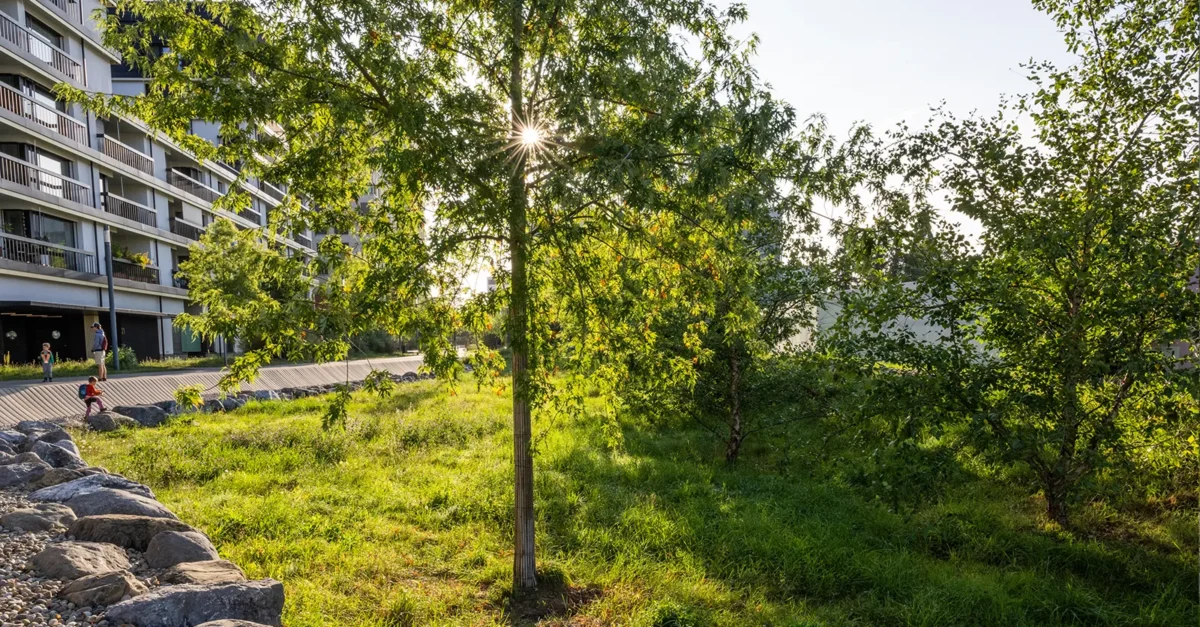
The core principle is as simple as it is effective. Rather than immediately channelling rainwater into the sewerage system, it is stored on site, allowed to infiltrate the ground or released at a later time. Limeco has already calculated the potential. Full implementation of ‘sponge city’ measures could reduce combined sewer overflows into watercourses by up to 90 per cent. Even by conservative estimates, halving this figure would be a breakthrough.
Less water, less energy
What is good for the environment also takes the strain off the infrastructure. Less rainwater in the sewer network means less pumping and lower energy consumption at the wastewater treatment plant. Currently, around a third of the extraneous water consists of rainwater. ‘Sponge city’ measures tackle this issue head-on, making the new wastewater treatment plant – due to be built by 2050 – smaller and more cost-effective.
Coordination is key
Nine towns and local authorities in the Limeco catchment area are on board. Limeco is taking on the groundwork that would take each local authority years to complete on its own. All stakeholders meet twice a year to exchange ideas. BlueX provides the organisational framework to link research and practice directly.
A flagship project with far-reaching impact
What is being developed in the Limmat Valley will not remain confined to the Limmat Valley. The findings from BlueX are intended to be applicable throughout Switzerland, for local authorities, planners and decision-makers facing the same challenges. Cooler public spaces, less flooding, more green space. The research has a concrete aim. The Limmat Valley demonstrates that climate adaptation is not wishful thinking, but planning.
Text: Christoph Grüninger • Image: Limeco
Ten years that have transformed the Limmat Valley
More Articles
Housing construction masks the shortage
The 52,000 approved flats indicate a substantial pipeline in Switzerland, yet the market remains tight. At the end of June 2026, the vacancy rate stood at just 0.93 per cent.…
Wittenbach is set to gain 62 flats by autumn 2028
Construction has begun on the Widenbach development in Wittenbach. Four four-storey blocks of flats, comprising 62 rental flats built to the Minergie standard, are being built on the site. Around…
Thurgau incorporates new ESP into its regional plan
Thurgau is aligning its location policy more closely with spatial planning. An amendment to the structural plan is intended to enshrine economic development priorities for commerce, industry and services in…
Berlin is pushing its expropriation plans to the very limits of the law
Berlin is heading for a major housing policy initiative. The Left Party, the Greens and the SPD want to nationalise up to 160,000 flats owned by large corporations and cap…
Kaiseraugst is giving rise to new tenancy disputes
In Kaiseraugst, an old tenancy dispute is now proving costly. Following a final judgement that had already awarded a 5 per cent rent reduction due to failure to meet the…