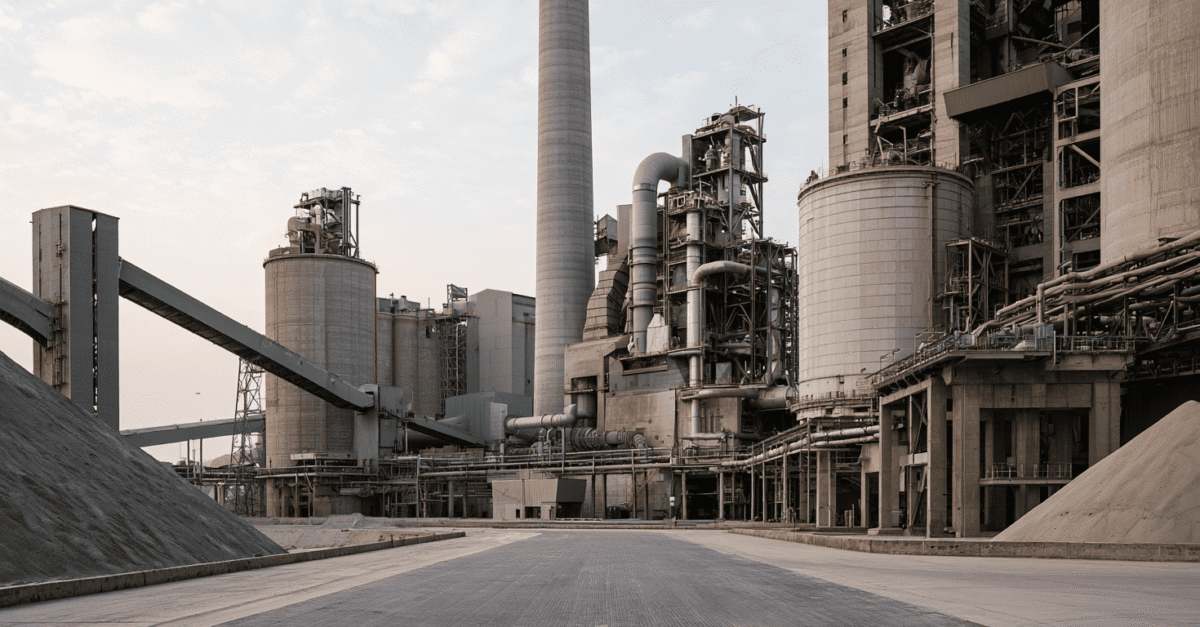

On August 21, Holcim commissioned a membrane-based pilot plant for CO₂ capture at the Höver cement plant near Hanover. The technology was developed at the Helmholtz Center Hereon. Cool Planet Technologies brought it to market readiness. The plant is designed to capture up to 90 percent of the CO₂ from the exhaust gas stream.
The process targets the critical point. When raw materials are burned, large amounts of CO₂ are produced directly from limestone. These process-related emissions will persist even if renewable energy sources replace fossil fuels. For the cement industry, therefore, carbon capture is becoming a key lever on the path to lower emissions.
From Pilot to Infrastructure
The pilot plant is expected to capture up to 10,000 metric tons of CO₂ annually. According to media reports, the Höver cement plant emits approximately 600,000 metric tons of CO₂ per year. This means that the current operation is a test in an industrial setting, not yet a comprehensive solution. Holcim is evaluating a plant with a capacity of up to 200,000 metric tons per year for the early 2030s.
The technology uses special polymer membranes that allow CO₂ to pass through faster than nitrogen and oxygen. The CO₂-rich stream is collected and processed. The remaining exhaust stream flows back into the plant with significantly less CO₂. The plant can be integrated downstream of the existing manufacturing process. It is precisely this retrofit capability that makes the approach attractive for existing cement plants.
CO₂ Becomes a Raw Material
The captured gas is intended for further use in partner industries. Applications in chemicals, biofuels, and packaging materials are being discussed. According to NDR, the first shipment of processed CO₂ to industrial partners is scheduled for March 2027.
This opens up new value chains. However, the plan will only work if the capture process is energy-efficient, there are enough buyers, and transportation and storage solutions are available for any remaining quantities.
More Than Just a Filter
Cement accounts for about 8 percent of global CO₂ emissions. The plant in Höver is therefore an important step. However, it is no substitute for a careful materials strategy. Using less clinker, recycled building materials, longer service life cycles, and the reuse of existing buildings remain just as crucial.
For the real estate industry, the cement transition begins long before the first concrete is poured. It starts with the question of whether a new building is necessary, which construction method reduces material use, and what emissions a building material causes over its entire life cycle. Holcim’s pilot project demonstrates a new technical option. Now this must be developed into an economically viable standard.