How Switzerland is training the PropTech specialists of tomorrow
The digital transformation of the property industry is not possible without qualified specialists. PropTech innovation arises where property knowledge, an understanding of technology and entrepreneurial thinking come together. Switzerland has a broad and practice-orientated educational offering that addresses precisely this interface and thus plays a central role in the PropTech ecosystem.

Interdisciplinarity is the key
PropTech is not a traditional field of study. Rather, expertise is created by combining different disciplines. In Switzerland, training programmes combine subjects such as property economics, construction, IT, data analysis, sustainability and management.
This interdisciplinarity reflects the reality of the industry. PropTech specialists need to understand technical solutions, categorise regulatory frameworks and think economically at the same time. Swiss educational institutions are responding to this with modular programmes and practice-oriented formats.
Universities as drivers of innovation
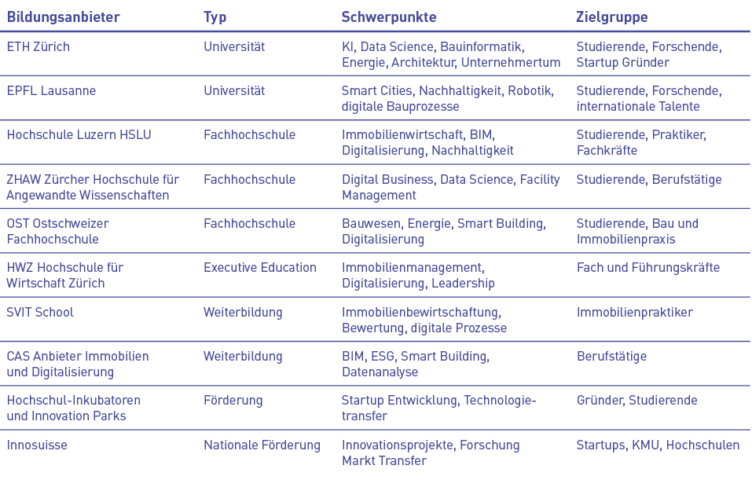
ETH Zurich and EPFL Lausanne form the academic foundation of many technological developments. Degree courses and research programmes in civil engineering, architecture, computer science and data science provide expertise that flows directly into PropTech solutions.
Universities of Applied Sciences such as HSLU, ZHAW or OST complement this offering with a strong practical focus. Projects in collaboration with companies, start-ups and public institutions enable students to work on real-world problems. This results in a direct transfer of knowledge into application.
Further education for property practice
In addition to academic education, in-service training is becoming increasingly important. Many specialists in administration, valuation, development or management need to catch up on or deepen their digital skills.
In Switzerland, there are a growing number of CAS and MAS programmes with a focus on digitalisation, BIM, data analytics, sustainability and real estate management. These programmes are aimed specifically at practitioners and impart applicable knowledge for everyday working life.
Collaboration with the industry
A key success factor is the close cooperation between educational institutions and the property industry. Companies act as practice partners, provide use cases or participate in the content design of training courses.
This keeps training content up-to-date and close to the market. Students and further education participants benefit from real insights into ongoing transformation processes and establish relevant networks at an early stage.
Entrepreneurship and start-up promotion
Many training programmes integrate entrepreneurial elements. Incubators, innovation programmes and student initiatives promote a spirit of entrepreneurship and experimentation. Students are encouraged to develop their own ideas and pursue them as start-ups.
This combination of education and entrepreneurship is an important driver for the Swiss PropTech scene. Numerous successful companies have emerged from university projects and have been able to establish themselves on the market thanks to targeted support.
Challenges and outlook
Despite the strong educational landscape, the shortage of skilled labour remains a challenge. The demand for specialists in the fields of data analysis, software development, BIM and ESG is outstripping supply.
At the same time, the need for hybrid profiles that combine technology and property practice is increasing. Educational institutions are therefore faced with the task of continuously developing their programmes and addressing new target groups.