What was waste yesterday is now used as a substitute for cement
Anyone who digs a tunnel ends up producing millions of metric tons of soil and rock, most of which has, until now, ended up unused in landfills. A new research project at the Cologne University of Applied Sciences aims to change exactly that and use this excavated material to produce a climate-friendly substitute for cement. If this breakthrough succeeds, a waste disposal problem will be transformed into a valuable raw material. The initial results from a previous project are already giving cause for hope.
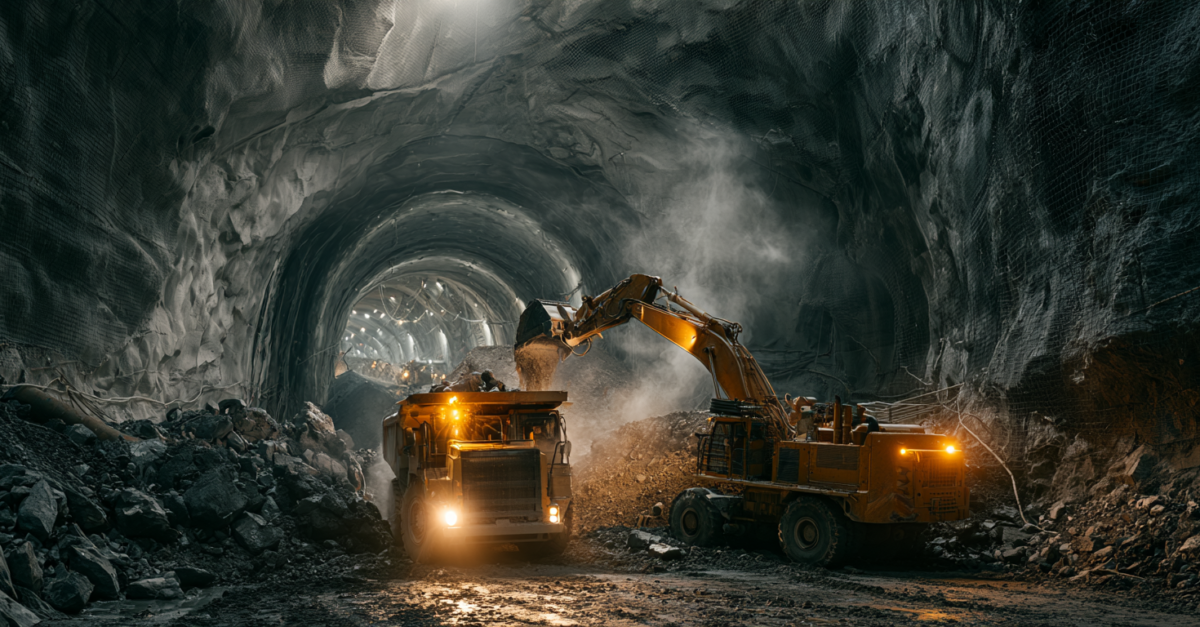

Under the name Geo-BAB, an interdisciplinary consortium is investigating how clay-mineral-rich material from tunnel construction can be used as a low-carbon alternative to cement through thermal treatment and chemical activation. The two-year collaborative project is funded by the Federal Highway and Transport Authority with approximately 650,000 euros as part of the Road Innovation Program.
How Clay Becomes a Binder
The focus isoncalcination, a process in which the clay-containing material is dried, finely ground, and then heated. This thermal treatment alters the crystal structure of the clay minerals, causing them to develop pozzolanic properties and enabling them to react with lime—a fundamental requirement for partially replacing cement clinker. At the same time, the team is researching a second, more radical approach: completely cement-free binders in which activators such as water glass trigger the strength development.
Why this matters for the climate
The need for action is urgent. Cement accounts for up to 91 percent of concrete’s carbon footprint and, globally, for about 8 percent of human-caused CO2 emissions—four times as much as all global air travel. Any proportion that can be replaced by calcined clay therefore has a direct impact on the carbon footprint of construction projects.
A previous project provides the proof
The completed TOFFEE project, also led by TH Köln, has already demonstrated that the approach works. With a 10 percent substitution of cement with calcined clays, the concrete achieved strength values comparable to those of conventional concrete; even with up to 40 percent substitution, the compressive strength remained suitable for practical use. These results provide the scientific basis on which Geo-BAB is now building.
is already putting this into practiceOther construction projects have long been experimenting with similar ideas. For the Filder Tunnel as part of the Stuttgart 21 project, Porr AG, in collaboration with MC-Bauchemie, developed a virtually cement-free ring-joint mortar that uses granulated blast furnace slag and fly ash instead of cement and has since been patented. In Lower Austria, a field test is also underway with an eco-concrete that emits a quarter less CO2 during production than standard concrete. These examples show that the shift from waste product to valuable resource in tunnel construction has already begun.