From Plant Construction to Knowledge Transfer: How AI Is Revolutionizing Business Succession
In construction projects—and thus also in sports and recreational infrastructure projects—the handover process between planners, contractors, and project owners is clearly defined. The focus is on quality, costs, and deadlines. From the perspective of real estate and facility management, however, the real challenge often begins only after construction is complete.
Knowledge Transfer: An Underestimated Challenge
Especially in sports and fitness facilities with complex building systems, diverse user groups, and high demands on availability, safety, and cost-effectiveness, the quality of the operational handover is crucial to long-term success. While the technical acceptance process is clearly structured, knowledge transfer to the operators often receives too little attention. The consequences include knowledge gaps, inefficient processes, operating errors, and avoidable operational risks.
In practice, the handover usually takes place via extensive documentation and one-time training sessions shortly before commissioning. At this point, the volume of information is often too great, and the connection to later application is too tenuous. Valuable knowledge gets lost in folders, PDF documents, or in the minds of individual people.
Using AI for Continuous Knowledge Transfer
From BPM Sports’ perspective, this is precisely where a key challenge lies. As a specialist in the use, operation, and commissioning of sports and fitness facilities, BPM Sports supports project owners and operators throughout the entire SIA process. Experience from numerous projects shows that the long-term operational viability of a facility depends less on the quality of its documentation than on the organization’s ability to make knowledge permanently available and to apply it.
Artificial intelligence enables a fundamental paradigm shift in this area. A one-time handover is replaced by a continuous transfer of knowledge throughout a facility’s entire lifecycle. The goal is no longer merely to transfer information, but to empower operators.
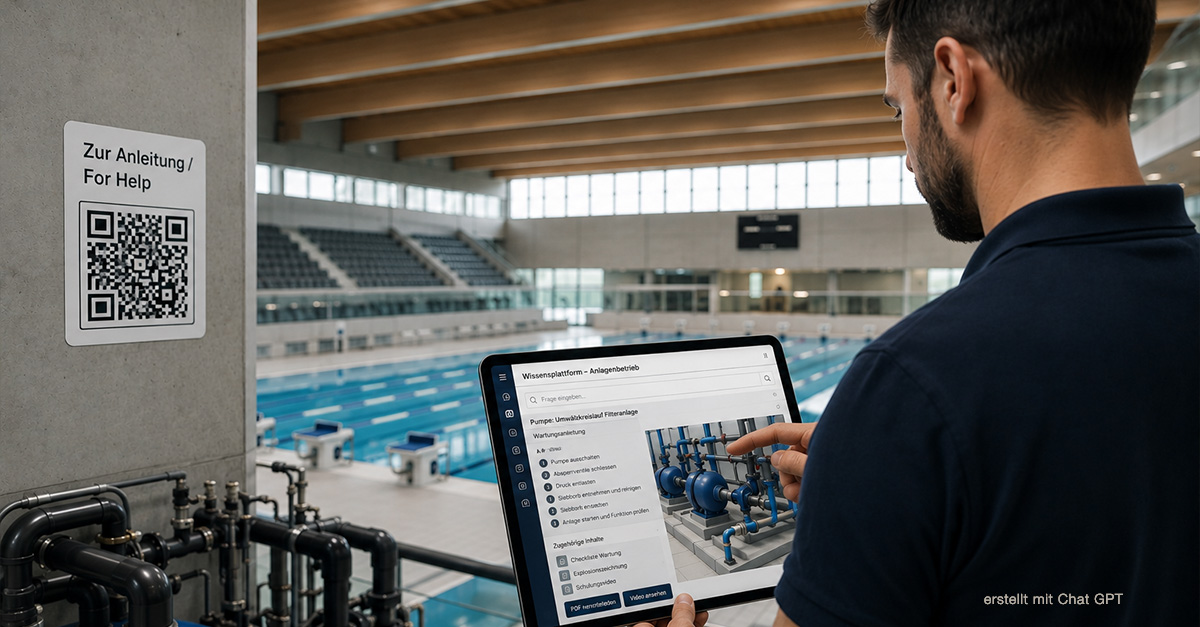
At the heart of this approach is a digital knowledge twin. Inspection records, maintenance instructions, operational processes, and experiential knowledge are consolidated into a structured, AI-enabled knowledge platform. Employees can ask questions directly in natural language and immediately receive concrete, plant-specific answers, including instructions, checklists, images, or videos.
Embedding Knowledge Where It’s Needed
The platform is supplemented by short micro-learning modules lasting just a few minutes. Knowledge is no longer imparted through one-time training sessions but is delivered as needed during the workday. Using QR codes on equipment, employees can directly access step-by-step instructions, safety information, or training videos. Learning takes place where the knowledge is needed: on the job.
Another advantage lies in the ability to tailor knowledge transfer to specific target groups. Building superintendents, facility managers, technical directors, and operations managers require different types of information. AI can automatically adapt content to an individual’s role, prior knowledge, and area of responsibility.
For future projects, a four-step approach is recommended:
- Basic training before commissioning
- Micro-learning modules during the first months of operation
- AI-powered knowledge assistant for day-to-day operations
- Regular refresher training on seasonal and rare operational situations
Why Sports and Recreational Facilities Benefit Particularly
Sports facilities, in particular, benefit from this approach. Diverse user groups, part-time employees, external service providers, and staff turnover increase the demands on knowledge retention. Instead of knowledge tied to specific individuals, a digital operational memory is created that ensures compliance with standards, reduces training time, and sustainably improves operational quality.
The operational handover thus evolves from a one-time project step into a continuous learning and empowerment process. For owners, operators, and facility managers, this creates measurable added value: greater operational reliability, higher efficiency, and better utilization of investments throughout the infrastructure’s entire lifecycle.
As a specialized partner for sports and recreational infrastructure, BPM Sports supports project owners and operators in optimizing knowledge transfer—whether with or without the use of AI—during the “planning,” “commissioning,” and “operation” phases. After all, the long-term success of an infrastructure project is determined not only by the quality of its construction but also by the ability to sustainably preserve and effectively apply knowledge.