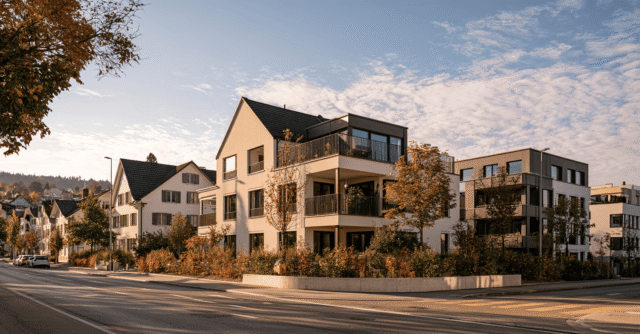

On 22 April 2026, the Federal Council adopted a report setting out measures to accelerate housing construction and instructed the DETEC to draw up a consultation draft by the end of 2026. Among other things, the plan is to enshrine housing construction in conjunction with inward-looking urban development as a matter of national interest in the Spatial Planning Act. Political pressure to increase density is thus clearly mounting.
However, it is particularly in the existing housing stock that it becomes clear why technical feasibility and planning instruments alone are not enough. Where owners, investors, local authorities, businesses and residents with differing objectives come together, conflicts often only come to a head at a late stage. For sites and neighbourhoods, this means longer procedures, uncertain investment windows and higher risks during implementation.
From posturing to implementation
Urban development rarely fails due to a lack of concepts. Often, another mechanism stands in the way. Stakeholders negotiate on the basis of visible positions, even though entirely different interests lie behind them – such as accessibility, footfall, returns, quality of life or political acceptance. If these interests remain unspoken, the debate narrows down to a battle over resource allocation. Only when needs are laid bare and weighed against one another do robust options emerge for land use, phasing, infrastructure provision and public benefits.
This pressure to negotiate is increasing because infill development takes place within existing settlements and thus directly impacts established land uses, ownership structures and local expectations. The federal government itself cites objections and appeals as factors causing delays in housing projects. Anyone wishing to drive forward densification must therefore not only plan, but also identify conflicts at an early stage, create scope for negotiation and clearly define roles.
Urban management is becoming a core competence
This is precisely where the CAS in Urban Management at CUREM, University of Zurich, comes in. The programme has been offered since 2018, comprises 15 ECTS credits and is divided into three modules: Urban Economics, Urban Development and Urban Leadership. It is aimed at specialists and managers in the fields of municipal and urban development, spatial planning and the property sector who need to steer transformation processes across institutional and disciplinary boundaries.
For the property sector, this is no mere soft skill. When densification is being driven by political forces and procedures are simultaneously under time pressure, the value of professionals who can translate interests, negotiate options and steer projects through complex constellations within the existing portfolio increases. Inner-city regeneration therefore requires more than just planning certainty. It requires leadership before projects become bogged down by their own conflicts.