Silicon modules established on the market today achieve an efficiency of around 20 to 24% and are therefore already close to the material-specific limit of 29.4%. This limit is a consequence of the so-called Shockley-Queisser limit, which describes a maximum efficiency of 33.2% under ideal conditions for solar cells with only one semiconductor layer.
The reason for this lies in the band gap of the material: it determines which wavelengths of light can be converted into electricity. If the band gap is too large, long-wave photons are lost; if it is too small, some of the energy is lost as heat. Silicon does not exactly meet this theoretical optimum, which is why only limited increases in efficiency are possible with conventional silicon technology.
Tandem principle
Instead of just one semiconductor layer, several layers with different band gaps are combined. Each of these layers utilises a different part of the solar spectrum, from short to long wavelengths. This allows significantly more of the irradiated energy to be converted into electricity, effectively overcoming the classic single-layer limit.
Theoretically, efficiency levels of over 60% are possible with tandem cells, depending on the material combination and structure. The technical challenge lies not only in the choice of materials, but also in transforming them into a stable module that works reliably under real conditions.
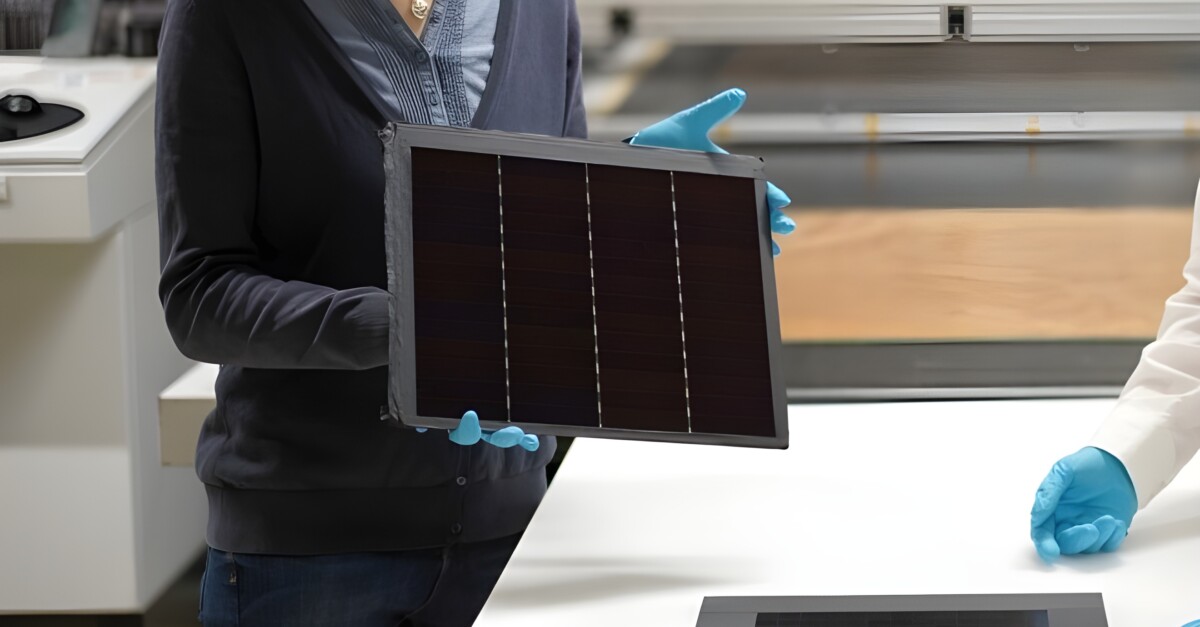
In the “Vorfahrt” project, a tandem module was created which, according to Fraunhofer ISE, achieves an efficiency of 34.2%, currently the most efficient solar module in the world. It is based on a triple-stacked III-V semiconductor structure on a germanium substrate, an architecture that was originally developed for space solar cells.
Project partner Azur Space has adapted its space cells to the terrestrial solar spectrum and scaled them up for module production. The company Temicon is contributing a nanostructure on the glass surface that minimises reflection losses and thus opens up additional efficiency percentage points.
The second record module comes from the “Mod30plus” project. Here, the researchers combined a III-V semiconductor with the more cost-effective silicon instead of germanium, achieving a module efficiency of 31.3%. The basis is III-V/silicon tandem cells with a cell efficiency of 36.1%, which were manufactured and interconnected for the first time in a small series at the institute.
III-V/silicon technology is moving away from pure laboratory status and towards industrially scalable processes. Both modules clearly exceed the physical limit of classic silicon modules of 29.4%. A value that was long considered almost impossible to achieve.
Module values for practical use
In photovoltaics, a distinction is made between cells and modules. Cells are measured under idealised laboratory conditions, while modules consist of many interconnected cells embedded in glass and frames. Inactive surfaces, conductor paths and reflections cause unavoidable losses.
Accordingly, module efficiencies are always lower than the cell efficiencies, even in the case of Freiburg’s record-breaking technology. Module values are therefore crucial for real applications, as modules are always installed on roofs, façades or vehicles, never individual cells.
When every square centimetre counts
High-performance modules become exciting where space is scarce and expensive. For example, in building-integrated photovoltaics, where modules act as façade or roof elements, or on vehicles. The project partners include Audi, which emphasises the potential for vehicle applications.
Efficiency for the mass market
Fraunhofer ISE is also pursuing another tandem route. Perovskite silicon modules, developed jointly with Oxford PV, among others. A full-format module with a surface area of 1.68 m² already achieves 25% efficiency and has been produced on production lines that are also suitable for mass production. This technology is aimed less at absolute records than at broad market penetration with comparatively cheap materials and should be suitable for standard roofs in the future. Research groups, including in Hong Kong, are also reporting perovskite-based cells with efficiencies of up to 40%, which illustrates the dynamism in this segment.