Solar cells that camouflage themselves
A butterfly has given researchers at Fraunhofer ISE the decisive clue. Solar modules that look like brickwork, roof tiles or individually designed façade elements and generate electricity with almost no loss of power. The new "ShadeCut" technology could resolve a long-standing point of contention: aesthetics versus the energy transition. This no longer has to be a contradiction in terms.
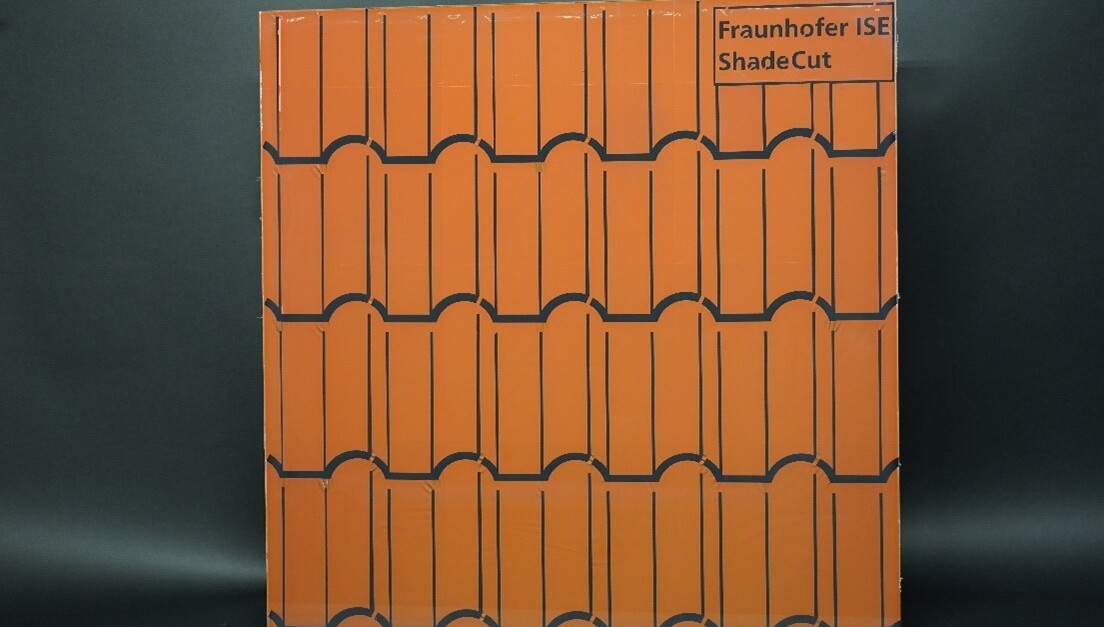
ShadeCut films make PV modules look like roof tiles, opening up new design possibilities for roofs and facades. Image: © Fraunhofer ISE / Marco Ernst
Nature shows us how it’s done. The Morpho butterfly produces its intense blue wing sheen not through pigments, but through three-dimensional microstructures that refract and reflect light. Researchers at Fraunhofer ISE have transferred this principle to photovoltaic modules. A vacuum process applies a similar surface structure to the cover glass or flexible films. Depending on the fine structure, this produces modules in a wide range of colors, from brick red to anthracite. The result is called MorphoColor®.
Patterns directly into the module
New is the “ShadeCut” technology, which provides colored films with transparent cut-outs and thus integrates complex patterns and motifs directly into solar modules. A laser or a CAD-controlled cutting process applies the desired motif to the film, whether it is a brick structure, masonry or a company logo. The technology works with all standard photovoltaic and solar thermal modules and can be used both as a flexible embedding film and as a backsheet film. The colored modules achieve around 95 percent of the output of a comparable uncoated module.
The end of the monument protection dilemma
Until now, building-integrated photovoltaics has often failed due to aesthetic requirements. Listed buildings and conservation areas in Switzerland and Germany in particular posed major hurdles. In several German federal states, monument protection has already been relaxed, provided that modules match the color of the building envelope. Modules can imitate brickwork or roof tiles deceptively realistically and fit in perfectly in terms of color, says Dr. Martin Heinrich, group leader at Fraunhofer ISE. An Innosuisse project at HSLU in the Viscosi town of Emmenbrücke has already produced a demo façade in 78 shades of color.
BIPV on the verge of a breakthrough
The market for building-integrated photovoltaics is growing rapidly. Globally, it is estimated to be worth around 85.9 billion dollars by 2034, compared to 28.3 billion in 2026. In Switzerland, the registration procedure for façade systems has simplified the approval process since this year, which has given a clear boost to demand for aesthetic façade solutions. The first commercial tandem modules with a BIPV focus are expected in 2026 for niche markets. Fraunhofer ISE estimates the total potential of PV on buildings at around 1,000 GWp by 2045.
What was created in the laboratory in Freiburg is now being applied to roofs and façades via a Swiss partner.