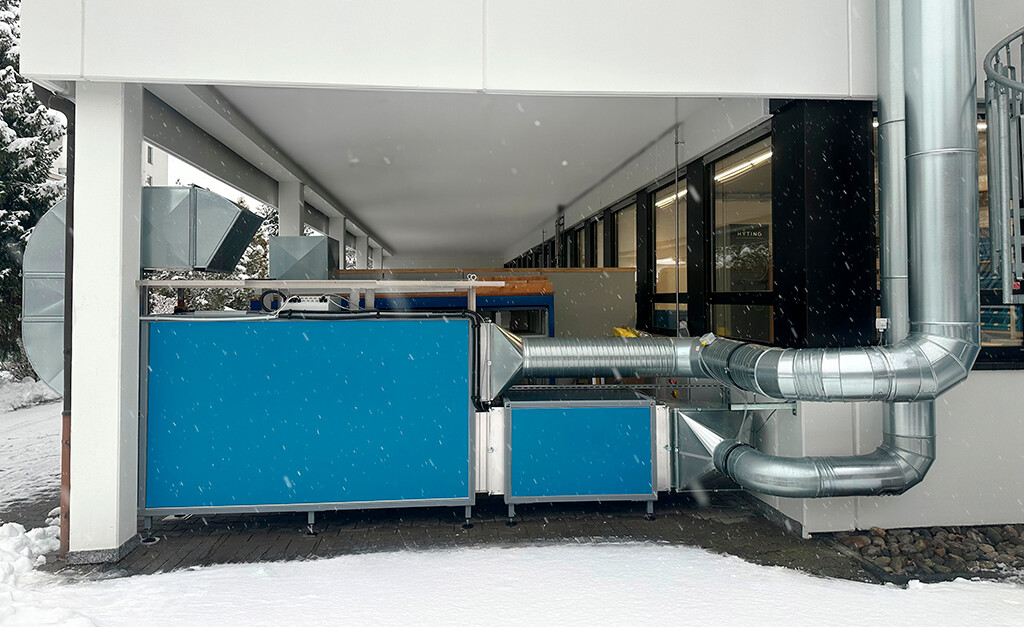
In a production hall, an inconspicuous device is making heating technology history. The first catalytic hydrogen air heating system has been put into operation at a customer. The 10 kW system provides peak load heat for a production area of around 1,000 cubic metres for the pump manufacturer Flusys, using hydrogen from regional supplies. For the young company from Wiesbaden, this is more than just a field test. It is a practical test for a technology that is intended to replace fossil fuels in the heating sector in the future.
Commercial and industrial buildings
The company is deliberately targeting commercial and industrial buildings rather than single-family homes. This is where high heat demand, limited electrical connected load and increasing pressure to decarbonise come together directly. A purely electrical solution using large heat pumps often fails due to expensive grid connections or simply a lack of capacity. The hydrogen heating system covers the peak load, while a heat pump or another heat source takes over the base load.
In Offenbach, the 10 kW unit works in a hybrid network with a heat pump. The heat pump supplies the production area during normal operation, while the H₂ heating system kicks in on particularly cold days or when capacity utilisation is high. This division of tasks allows the heat pump to be dimensioned smaller and reduces the required electrical connected load, a noticeable lever for investment and output prices. For locations with an existing or planned hydrogen infrastructure, the system thus becomes an economical component of the energy supply.
The flameless hydrogen heating system
Technologically, the company differs significantly from conventional condensing boilers or H₂ burners. The system works with a flameless, catalytic process. Hydrogen is mixed with ambient air, remains below the lower explosion limit and only reacts with the oxygen in the catalyser. Heat is generated, but no visible flame, as the process is based on controlled oxidation rather than combustion.
The lower process temperatures mean that neither CO₂, NOx nor particulate matter are produced; the only by-product is water in the form of humidity. At the same time, flammable hydrogen concentrations are never used in the appliance, making the technology inherently safe. HYTING sees this as a kind of “plug-and-play heating” with hydrogen that utilises existing air ducts or ventilation systems and can be scaled in a modular design.
Practical test, endurance test and approval
The system is not the first endurance test for the young technology. A leading engineering service provider had previously accompanied a 2,500-hour endurance test that simulated around ten years of real operation. During the test, there were neither failures nor measurable wear and tear on safety-critical components. Continuous emission measurements confirmed the absence of CO₂, NOx and particulate matter emissions.
The first customer system now marks the transition from the laboratory to industrial reality. Further systems are to follow in the course of the first quarter of 2026, also in commercial applications with existing hydrogen expertise.
Where does the technology make sense
Despite the attention, catalytic hydrogen heating is no substitute for gas heating or heat pumps in the broad market. Hydrogen is currently expensive, the infrastructure is limited and a comprehensive H₂ network for residential neighbourhoods is not in sight. For the foreseeable future, there is therefore no basis for economical use in single-family homes.
The situation is different in industrial clusters, harbour regions or chemical parks, where hydrogen is already being produced or the hydrogen core network is being set up. This is where it can play to its strengths. As peak load heating in combination with heat pumps, as a supplement to industrial waste heat or as a flexible option in logistics properties with their own hydrogen production from PV surpluses. The role is thus clearly defined, not as a competitor to heat pumps, but as a building block in hybrid systems for companies that can utilise H₂ without major additional expense.
Whether the niche becomes more will ultimately be decided outside the technology room. The price of hydrogen, the pace of grid expansion and political decisions will determine whether flameless H₂ heaters will be used more frequently in commercial buildings in the future or remain a specialised tool that is primarily used in places where hydrogen is already part of the energy mix.