Locarno is attracting affluent families
According to UBS, Locarno in Ticino will continue to be regarded as a prime location for low-income households in 2026. However, the other end of the ranking is politically controversial. For middle-income households, the city now ranks only second, and for high-income households, third. This is precisely where a new housing policy initiative is now coming into play.
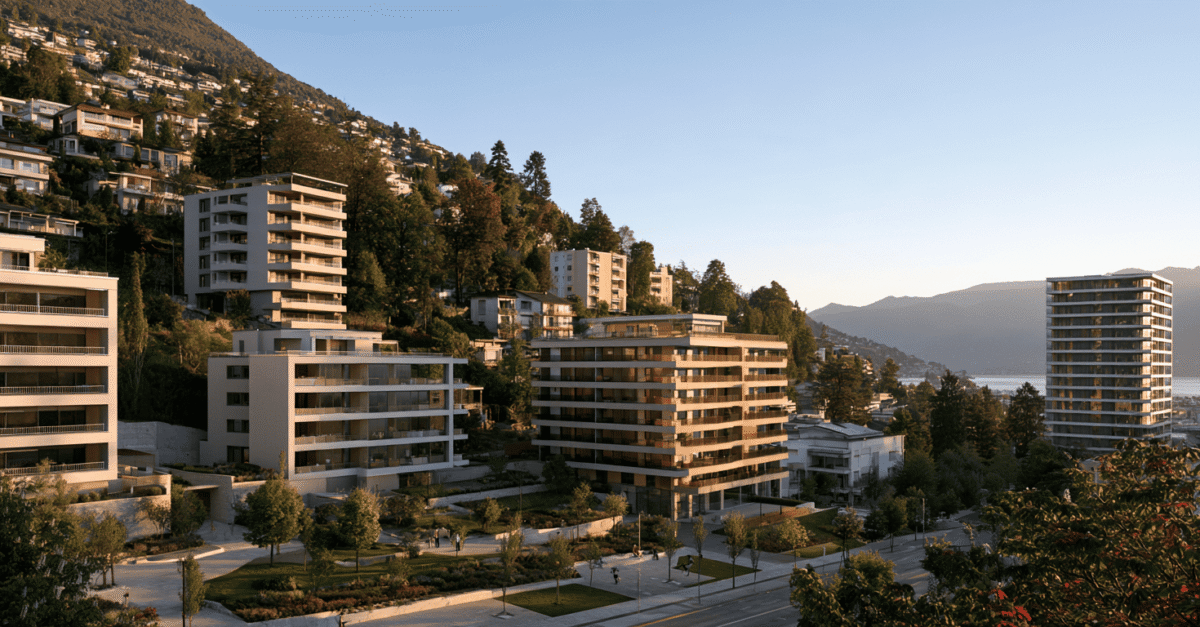

The new motion tabled by the FDP group on the Municipal Council is dated 16 September 2026 and calls on the municipality to draw up a clear housing strategy for middle- and upper-class families. This has been prompted by the latest UBS ranking on residential attractiveness. In this ranking, Locarno in Ticino is ranked first for low-income households, but only second for middle-income households and third for high-income households.
For local planning, this is more than just a question of image. The group argues that the bottleneck lies not primarily in affordable flats, but in high-quality family homes with 4.5 and 5.5 rooms, in attractive neighbourhoods and in well-designed public spaces. It also refers to a study commissioned by the city, which found that the housing stock is heavily dominated by small flats and that, in recent years, Locarno has lost families and residents under the age of 65 to neighbouring municipalities.
Political pressure on the
housing strategy. The interpellation by Stefano Lappe, Orlando Bianchetti and co-signatories is published on the city’s website as a pending matter. The title alone reveals its political crux. Locarno is defending its appeal to families on a modest budget, whilst at the same time seeking to become more competitive again for households with higher purchasing power. This directly affects housing policy because, in the view of those behind the motion, additional planning restrictions aimed at keeping rents moderate could fail to address the actual market problem.
UBS ranking shifts the debate
The latest UBS analysis for the Ticino region paints a mixed picture. For low incomes, Locarno leads ahead of Tenero-Contra and Lugano. For middle incomes, Lugano is ahead of Locarno, whilst for high incomes, Lugano and Ascona lead ahead of Locarno. For the city’s housing market, this shifts the discussion from the question of basic affordability to the question of which types of housing and neighbourhood qualities are lacking for families with greater financial means.
Further regulation is only part of the picture
Added to this is the fact that, since the Federal Office for Spatial Development’s finding in February 2026, Locarno has exceeded the 20 per cent threshold for second homes. Since then, in principle, no new second homes may be authorised within the city limits, subject to statutory exceptions. This development further alters the starting point for the housing market, but does not yet address the need for larger and higher-quality family homes.
As of 17 September 2026, the municipality has yet to respond to the motion. It therefore remains to be seen whether the city will adjust its existing housing policy, give greater consideration to the hillside neighbourhoods, or specifically address the issue of the supply of large flats.