
The public review marks the next critical step in one of the largest open-space projects in the Canton of Zurich. After four years of detailed planning, the proposal is available for public review in Schlieren, Oberengstringen, Unterengstringen, and Zurich through September 28, 2026. Afterward, objections will be addressed before the Cantonal Council and the State Council decide on the final plan and project funding.
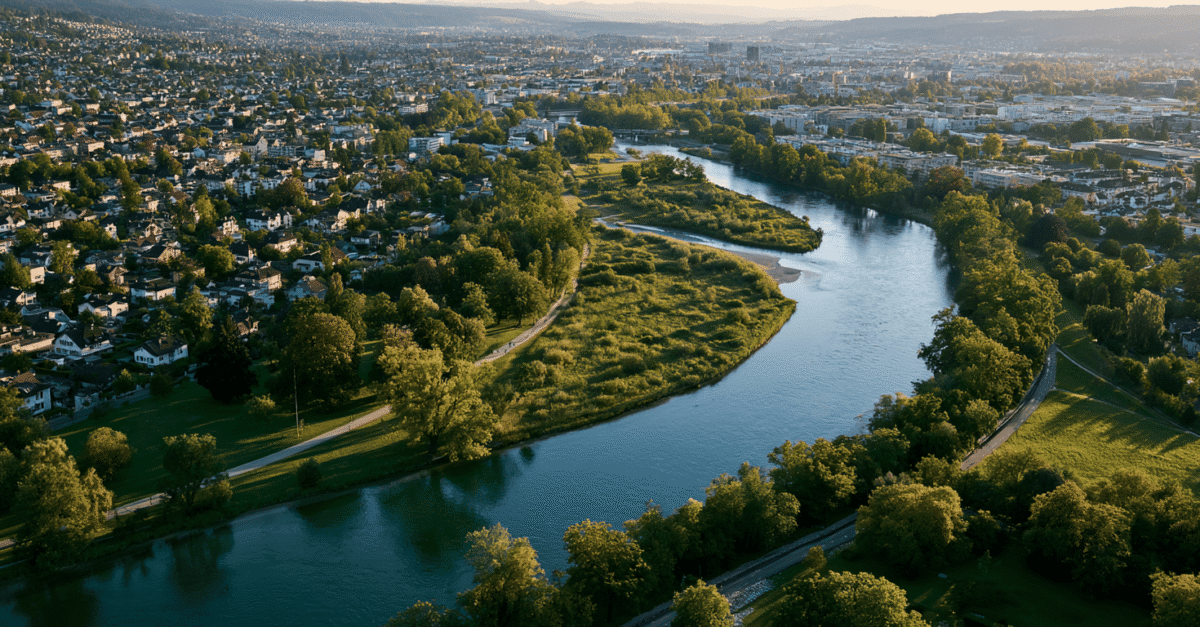
At its core, the project involves the revitalization of a 3.2-kilometer stretch of the Limmat River between the city limits of Zurich and the Überlandstrasse bridge near Dietikon. According to the canton, this is set to become the most significant urban river revitalization project ever implemented, with completion scheduled for fall 2033. Plans include nature zones, mixed-use areas, and five local recreation zones in a valley that has become heavily urbanized in recent decades.
More space, more protection, more potential for conflict
The project aims to address multiple long-standing issues at once. The straightened Limmat has lost habitats, while the existing floodwall is considered in need of renovation and at risk in the event of a flood. A drainage system with a pumping station will therefore also be added in Betschenrohr. This is relevant for property owners, planners, and local municipalities because revitalization here is not merely a matter of landscape policy, but rather a hydraulic engineering project with direct consequences for land use, infrastructure access, and protective infrastructure.
Contaminated Sites Drive Up Costs
The costincrease is particularly contentious. As things stand, the canton estimates that planning and implementation will cost around 95 million Swiss francs. The separate disposal of contaminated soil in the Betschenrohr alone will cost around 13 million Swiss francs. Contaminant levels detected there have altered the initial situation since 2024. Added to this is the drainage pumping station as a new cost item. The project is to be financed largely by the canton and the federal government, with the federal government expected to cover at least half of the costs.
Betschenrohr Remains the Sticking Point
In addition to the costs, the issue of land use is a major point of contention. Approximately 20 hectares of land are needed for the project, including part of the Betschenrohr community garden area. The city of Schlieren is simultaneously working on a plan to ensure that affected gardeners can continue to use the area for recreational purposes as much as possible. Investigations into additional space on adjacent land are underway. The project also includes plans for an observation tower and the separation of pedestrian and bicycle traffic.
The timeline remains lengthy. The permitting process, expected to last until mid-2028, will be followed by planning and construction preparation; the construction phase is scheduled from mid-2029 to mid-2033. This is precisely why the current public review is more than just a formal step. It demonstrates just how costly, politically sensitive, and land-intensive urban revitalization becomes when flood protection, contaminated sites, and recreational demands must all be addressed simultaneously.