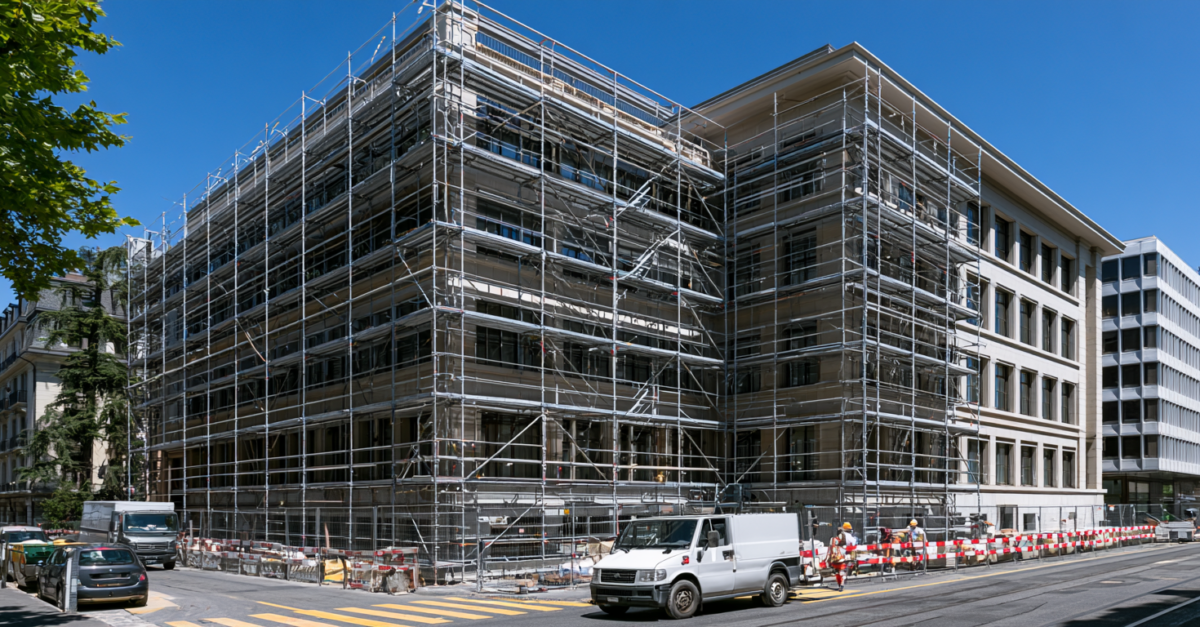

Geneva is significantly stepping up the energy-efficiency refurbishment of its cantonal building stock. Around 300 prioritised government buildings are to be refurbished by 2038. CHF 1.25 billion has been earmarked for this purpose. The canton is deliberately focusing the programme on those properties that consume the most energy and therefore offer the greatest potential for reducing CO₂ emissions.
This move is significant for the construction and property sectors because it transforms a climate target into a long-term, plannable investment programme. The selected projects will run over thirteen years and are expected to generate an average of around 80 million Swiss francs per year. The programme primarily concerns the public building stock, including educational facilities, administrative premises and healthcare buildings.
Schools are the focus
According to available data, around half of the programme relates to educational buildings. More than 117 school and higher education buildings are listed. For Geneva, this means a wave of refurbishments across a building stock that is heavily used on a daily basis and where technical upgrades are often difficult to carry out whilst the buildings remain in use. Some major works are not scheduled to begin until 2030, whilst smaller measures will start earlier.
The canton manages more than 1,700 buildings with a total floor area of around 2 million square metres. The 300 projects now prioritised account for around 90 per cent of this building stock’s energy consumption. In addition, individual properties that exceed regulatory thresholds for heat consumption are being included. The focus is primarily on building envelopes, technical installations, heating systems, energy efficiency and, in some cases, comprehensive refurbishments.
New management structure for a large building stock
To ensure the programme does not fail due to a lack of processes, Geneva established a dedicated directorate for the ecological transition programme within the cantonal building authority at the start of 2026. Its role is to prioritise, standardise and manage implementation across numerous individual projects. This is more than just an organisational adjustment. For the purposes of tendering, planning and construction, it transforms scattered individual projects into a consolidated portfolio with standardised procedures.
For the industry, this is precisely the crucial point. A refurbishment programme on this scale generates not just individual contracts, but a demand for planning, building analysis, site management, building services, building envelope refurbishment and construction capacity that will be visible for years to come. At the same time, Geneva demonstrates that climate policy for existing buildings is increasingly driven by prioritisation: not the entire building stock is being renovated at once, but rather those properties with the highest energy consumption, the highest emissions and the greatest need for adaptation to heat.
Renovation rather than tokenism
The political framework is clear. The cantonal climate plan aims to reduce direct greenhouse gas emissions by 60 per cent by 2030 and to achieve net zero by 2050. In the building sector, this involves not only replacing fossil-fuel heating but also ensuring the existing building stock is capable of coping with more frequent heatwaves. Geneva combines both aspects, turning climate adaptation, energy efficiency and public building practice into a single investment programme.
Ultimately, it is implementation that counts. If standardisation, tendering processes and alternative solutions work for the users affected, Geneva can turn a political goal into a robust renovation programme. If this coordination fails, the conflict of objectives between the pace of climate action, construction capacity and operational disruption will persist.