

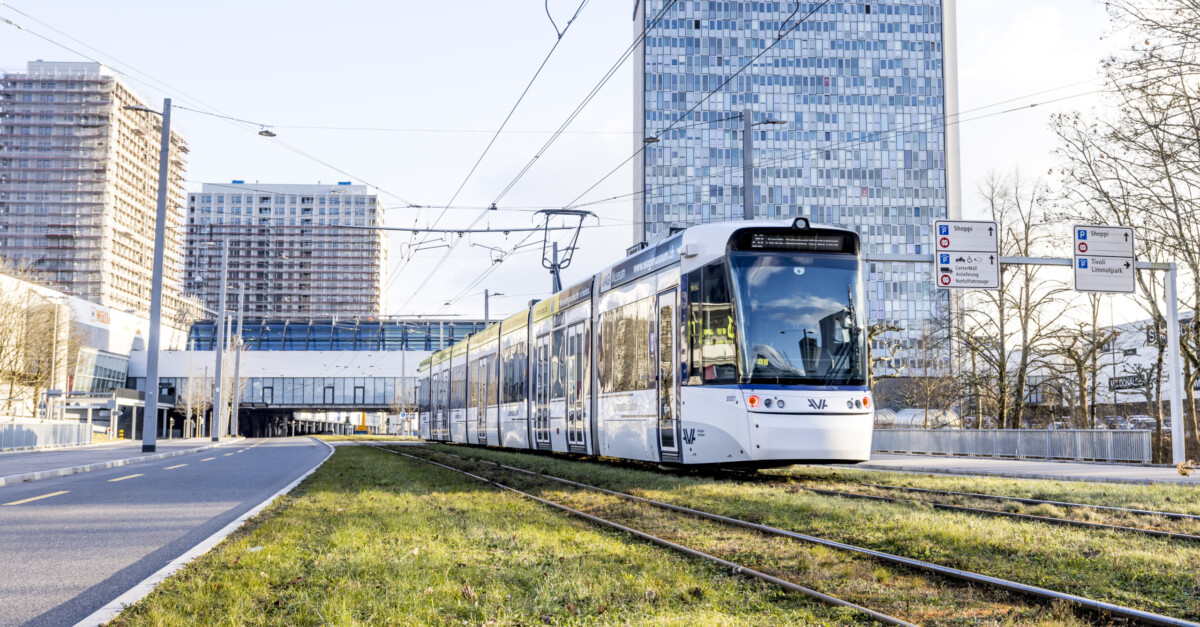
In its first year of operation in 2023, 5.7 million people travelled on the Limmattalbahn. In 2024, the figure rose to 6.1 million, and by 2025 it had already reached 6.5 million. This growth of over twelve per cent in three years is no coincidence, but the result of a railway that stops where people in the Limmat Valley live and work. Dietikon Station, Schlieren Centre and Zurich Altstetten top the list of the most frequently used stops. All three are direct interchange hubs with the S-Bahn network.
The bumpy start
The roll-out did not go entirely without a hitch. During the first few months of operation, the traffic light control system and vehicle technology required fine-tuning. More serious were two collisions in the spring of 2024 in the Spreitenbach area. One of the eight Stadler Tramlink trams subsequently spent a year and a half in the workshop. Those responsible responded decisively with adjustments to the infrastructure and signalling systems, as well as targeted training. The result is clear: 23 accidents in 2023, 15 in 2024 and just 5 in 2025.
Technology that thinks for itself
The Tramlink vehicles from Stadler Valencia are no ordinary trams. As bidirectional vehicles, they do not require turning loops, which saves space and keeps operations flexible. Because the route was also used by the VBZ during the first phase, the vehicles are capable of operating on two different voltages. All stops are fully accessible, modernly equipped and also suitable for visually impaired passengers.
What’s next
The 15-minute service interval has proved its worth. However, the Limmat Valley continues to grow. New neighbourhoods in Schlieren, Dietikon and Spreitenbach are attracting residents and businesses. Demand is set to rise. An expansion to a 7.5-minute service frequency is planned, but this will require the procurement of additional vehicles. Anyone familiar with developments to date will have little doubt that this step will be taken. The question is not ‘if’, but ‘when’.
Text: Christoph Grüninger • Image: Aargau Verkehr
The railway that nobody wanted but everyone needs
More Articles

Zurich’s development volume jumps to 450 million
With the acquisition of Lebensraum Schweiz, Admicasa is significantly scaling up its property development business in the Greater Zurich area. According to the company, the agreed transaction involves projects worth…

Renens gives construction waste a new lease of life
At the Les Palettes site in Renens, excavated material from building sites is processed into fertile substrate. The project utilises 7,000 square metres of a development site that has been…
Wädenswil is increasing its density without displacing residents
On Neudorfstrasse in Wädenswil, a housing estate is set to expand from 103 to around 160 flats, without the existing tenants having to move out. The plans include extensions, refurbishments…

Cardada is on the verge of being excluded from the building zone
Cardada and Colmanicchio are once again coming under pressure, despite the fact that local planning regulations have already been tightened. The Ticino State Council does not intend to approve large…
Zurich clears 4,000 flats from the ISOS backlog
In Zurich, a major obstacle to housing construction is being removed. On 18 September 2026, the Federal Council amended the rules governing the application of the ISOS and brought them…