The material that thinks – without a brain
Steel bends, rubber stretches, materials always react to forces in the same way. Until now. Researchers at the University of Amsterdam have developed a metamaterial that learns, forgets and adapts flexibly, without a central brain or program code. The study was published in "Nature Physics" and marks a paradigm shift in materials science.
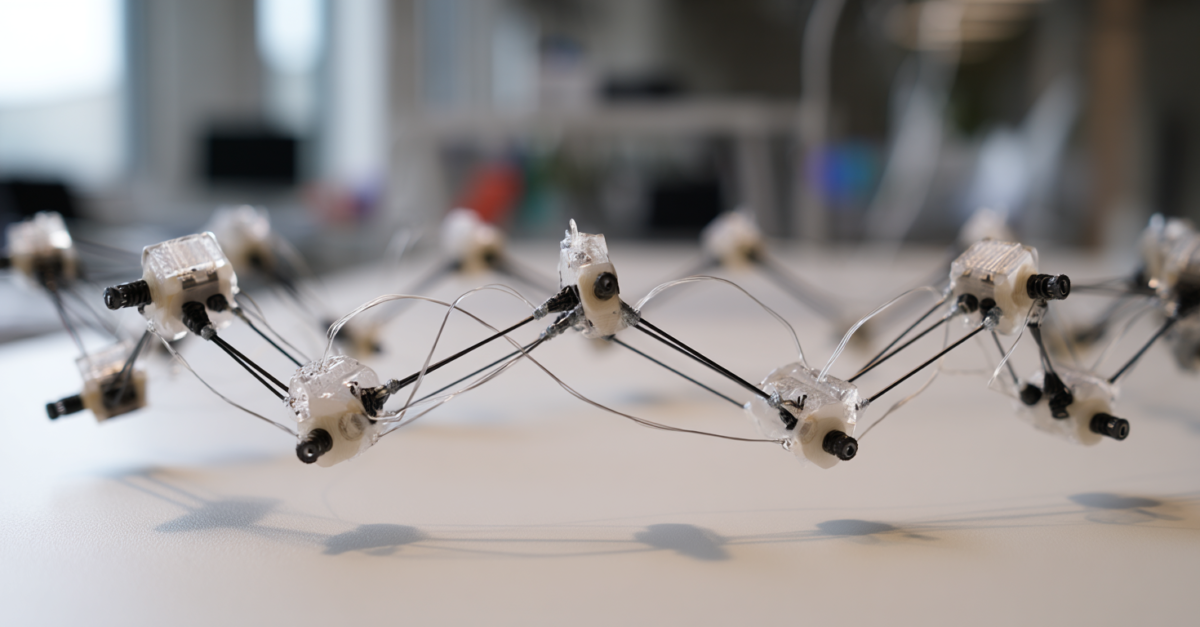

The material consists of a chain of identical joints connected by an elastic framework. An integrated microcontroller measures the current position, stores past states and exchanges information with neighboring elements. The overall behavior results from the interaction of many simple units. Just like simple organisms that react to their environment without a complex brain.
Learning through repetition
Individual joints are moved into defined positions and the remaining elements are gradually moved into a target structure. The microcontrollers adjust torques in several runs, called “epochs” in the experiment. Stiffness and interactions within the structure change. The “information” is not outsourced to software, but stored directly in the physical structure. First author Yao Du sums it up: “As soon as the system starts to learn, the possibilities of where it can develop seem almost limitless.”
Three abilities in one
The system masters three properties that were previously reserved for biological systems. It learns new reaction patterns to defined inputs. It stores several states simultaneously and switches between these states depending on the input. Previous work by the laboratory had already shown that such structures can move without central control. What is new is the adaptability, as the material chooses its form of movement depending on the environmental stimulus.
Fields of application and next steps
The research team sees the greatest potential in adaptive components that adjust to changing loads, in soft robotics without central control and in systems for unstructured environments such as exploration. From August 2026, research in Amsterdam will be expanded in collaboration with the Learning Machines group. The Dutch research agenda NWA 2026 will dedicate a separate focus to adaptive materials. In addition to technical issues, the focus will also be on control and safe use.
The boundary between material and machine is becoming blurred
Instead of passive materials, adaptive systems are being created whose properties actively change. In the future, time-dependent behavior and the handling of uncertain conditions, so-called stochastic scenarios, will be integrated. This increases robustness and makes the technology suitable for real application environments. Intelligence is not created through central control, but from the interaction of many simple elements.