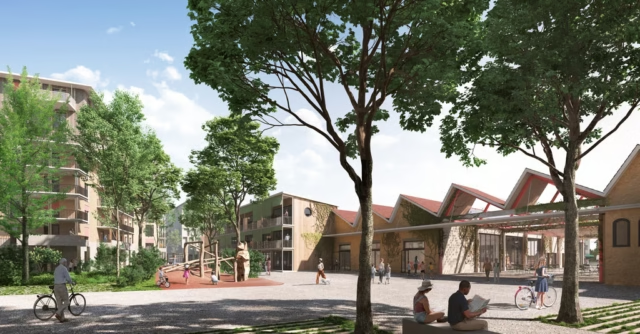
The model projects are seen as a field of experimentation for municipalities, regions and private organizations that want to tackle current challenges with new methods. These include an ageing population, housing shortages, a lack of space for sport and exercise, the decline in biodiversity and gaps in basic services in rural areas. What is needed are bold, directly implementable projects whose experiences can serve as a model for other regions. This funding instrument has been in existence for 25 years and is now supported by nine federal agencies from four departments under the leadership of the Federal Office for Spatial Development ARE.
33 projects, six thematic priorities
33 projects were selected for the 2025-2030 program generation and allocated a total of CHF 4.274 million. In addition to financial support, the projects will receive technical support and assistance with knowledge transfer, especially if solutions prove successful. The projects are divided into six thematic priorities.
- Strengthening central functions in rural and mountain regions
- Improving the quality of life through biodiversity and attractive landscapes
- sport and exercise-friendly settlement planning
- more sustainable regional food systems
- sustainable housing through conversion and transformation of existing buildings
- Co-creation of local services
Broad federal sponsorship
In addition to the ARE, the Federal Roads Office, the Federal Office for the Environment, the Federal Office of Public Health, the Federal Office of Culture, the Federal Office of Sport, the Federal Office for Agriculture, the Federal Office for Housing and the State Secretariat for Economic Affairs are involved. These federal agencies contribute their expertise and ensure that successful model projects also have an impact on other regions and programs. Some earlier projects have already been recognized with prestigious awards such as the Wakker Prize. The new projects will start at the beginning of 2026 and are intended to show how sustainable spatial development can be shaped on the ground.