Old technology rethought
Earth as a modern building material? What sounds like the past is in fact the future. Rammed earth is making a remarkable comeback in architecture and research. Now supported by robotics and new design concepts. The combination of ancient knowledge, sustainability and high-tech makes clay a symbol of a building revolution that rethinks earth, energy and aesthetics.
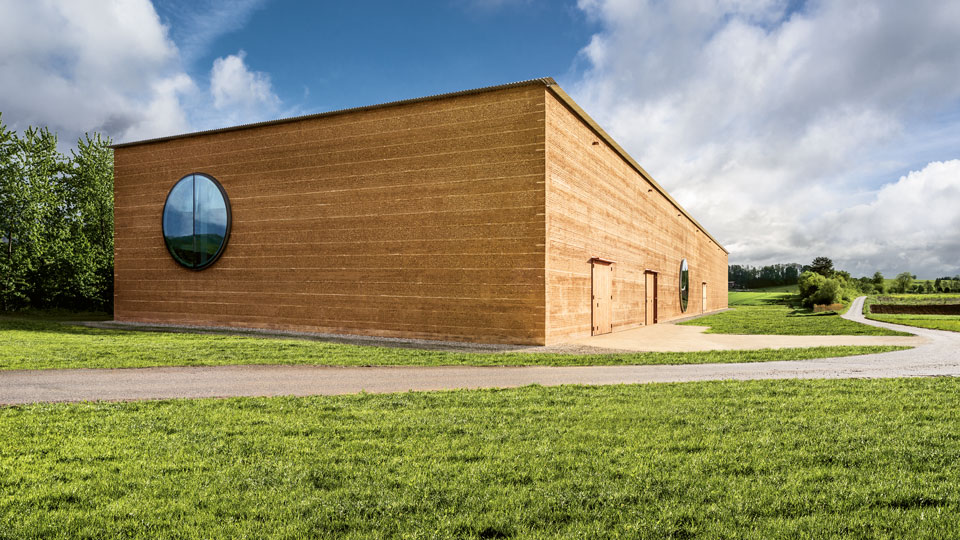
Foto: Ricola Group AG, Laufen
When you think of modern construction today, you see glass, concrete and steel. But a building material that has existed for thousands of years is making a powerful comeback: rammed earth. Entire cities, castles and temples were built from it in the past and many of these structures are still standing today.
Rammed earth combines regional raw materials, circular use and a healthy indoor climate. It stores heat, balances out moisture and requires hardly any energy to produce. The building material thus responds to key requirements of the building revolution, resource conservation, climate protection and healthy living.
Joschua Gosslar from the Institute for Structural Design at TU Braunschweig speaks of a “renaissance of clay” that combines traditional craftsmanship with technical precision.
How rammed earth works
Rammed earth is made from clay, sand, gravel and water. This mixture is placed in layers in a formwork and compacted. This used to be done by hand, but is now often done by machine. The result is solid, layered walls with a high heat storage capacity.
Thanks to its diffusion-open behavior, the building material contributes to a balanced indoor climate. Without structural weather protection, however, clay loses its strength. Large roof overhangs, water-repellent plaster or structural separations are therefore essential.
Research projects such as HyRaEarth are working on permanent solutions to combat susceptibility to moisture, for example through environmentally friendly hydrophobic coatings.
Robotics on the construction site
The processing of rammed earth is complex with many work steps, high manual labor intensity and long construction times. Researchers at TU Braunschweig are therefore developing a robotic production unit that applies rammed earth walls additively. Layer by layer, precisely and without conventional formwork.
The system combines a moving formwork with a compaction unit that automatically moves upwards. The aim is a mobile production unit that works on site with excavated material. “Clay is completely reversible,” explains Gosslar. “It can be reused after a hundred years as a building material for a new house.”
The research thus transfers the principles of 3D printing to clay and earth construction, creating the basis for industrial yet handcrafted construction methods.
International pioneering projects
Architectural firms around the world are demonstrating what can be created from earth. Casa Franca in Paris was compacted with 550 tons of excavated earth to create load-bearing walls that make air conditioning systems superfluous. The Bayalpata Hospital in Nepal used local clay, reducing construction costs by 40 percent and strengthening the regional building culture. The Ricola Herbal Center in Laufen by Herzog & de Meuron used prefabricated rammed earth panels, combined with photovoltaics and modern building technology. A residential building in Desert Wash Home, USA, is topographically integrated into the natural watercourse.
These projects prove that earth is no longer a niche material, but has arrived in contemporary building construction worldwide.
Technical values and standards
The material performance of rammed earth is now well documented. Its bulk density is between 1,700 and 2,400 kg/m³ and its compressive strength is between 1.5 and 2.5 N/mm² – individual tests reach up to 10 N/mm². These values make it structurally stable, but require new calculation methods, as the modulus of elasticity is significantly lower than that of concrete.
Earthen buildings are legally regulated by the DIN 18940 to 18948 series of standards and the earth building rules of the Dachverband Lehm. They ensure product quality, but also restrict application.