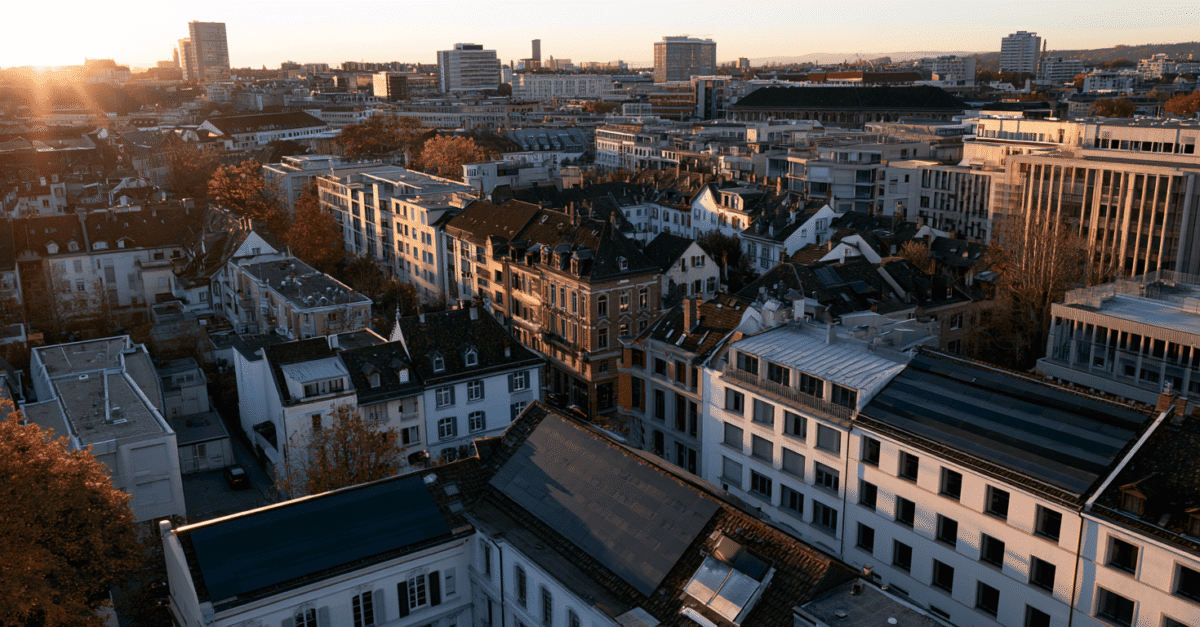

The Cantonal Government had already referred the revised bill to the Grand Council in 2025. The central provision remains the obligation for existing buildings with a suitable roof area of more than 100 square metres to generate their own electricity. A 15-year transition period is envisaged for these buildings. Subsidies and simplified approval procedures are intended to support the expansion.
For property owners in Basel-Stadt, one thing in particular has now become clearer. Politicians now want to make the installation of solar panels on roofs mandatory, without further lowering the threshold for smaller existing roofs. It was precisely this expansion that was controversial in the committees, but, according to the latest indications, it did not gain acceptance.
40 per cent remains the target
The canton estimates the solar power potential on roofs and façades at around 40 per cent of the canton’s current electricity demand. According to the cantonal government, the subsidies for photovoltaics are to run until 2040, that is, until the mandatory requirement for existing buildings comes into force. For the property sector, this increases the pressure on owners to align renovations, roof utilisation and investment cycles with the new requirement at an early stage.
Air-conditioning systems excluded from the package
For the time being, a relaxation of the rules on air-conditioning systems is not part of the solar initiative. A motion by Daniel Seiler on the liberalisation of air-conditioning systems was on the agenda of the Grand Council on 11 November 2026. This issue, which is relevant to both heat management and building operations, is therefore being dealt with separately, even though self-generated solar power would, in political terms, actually bring the operation of such systems closer to the energy debate.
Basel is thus separating two closely linked issues for owners, property managers and planners. The expansion of photovoltaics is being put into concrete terms, whilst the rules on summer heat protection and technical cooling remain, for the time being, caught up in the existing political dispute. Anyone planning roofs, building envelopes or major refurbishments must therefore already factor in the solar obligation today, whilst for air-conditioning systems they must continue to anticipate separate procedures and new legislative initiatives.