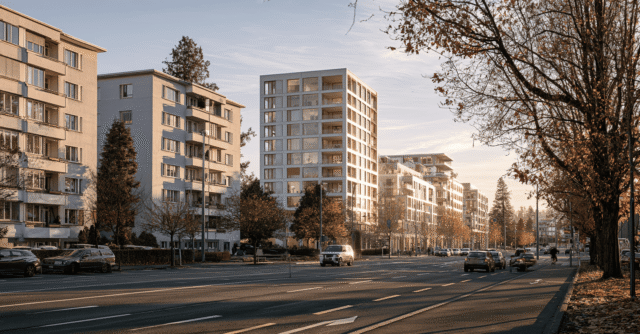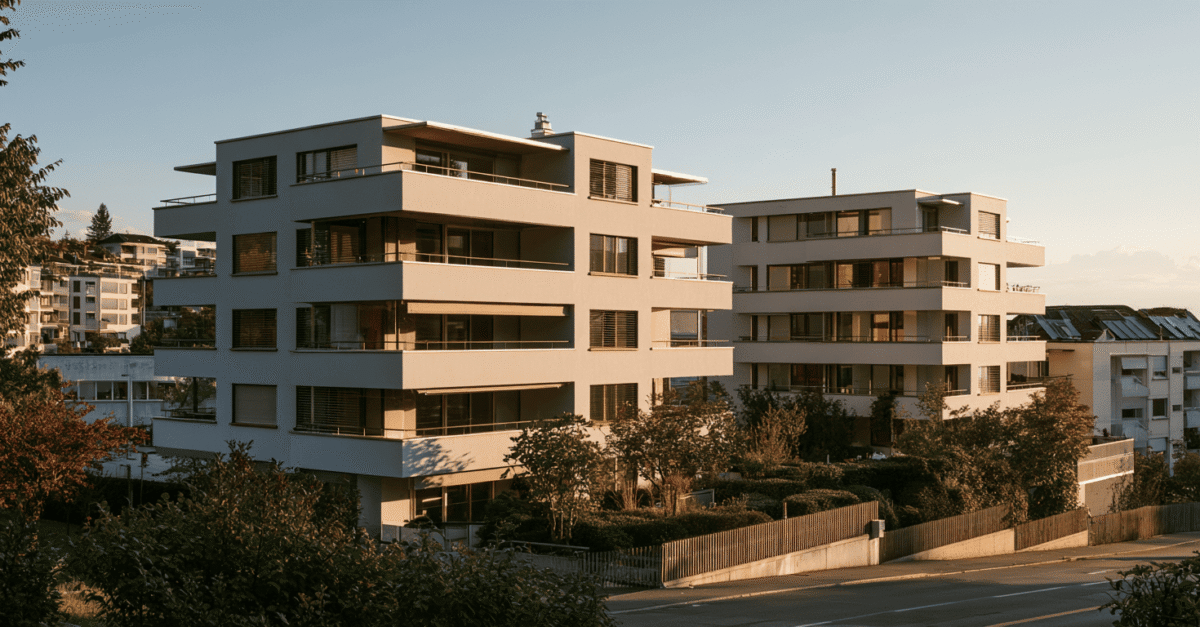

On 26 August 2026, the Hünenberg Municipal Council adopted the new letting guidelines for council housing. They will come into force on 1 October 2026 and are due to be applied for the first time to the flats in Maihölzli from January 2027. Anyone wishing to secure a subsidised flat there must prove that they have a connection to Hünenberg, either as a place of residence or work.
This marks a further consolidation of a housing policy in the canton of Zug that increasingly reserves affordable flats for the local population. The Zug cantonal government explicitly lists this preferential treatment as a measure in its Housing Policy Strategy 2030. In parallel, legislative work is underway through which the canton aims to ease pressure on the housing market and facilitate more affordable housing.
Subsidised housing stock is being reorganised politically
In the canton of Zug, around 1,900 flats are subject to the Housing Promotion Act. As regards rent subsidies, tenants are already required to have lived or worked in the canton for at least three years. With rules such as those in Hünenberg, this principle is shifting ever more strongly from financial support to the actual allocation of flats. This initially affects the subsidised housing stock, but can clearly be interpreted as a significant political signal.
The canton is considering the next step
The Housing Policy Strategy 2030 identifies giving priority to the local population not merely as an idea, but as a concrete measure. In September 2026, the Cantonal Government also submitted a partial revision of the Planning and Building Act for consultation. This is intended to enable regulations prioritising the local population through planning agreements. For investors, developers and local authorities, it will therefore be crucial to determine how far such requirements will extend in future beyond council or subsidised housing.
Monaco highlights the downside
The comparison with Monaco is not a ready-made model, but a stark warning. There, a protected rental sector coexists alongside a largely free market. It is precisely this dichotomy that can exacerbate price differences, restrict access for newcomers and increase pressure on the free market segment. This is particularly relevant for Zug because the canton is experiencing strong economic growth and its housing market is already among the most expensive in Switzerland.
Extending the scheme to private projects is a delicate matter
As long as priority remains limited to council or subsidised housing, the state primarily controls the allocation of a clearly defined segment. However, there has long been political debate as to whether local ties should play a greater role in future in new developments by private developers. It is precisely in this context that a social allocation rule would amount to a significant intervention in letting, development and investment logic.