Circular building with reeds
On Lake Neusiedl, a detached house with a thatched roof shows how circular construction can be achieved with local, regenerative materials. The building combines architectural quality, ecological responsibility and pioneering work for natural building materials in new construction. With appeal far beyond Burgenland.
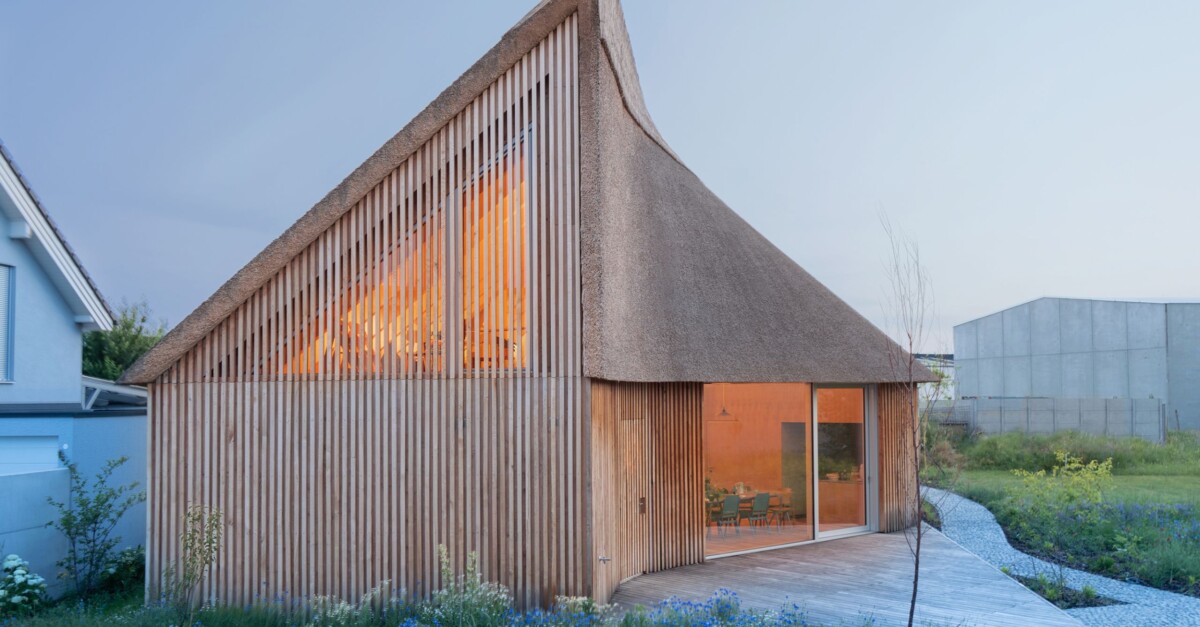
The residential building by Marina Rosa and Jacobus van Hoorne, designed by Gilbert Berthold, architect and research assistant at BFH, deliberately stands out in a single-family housing estate on Lake Neusiedl. It combines a consistent timber construction with a striking thatched roof and thus relies on local, renewable raw materials with a low ecological footprint. The numerous awards, from the client prize of the Central Association of Austrian Architects to the architecture prize of the province of Burgenland and the newcomer prize “House of the Year”, underline the exemplary character of the project.
Reeds as a high-performance building material
Jacobus van Hoorne, originally a particle physicist at CERN, took over his father’s reed cutting and thatching business and developed it into an innovation laboratory. Together with Berthold, he developed a roof structure that met strict fire protection requirements and was officially approved through real fire tests. A milestone for reed in new buildings, even in densely populated areas. The gently curved roof surfaces follow the material logic. Each additional degree of inclination extends the service life of the roof, the construction makes the qualities of the natural material visible and legible.
Geometry, material and space as a unit
The floor plan of the house follows an S-shape resulting from the rotation of the central living space. At its heart is a two-storey, light-flooded atrium that opens onto the garden and is closely linked to the outside space via terraces. Compactly organized functional spaces create scope for spacious recreation areas. The interplay between the thatched roof and the natural oak façade connects the building and the landscape. The roof becomes a design-defining element and a contemporary interpretation of traditional craftsmanship.
Real-life laboratory for bio-based materials
For Gilbert Berthold, the project marked the start of his self-employment and at the same time a real testing ground for sustainable construction. Today, the house serves as a home, study object and exhibition space all in one. It provides data on energy efficiency, indoor climate and the long-term behavior of bio-based building materials. In the context of the BFH, it fits in with research into plant-based materials such as straw, flax, hemp and mycelium and shows that reeds can be used not only as an insulating material, but also in a leading architectural role.
Symbol of a regenerative building culture
The project illustrates how circular building with regional resources can already be implemented today. It shows students and professionals that regenerative architecture is not a vision of the future, but a built reality. With reeds as a strong symbol for a building culture that rethinks nature, technology and society.