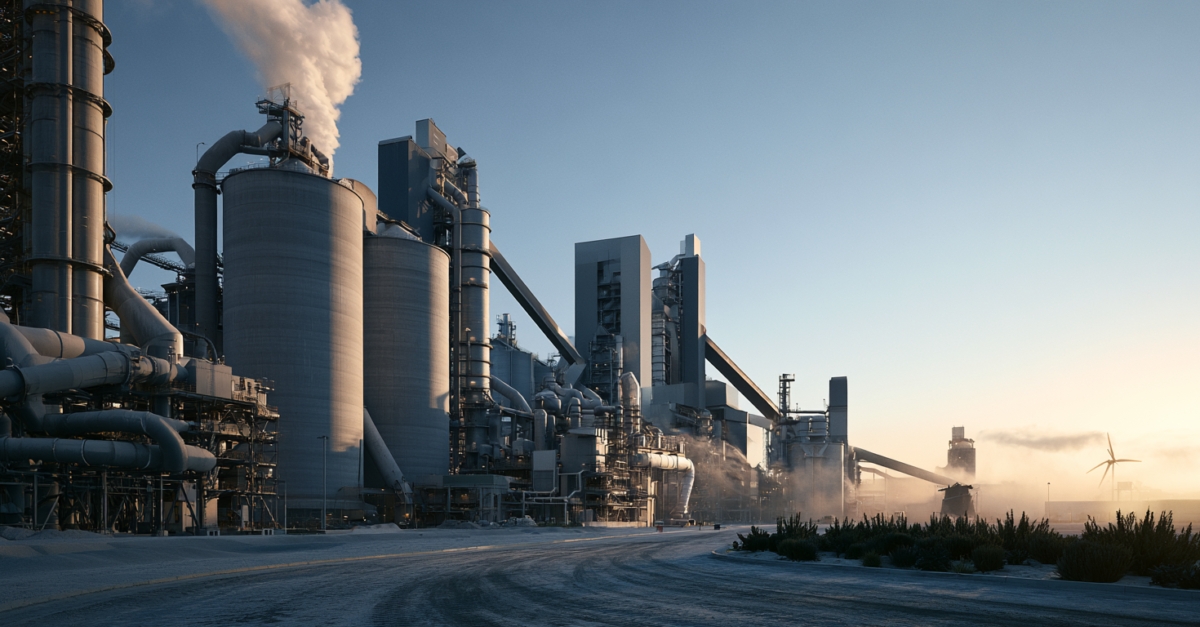

Approximately four billion metric tons of cement are produced worldwide each year. This production accounts for five to eight percent of global CO₂ emissions. Calcination is particularly problematic. In this process, limestone is heated to produce quicklime, a process that releases CO₂.
This is precisely where the ETH study comes in. It combines an established cement production process with Direct Air Capture, or DAC for short. The goal is not only to reduce emissions at the plant; the facility is also designed to remove CO₂ directly from the ambient air.
Lime Becomes a Cycle
The technology is based on calcium looping. Limestone is heated electrically and breaks down into quicklime and CO₂. Because the kiln is powered by electricity rather than coal or gas, there are no additional emissions from fossil fuel combustion. The CO₂ released during the process can also be captured directly.
The quicklime is then treated with water and exposed to air. In the process, it binds CO₂ again and reverts to limestone. The more frequently this cycle is repeated, the more carbon dioxide the plant can remove from the atmosphere. The captured CO₂ does not remain in the cement. It is compressed and transported to suitable underground storage sites. Under these conditions, a cement plant could even remove more CO₂ on a net basis than it emits throughout its entire process chain.
Electricity Is the Deciding Factor
The decisive factor is the energy supply. Direct Air Capture requires a lot of electricity. The ETH researchers therefore examined scenarios ranging from today’s U.S. electricity mix to a largely renewable system with solar power and battery storage.
The result is encouraging, but clearly contingent on certain conditions. With a highly decarbonized electricity supply, calcium looping plants could actually remove 85 to 96 percent of the captured and stored amount from the atmosphere on a net basis. For every metric ton of CO₂ permanently stored, 40 to 150 kilograms of CO₂ would still be emitted along the entire value chain.
From the Lab to the Plant
The approach is more than just a theoretical idea. The study was conducted in collaboration with the U.S. company Heirloom Carbon Technologies, which has been operating a commercial facility in California since 2023 with a capacity of approximately 1,000 metric tons of CO₂ per year. A significantly larger facility is planned for Louisiana.
For the cement industry, the appeal lies in existing raw materials and processes. Lime, calcination, and industrial kilns have long been part of production. The main new elements would be additional air contact surfaces, CO₂ capture, and electrically powered calcination kilns.
The potential requires proof of concept
The solution is not yet a sure thing. The results are based on scenarios extending to 2050. Indirectly heated electric calcining kilns are not yet in large-scale industrial use. The study also does not include a detailed analysis of economic viability.
Nevertheless, the ETH study sends a strong signal. The decarbonization of the construction industry need not end with merely lower emissions. If renewable electricity, CO₂ storage, and new industrial facilities work together, one of the largest emitters could become an active participant in climate restoration.