How researchers are turning concrete into a climate saver
Concrete is the most widely used building material in the world and one of the biggest climate offenders. A European research team with Empa and ETH Zurich wants to change this. The goal is not less concrete, but a printed, cement-free and even CO₂-negative building material that can be repaired and reused.
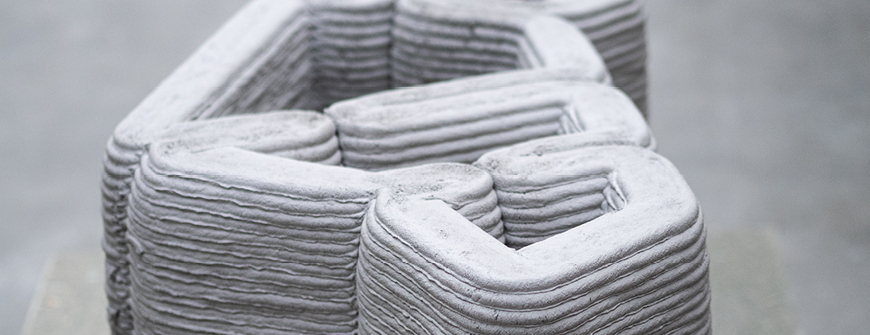
Photo: Empa
The EU project CARBCOMN, launched in 2024 and funded by Horizon Europe with around six million euros, is taking a radical approach. Instead of using more material, the researchers are optimizing the shape. The principle is called “compression dominant structures”: concrete components are designed in such a way that they are almost exclusively subjected to compression, similar to the arches of historic stone bridges. Concrete can withstand compression well, but hardly any tensile forces. If you make consistent use of this, you need less material and less reinforcement.
Printed, not poured
Digital production makes shapes possible that would be unthinkable with traditional formwork. The robot prints the concrete layer by layer and leaves cavities where no reinforcement is required, directly controlled by the digital model. This not only saves material, but also reduces the seismic load in proportion to the weight loss. This is a decisive advantage in earthquake-prone regions.
No cement, no problem
The concrete used in the CARBCOMN project contains no cement. Steel slag, a by-product of the steel industry, is used as a binding agent. After printing, the components are placed in a chamber in which CO₂ is injected. The reaction with the slag mixture hardens the concrete and permanently binds the greenhouse gas. The result is a building material with a negative CO₂ balance that is made exclusively from industrial waste.
Metal with memory
This concrete does not manage entirely without reinforcement, but with a specialty that Empa has been using for around 20 years: iron-based shape memory alloys (Fe-SMA). These pre-stretched metal rods contract during heating instead of expanding, thus subsequently pre-stressing the component. They are only inserted after printing, do not interfere with the automated process and can be separated from the concrete later. The Empa spin-off re-fer contributes this technology directly to the consortium.
Built for dismantling
What is built should also be able to be dismantled again. The individual concrete modules are designed as discrete blocks that can be detached, transported and reassembled elsewhere. Zaha Hadid Architects and Mario Cucinella Architects are working with the engineering teams to develop free-form structures that express this circular principle architecturally. By 2028, a real prototype will prove that concrete construction can also look like this.