How the Wolf site in Basel is becoming a residential neighbourhood
Where goods used to be loaded, hundreds of flats will be built in the coming years, complemented by commercial and public uses. The first architectural competitions have been decided. The winning projects "Janus" and "Binaria" show how dense residential construction can succeed despite road and railway noise, sustainability requirements and high social expectations.
The relocation of freight handling to the harbour area freed up a 16-hectare site near Basel SBB station. SBB has been pursuing the vision of a mixed neighbourhood here for years, combining living, working and leisure. The urban development plan is based on a design by Christ & Gantenbein and EM2N. The central element is a large courtyard that stretches from east to west, shields against noise and links public and private uses as a green boulevard.
Two faces “Janus“project
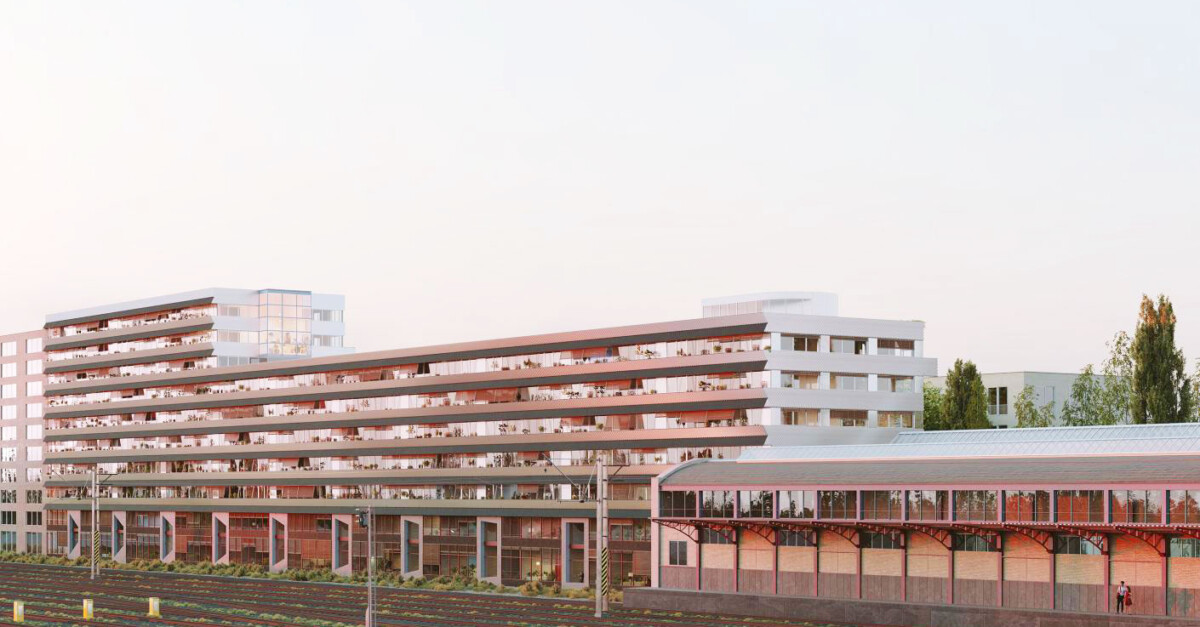
The Paris-based firm Experience, together with M-AP Architects from Lausanne, won the competition for the MF02 construction site. Their “Janus” project responds to the contrasts between the railway side and the inner courtyard with two architectural languages.
A horizontal ribbon façade with striking concrete frames stretches towards the track side, conveying a powerful image to passing trains. Towards the courtyard, a finely structured façade with staggered balconies and greenish decorated surfaces appears.
The construction method follows a hybrid approach of concrete skeleton and timber construction. The floor plans are compactly organised, with a clear separation between bedrooms, wet rooms and spacious living areas. Only the lack of privacy in the ground-floor flats was criticised.
Noise protection as a design element “Binaria” project
The “Binaria” project by Basel-based ARGE Parabase and Confirm won the competition for the MF03 construction site. It counters the street noise with a robust north façade made of reused trapezoidal sheet metal and protruding acoustic elements. In contrast, a transparent, green glass façade with balconies and plant troughs opens up to the courtyard side.
The multi-storey passageway connecting the courtyard and the street is particularly striking. The circular ventilation grille made of sound-absorbing panels makes a strong architectural statement here. Inside, linear floor plans allow for flexible living concepts from 2.5 to 5.5-room flats. Sustainability is characterised by reused beams, recycled concrete and re-used wood.
Pilot character with high standards
Both winning projects pursue innovative approaches to noise protection, the flexibility of the flat layouts and the use of recycled materials. The roofs are used for photovoltaics and rainwater management, the façades are partially planted or fitted with integrated solar technology. Energy is generated from renewable sources, while shading and evaporation provide thermal insulation in summer. Special attention is paid to reversible construction. Constructions are to be screwed together instead of glued in order to facilitate subsequent reutilisation or material cycles.
Milestones and prospects
The new buildings in the west of the site will be realised in the first stage, with construction scheduled to begin in 2028. A second stage with a city logistics hub and additional uses will follow from 2031. Even before completion, SBB will open the site for interim use. The listed 2,000 m² railway hall will be used for sports activities, for example. The Wolf site will thus become a pilot project for urban housing construction that answers questions about noise protection, sustainability and socially mixed housing on a large scale. For Basel, this is not just an urban planning experiment, but a decisive step towards more affordable living space and a higher quality of urban life.