Shanghai relocates Shikumen complex with robots
The Huayanli complex in Shanghai is the first time a 7,500-tonne historical ensemble in the Shikumen style has been relocated with the help of 432 specialized robots. The project combines technological precision, urban planning foresight and the protection of cultural identity in a remarkable way.
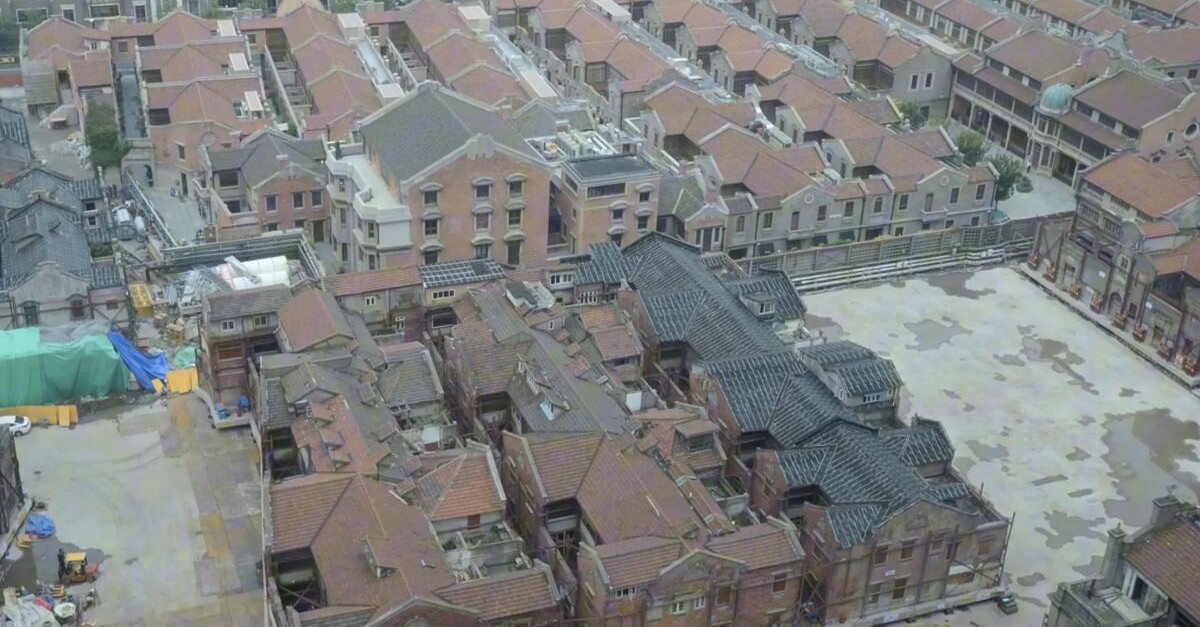
With this project, the city of Shanghai is demonstrating its ability to combine heritage conservation and urban development. The Huayanli complex, built between 1920 and 1930, is part of the Zhangyuan district, which looks back on over 140 years of history. With a total area of 4,030 square meters and three brick and timber buildings, it is not only architecturally significant, but also an important testimony to urban identity.
The temporary relocation is necessary in order to construct a three-storey underground facility of over 53,000 square meters. This will create cultural and commercial spaces, more than 100 parking spaces and connections to three subway lines. An ambitious project in a densely built-up historical environment.
Robot-assisted precision work in the historic core
Given the narrow alleyways and limited space, the construction team relied on a combination of advanced technologies and customized robotics. A total of 432 self-propelled robots move the ensemble at a speed of around 10 meters per day. A logistical masterpiece that enables minimal disruption with maximum precision.
In addition, miniaturized robots were used for foundation work, which move through narrow doors and corridors thanks to remote control. Supported by BIM and point cloud scans, precise 3D models of the existing building were created to identify potential collisions and structural challenges at an early stage.
Smart earthmoving and minimally invasive interventions
Another technical innovation is the specially developed earthmoving robots with foldable gripper arms. These can move in spaces less than 1.2 meters wide and use deep learning algorithms to distinguish between clay and obstacles. As a result, the construction project is progressing with high efficiency and minimal risk to the historic building, despite the cramped conditions.
Zhang Yi, General Manager of the Shanghai Construction No 2 subsidiary responsible for urban renewal, explains the approach: “We designed several curved transportation routes for the excavated earth and implemented a conveyor belt system like in a factory. This allows us to reduce disruption and achieve high working speeds at the same time.”
Linking old and new
The project is more than just a technical masterpiece. It exemplifies an urban vision that sees historical heritage not as an obstacle, but as a resource. Once the work is complete, the Huayanli complex will return to its original location. However, above a modern infrastructure that connects it to the surrounding high-rise buildings, shopping centers and residential districts. The integration of above-ground conservation measures with modern underground facilities offers a model for the sustainable revitalization of historic districts in growing metropolises. For Shanghai and for international urban planners and engineers, this project is a milestone. It shows how cultural identity and urban modernization can be combined to form a harmonious whole.