

People often talk about innovation in grand terms – about courage, inventiveness and competitiveness. Yet young businesses often fail not because of a lack of ideas, but because of a far more mundane question: where can they even begin? Where can they find premises that are accessible, remain affordable and allow for growth? Schlieren offers an answer that is as simple as it is effective. The town provides spaces where start-ups and established SMEs can come together in an innovative environment.
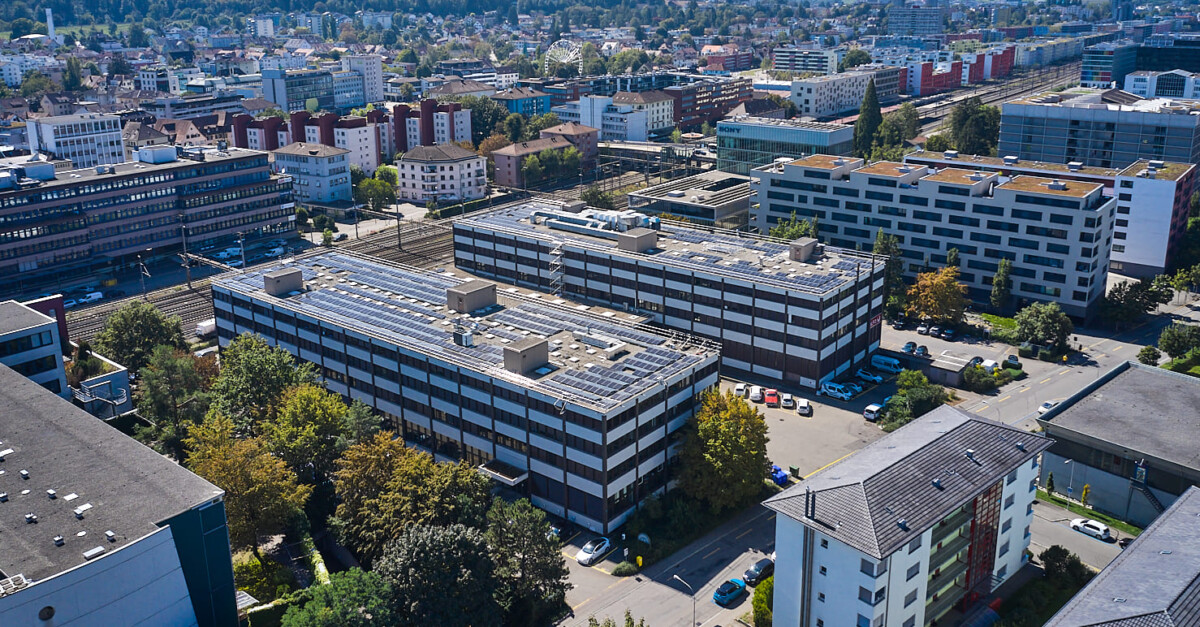
This is precisely where the strength of the Innovation and Young Entrepreneurs Centre (IJZ) lies. It is not an abstract support programme, nor is it a vague vision. It is a tangible place at Rütistrasse 12 to 16, just a few minutes’ walk from Schlieren railway station.
Location: an underestimated factor for success
In the start-up narrative, the focus is usually on founders and investors. Location often only comes into the picture later on. Yet it is crucial. Anyone wishing to attract talent, meet partners and welcome clients needs a location that works. The IJZ is situated near the station, where transport links, accessibility and urban energy converge.
The office and workshop spaces are available in various sizes, ranging from 50 to 1,500 square metres, and are currently 100 per cent let. Rental rates, depending on the fit-out, fall within the lower to mid-range per square metre per year, plus service charges and heating costs. For start-ups, this is not a minor detail, but a tangible location factor.
Schlieren understands what start-ups and SMEs need
It is not just the facilities on offer that are remarkable, but the philosophy behind them. Schlieren did not acquire the IJZ by chance, but built it up as a deliberate political initiative. The town recognised an opportunity for its economic strategy in underutilised commercial buildings in a prime location next to the railway station. In 2012, the municipal council approved the purchase of the properties; in 2013, the first companies moved in. By the time of its anniversary year, the town had invested a total of 22 million Swiss francs in the purchase price and interior fit-outs of the IJZ.
That is the real story. A city does not wait for innovation to spring up of its own accord somewhere. It creates the physical conditions for it. Not glossy facades. Not symbolism. But square metres in a market where precisely these square metres are often in short supply for start-ups.
Space turns into density
The figures demonstrate just how effective this model is. By its tenth anniversary, the IJZ comprised around 17,000 square metres, with 47 tenant firms and 420 workplaces. Around 70 per cent of the companies are active in research and development. Many of them are spin-offs from ETH Zurich or the University of Zurich.
When young companies work side by side, the result is more than just a collection of tenancy agreements. A dynamic ecosystem emerges. Alongside service providers and craft businesses, the IJZ is also home to organisations such as Start Smart Schlieren and the Healthtechpark Zürich-Schlieren. This fosters closer connections, shortens distances and strengthens a location that is positioning itself as a ‘Start-up City’.
The IJZ is part of a wider movement
Anyone who views the IJZ in isolation underestimates its impact. Schlieren has been systematically developing its business location for years. The location promotion initiative acts as an interface between politics, administration and business. It advises companies on setting up operations, arranges office and commercial premises, and develops strategies for underutilised sites. The IJZ fits perfectly into this framework.
This strategy is proving effective. The number of registered businesses has risen from around 650 at the end of the 1990s to approximately 1,440 today. The biotechnology and Startup City clusters have been further interconnected and strengthened. The IJZ is now home to over 57 start-ups and SMEs, providing more than 500 jobs. The demand for office and laboratory space in both clusters remains high.
Schlieren is not merely growing; it is learning to manage its growth. The town does not wait until the need for space becomes a problem before recognising it. With the IJZ, it has a tool at its disposal that meets demand, retains companies and channels development. An example of how location policy can have a major impact on a small scale.
Not hype, but craftsmanship
The IJZ does not peddle the romanticised myth of start-ups. It demonstrates something more down-to-earth – and therefore more valuable. Innovation requires administration, ownership, political decisions and land management. Precisely because public discourse so often relies on buzzwords, the Schlieren model seems almost provocative. It is concrete, it is transparent, and it is measurable.
Through the IJZ, the town of Schlieren does more than simply provide premises. It lowers the barrier to entry, ensures proximity to the railway station and brings young companies together in one place. It fosters an environment where research, entrepreneurship and growth can converge. Anyone wishing to know what local business promotion might look like in the 21st century will find no theory in Schlieren. Instead, they will find a working experiment with a clear direction.
A hub of energy for the future
The Innovation and Young Entrepreneurs’ Centre is also a powerhouse when it comes to energy. In 2022, a photovoltaic system with a capacity of around 350 kilowatts was installed on the roof, covering a significant proportion of the electricity requirements for the approximately 500 workstations. As early as 2021, the centre was connected to ewz’s district heating network. As a result, the heat supply is now largely based on renewable energy.
Text: Sabine Billeter • Images: City of Schlieren
Schlieren does what others talk about
More Articles

European fund collapses under pressure to redeem
Trading on the Swiss stock exchange has been suspended; delisting will take place on 23 October 2026. After two years of deferred redemptions, the fund management company has pulled the…
Wittenbach is set to gain 62 flats by autumn 2028
Construction has begun on the Widenbach development in Wittenbach. Four four-storey blocks of flats, comprising 62 rental flats built to the Minergie standard, are being built on the site. Around…
Thurgau incorporates new ESP into its regional plan
Thurgau is aligning its location policy more closely with spatial planning. An amendment to the structural plan is intended to enshrine economic development priorities for commerce, industry and services in…
Berlin is pushing its expropriation plans to the very limits of the law
Berlin is heading for a major housing policy initiative. The Left Party, the Greens and the SPD want to nationalise up to 160,000 flats owned by large corporations and cap…

New Anti-Money Laundering Regulations are increasing the pressure for compliance in sales
Since 1 October 2026, stricter anti-money laundering rules have also applied in Switzerland to certain advisory services relating to property transactions. For estate agents, trustees and notaries, the specific role…