Improve quality, streamline processes
Switzerland needs to grow inwards, but many building permit procedures take too long and are unnecessarily complex. What is needed is early cooperation between all parties involved, clear responsibilities and digitally supported processes so that high-quality inner-city development becomes a reality more quickly.
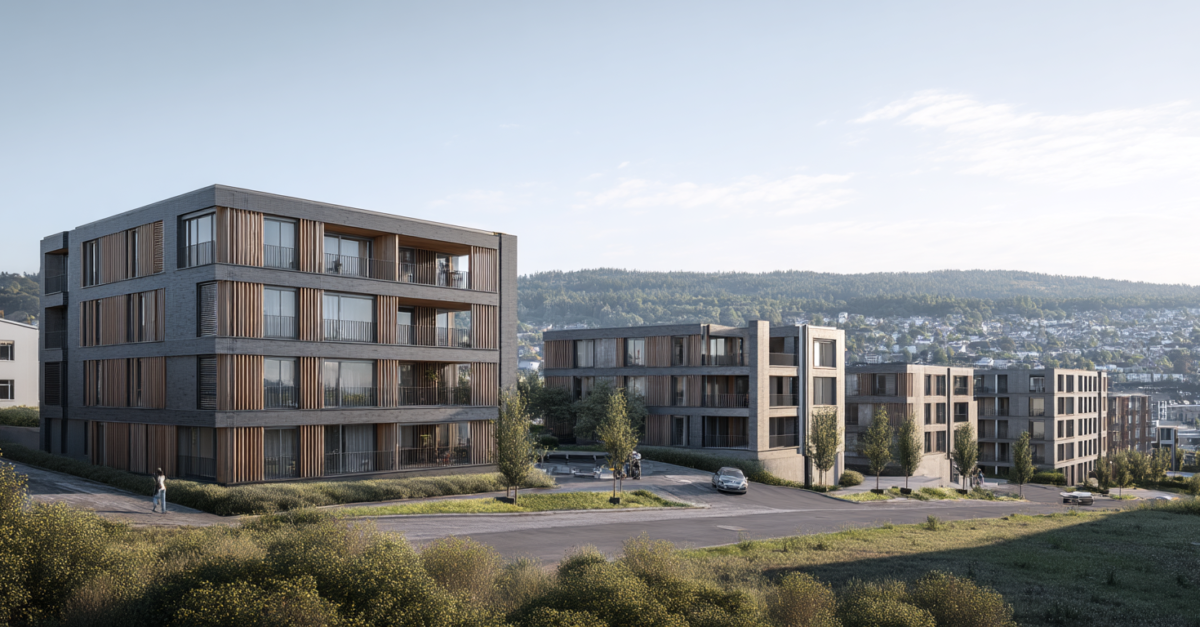

Since the revision of the Spatial Planning Act, economical land use has been the guiding principle, but in practice, procedures often remain slow and cumbersome. Interests clash, responsibilities are not always clear and objections can block projects for years.
Anyone who wants to promote inner-city development must therefore start earlier. Project sponsors, planners, authorities, politicians and implementers should enter into a structured dialog before the planning application is submitted. This allows conflicts to be clarified, quality to be defined and procedures to be geared towards a realistic target image from the outset.
Five factors for better procedures
Representatives of the federal government, cantons, municipalities and the construction industry have identified five success factors in a dialog lasting several years. It requires attitude, early and structured dialog, clear responsibilities, acceptance and everyday benefits of the projects as well as a clear strategic embedding.
What is often missing is less technical knowledge than consistent application in everyday life. Reliability between the stakeholders, the will to implement and tools that help to manage complex processes pragmatically. Corresponding work aids were presented at Swissbau in January 2026 and then made available online. As concrete support to “make building easier”.
Contribution of the construction industry
The construction industry is actively involved in the search for solutions. For example, as part of Federal Councillor Guy Parmelin’s housing shortage action plan and on the basis of studies by ARE and BWO. This work has resulted in a concept for a two-stage building permit procedure. The use and architecture are clarified first, followed by technical aspects and standards.
This model is to be accompanied by consistent digitalization throughout the entire process. The aim is to increase planning security, avoid loops, clarify interfaces and thus reduce both the duration of the process and the workload for everyone involved. The concept is intended as a basis for discussion and makes the industry’s perspective tangible for authorities, politicians and the public.
ISOS, townscape protection and municipal autonomy
Another focus is on dealing with ISOS as well as monument and townscape protection. In the dialogues at federal level, it was established that cantons and municipalities can deviate from ISOS conservation objectives when fulfilling their own tasks, for example in housing construction, if there are overriding interests. This strengthens the municipalities’ scope for action and facilitates local considerations.
An amendment to the ordinance is planned by fall 2026 in order to focus the direct application of ISOS on cases that are actually relevant to the townscape. At the same time, it is being examined how a new division of tasks between the federal government and the cantons could further develop the practice. A corresponding committee postulate from the National Council has been transferred. The construction industry is closely following this process and is calling for a sustainable balance to be struck between protection and development.
Fast, digital and high-quality approval procedures
The course is set: the industry is committed to leaner, digital and faster building approval procedures, with a clear focus on two-stage procedures, practical tools and reliable cooperation.
After all, Switzerland’s inner city development can only succeed if everyone involved pulls together. With transparent processes, clear responsibilities and projects that are both qualitatively convincing and create urgently needed living and working space.