New plant in Dübendorf produces renewable methane
The Swiss Federal Laboratories for Materials Science and Technology (Empa) has put the move-MEGA methanisation plant into operation. This is intended to improve the power-to-gas process by means of sorption-enhanced methanisation.
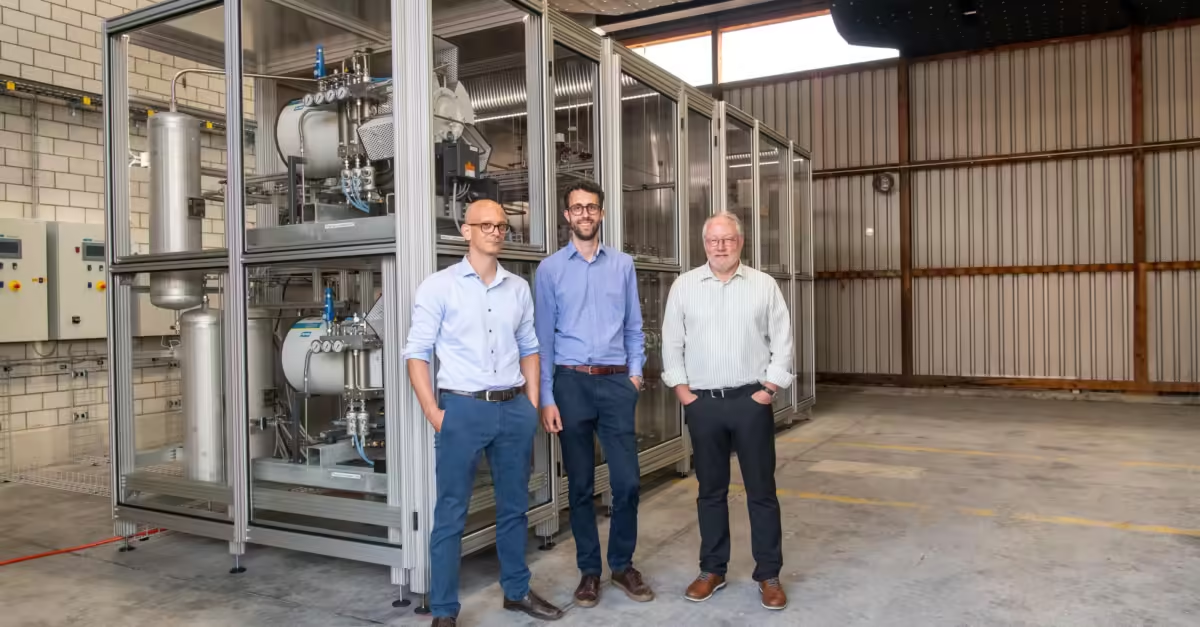
Empa has commissioned the move-MEGA methanisation plant in Dübendorf. The project demonstrates the sorption-enhanced methanisation developed by Empa and is intended to improve the power-to-gas process, as detailed in a press release. The plant demonstrates how solar power is converted into hydrogen using electrolysis and then processed into methane by adding CO2. The synthetic methane can be fed directly into the gas grid and replace fossil natural gas.
According to the press release, sorption-enhanced methanisation is central to the plant. Zeolite pellets absorb the water produced during the reaction and shift the chemical balance in favour of methane formation. As a result, the methane produced can be used directly or fed into the grid. “Thanks to sorption-enhanced methanisation and heat management, we achieve high sales and significantly greater load flexibility than with conventional processes. This makes the technology particularly attractive for direct coupling with photovoltaic or wind power plants,” explains move-MEGA project manager Florian Kiefer.
The use of CO2 from the ambient air for methanisation enables negative CO2 emissions through methane pyrolysis. The synthetic methane can be broken down into solid carbon and hydrogen downstream. The carbon is used in concrete or asphalt.
“Methanisation in conjunction with methane pyrolysis opens up a way to combine the supply of renewable energy with the permanent removal of CO2 from the atmosphere,” explains Christian Bach, initiator of the move-MEGA project and head of the Chemical Energy Carriers and Vehicle Systems department at Empa.
In addition to methanisation, the focus of the move-MEGA project is also on the use of the waste heat generated. The project is supported by the ETH Board, the Canton of Zurich, Glattwerk, Avenergy Suisse, Migros, Lidl Switzerland, Armasuisse and Swisspower.