Hot concrete from Pompeii
At an ancient building site in Pompeii, researchers have discovered evidence of a hot-mixing process for Roman concrete. The discovery strengthens the theory of self-healing concrete and contradicts the traditional description by the architect Vitruvius. With consequences for the understanding of ancient architecture and for future, sustainable building materials.
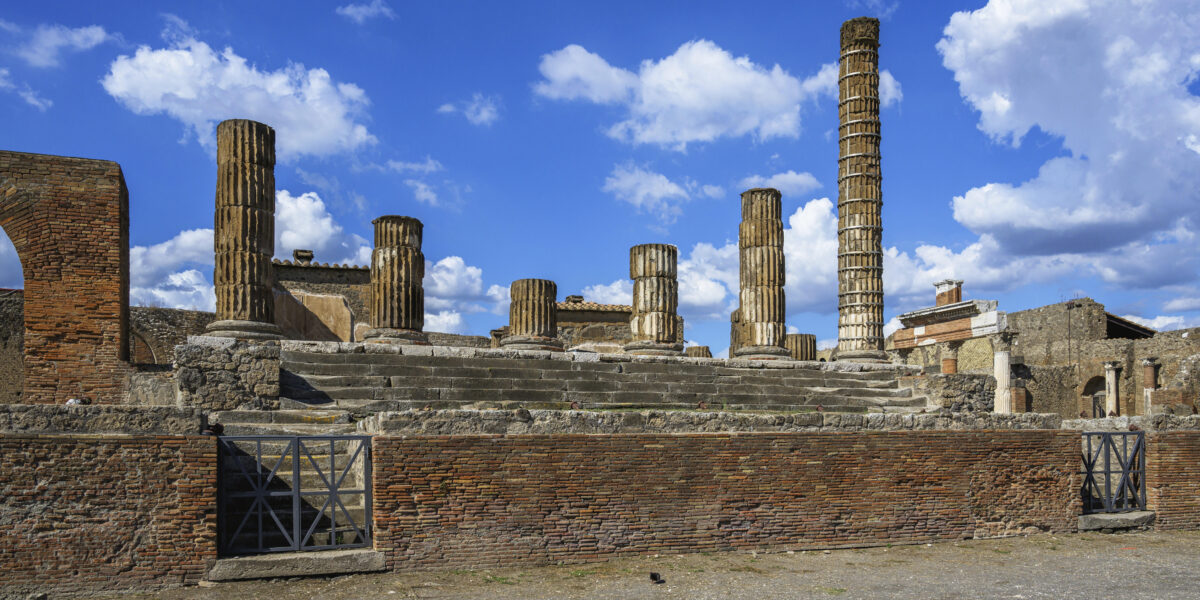
Foto: picture alliance / imageBROKER | Maciej Olszewski
Roman concrete forms the backbone of many structures from port facilities to aqueducts that have withstood wind, weather and earthquakes for over 2000 years. Admir Masic’s research group at MIT has been investigating for years why this building material is so exceptionally durable, based on chemical analyses of ancient mortar. As early as 2023, the team formulated the hypothesis that the Romans did not use lime as a ready slaked paste, but mixed it dry as quicklime together with volcanic ash and only then added water.
Pompeii as a preserved building site
The latest investigations are based on a unique site in Pompeii. A construction site “frozen” by the eruption of Vesuvius in 79 AD with half-finished walls, piles of material and tools. In samples from the pre-mixed dry heaps, from walls under construction and from finished components, the researchers found not only the familiar white lime clasts, but also intact fragments of quicklime in the dry mixture. This suggests that the slaking reaction, i.e. the reaction of the burnt lime with water, only took place during the actual mixing and hardening of the concrete and not beforehand, as described in classical accounts.
Contradiction with Vitruvius and how it is resolved
In the 1st century BC, Vitruvius described in “De architectura” that lime was first slaked with water and then mixed with aggregates. The hot mixing technique that has now been identified deviates from this in that the lime is combined with volcanic ash as quicklime in the dry phase and the water is only added afterwards. Isotope analyses of the mortars show the characteristic carbonation processes that match this process and differ from mortars with previously slaked lime. Instead of completely “refuting” Vitruvius, experts tend to interpret the findings in such a way that his description does not reflect the entire spectrum of Roman practice. Regional or temporal variations such as hot-mixing appear to have been more widespread than long assumed.
Self-healing concrete as a model for tomorrow
The hot-mixing process generates considerable heat when quicklime and water come into contact, trapping reactive lime particles in the concrete structure. If microcracks form later, these particles can dissolve again, react with penetrating water and fill the cracks again. A self-healing mechanism that plausibly explains the longevity of Roman buildings. The new findings are being incorporated into the development of modern, sustainable concrete. The aim is to reduce CO₂-intensive binder content, massively extend the service life of buildings and thus reduce the consumption of resources in the construction industry. All in the spirit of an ancient model that is only now being fully understood chemically.