Cooperative housing for new Basel city district
The Basel Housing Cooperative and Vivanta AG will implement the winning designs for two residential buildings with a total of 270 affordable flats on the SBB's Wolf site. The tender also placed particular emphasis on recyclability and ease of dismantling.
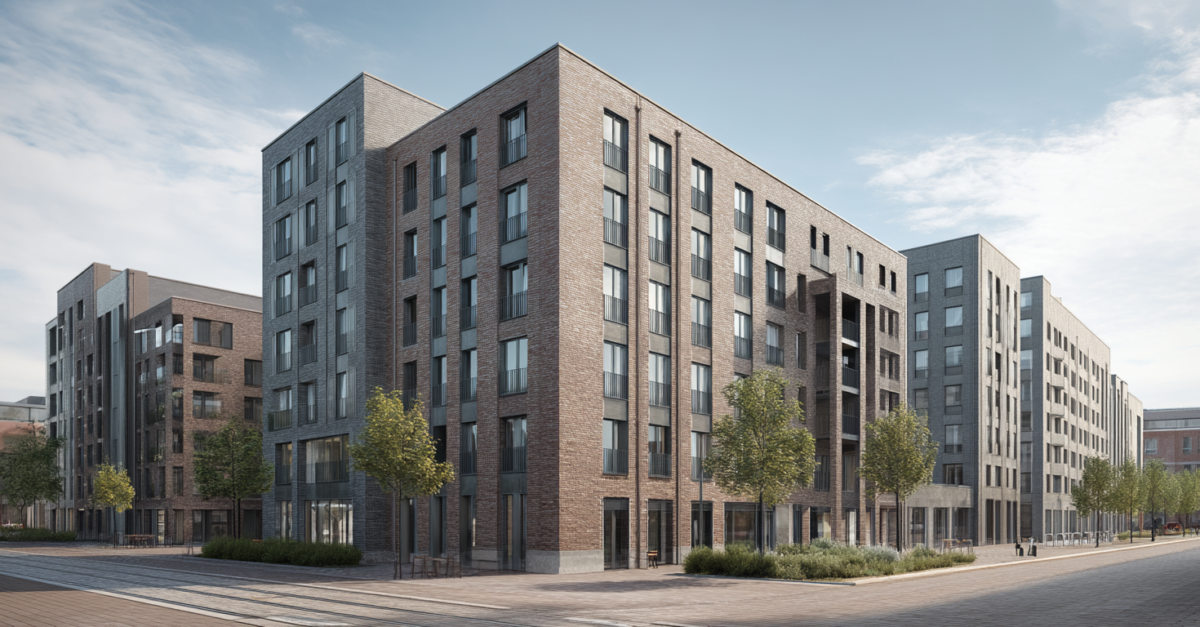

According to a press release, Basler Wohngenossenschaft (BWG)and Vivanta AG, a subsidiary of UTILITA Anlagestiftung für gemeinnützige Immobilien, will begin construction of two residential buildings on the Wolf site in Basel in 2028. They emerged as the winners of the competition in spring 2025 with a unanimous jury vote. Now, as the owner of the site at the former freight station, SBB has granted building rights for two construction plots. BWG plans to build around 150 cooperative apartments. Vivanta’s proposal envisages around 120 affordable residential units.
SBB is developing a new urban quarter on around 160,000 square metres of the Wolf site. The first stage of development will begin in 2028 with the two aforementioned buildings in the western part of the site. The winning project, Janus, by the architectural firms M-AP from Lausanne and Experience from Paris, will be implemented for the new MF02 building. The new MF03 building, with the project name Binaria, is the work of Parabase GmbH from Basel and Confirm AG from Zurich.
The jury reports for the two buildings on the MF02 and MF03 construction sites make it clear that, in addition to architectural, social and economic project requirements, recyclability and resource conservation were also key evaluation criteria. They state: “Repairability, maintenance and future dismantling (design for disassembly) must be ensured through the selection of suitable materials and their assembly.”
According to the project description, a perimeter block development is intended to create urban living quality. Green spaces and open spaces will be designed according to the sponge city principle. They are intended to enable a pleasant microclimate and natural rainwater management. According to the tender, the renewable energy sources available on the construction site, such as heat recovery from wastewater, geothermal probes and photovoltaic systems, are to be “used to their full extent”.